Search is evolving faster than ever before. Users no longer just find answers through traditional search engines. AI-powered search experiences like ChatGPT, Google AI Overviews, and other generative search tools are transforming how people find and consume information.
Hence, GEO content optimization is an integral part of marketers, businesses and publishers strategies. Websites will need to generate content that AI systems can comprehend, summarize and cite, instead of just optimizing for blue links. If you’re thinking about how to optimize content for GEO, the answer is more than just traditional SEO tactics. Successful GEO optimization depends on authority, structure, entities, and user intent.
In this guide, you’ll discover practical strategies for GEO content optimization and how to create content that performs well in traditional and AI-powered search.
What Is GEO Content Optimization?
GEO content optimization means optimizing content for Generative Engine Optimization (GEO). We want to improve visibility in AI-powered search experiences that provide answers, not just links to answers.
Classic SEO is about ranking web pages in search results. GEO’s goal is to increase the likelihood that your content is cited, referenced, or summarized by AI systems.
GEO vs SEO
SEO and GEO work together, but they have different objectives. Understanding the difference between SEO, AEO and GEO helps businesses adapt to modern search.
| Traditional SEO | GEO |
| Optimizes for rankings | Optimizes for citations |
| Targets keywords | Targets entities and context |
| Focuses on clicks | Focuses on visibility and mentions |
| Measures traffic | Measures citations and AI exposure |
Strong SEO remains important, but modern websites also need GEO optimization to remain visible in AI-driven experiences.
Why GEO Content Optimization Matters in 2026?
AI search tools are increasingly giving users direct answers. This means users can find information without having to click through multiple links.
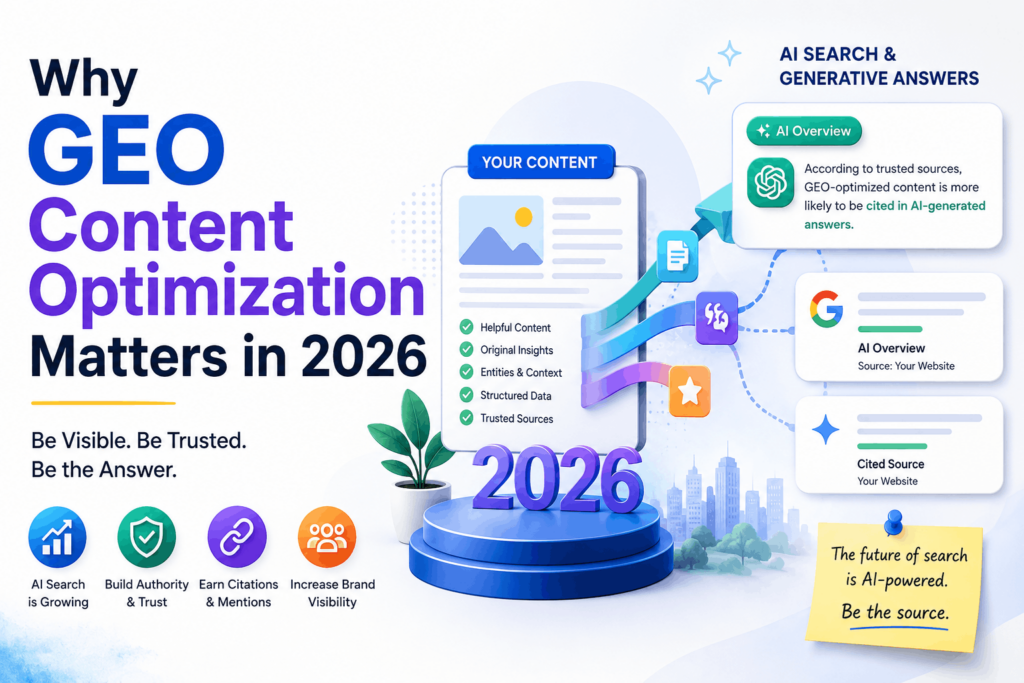
As more websites adopt AI search, those employing GEO content optimization are more likely to:
- Appear in AI-generated answers
- Earn citations from AI systems
- Build brand visibility
- Increase authority in their niche
- Generate qualified traffic
Businesses that ignore GEO optimization risk losing visibility as search behavior shifts.
How AI Search Engines Understand Content?
Before learning how to optimize content for GEO, it’s important to understand how AI systems process data.
Entities and Context
AI search engines are all about people, brands, products and concepts. AI systems are better able to understand content when relationships between entities are explicitly defined.
For instance, an article about AI search should naturally include related concepts like:
- AI Overviews
- LLMs
- Search intent
- Structured data
- E-E-A-T
Entity-rich content strengthens GEO content optimization efforts.
Authority and Trust
AI systems like to depend on reliable info. This means that content backed by expertise, evidence and real experience is more likely to be cited.
Structured Information
Well-structured content with headings, lists, tables and concise answers allows AI models to retrieve information more efficiently.
How to Optimize Content for GEO?
If you’re wondering how to optimize content for GEO, the following tips can help you get found in AI-powered search.
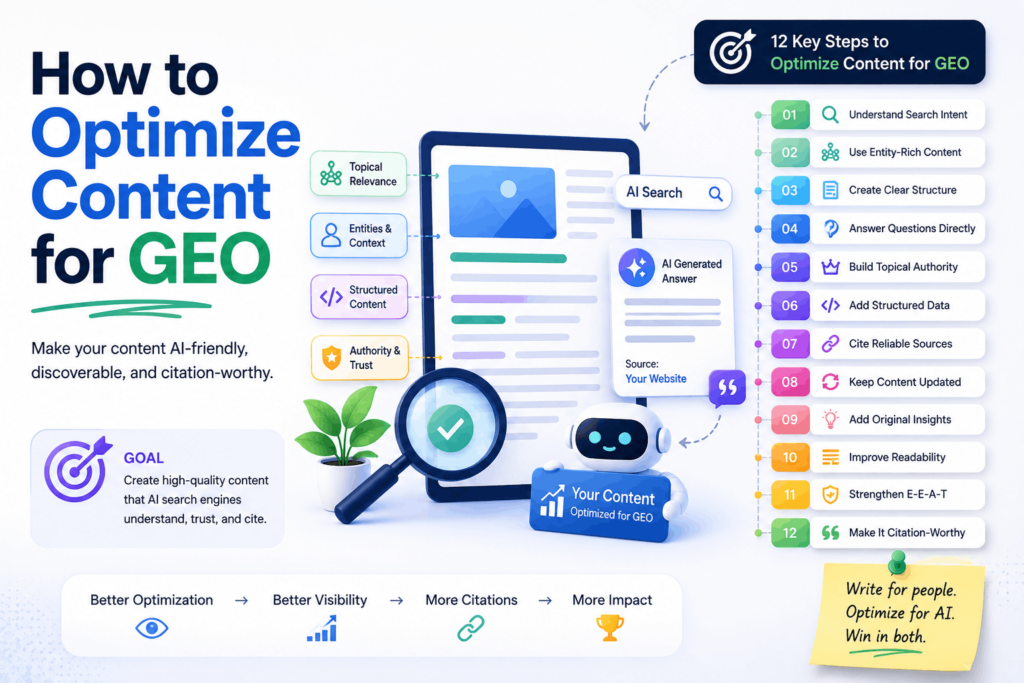
1. Understand User Intent First
Every piece of content should serve a particular search intent.
Users may search for:
- Informational queries
- Transactional queries
- Navigational queries
- Commercial investigation queries
Understanding what users want to know is the first step in successful GEO content optimization.
2. Use Entity-Rich Content for Better GEO Content Optimization
AI systems the relationships between concepts.
Instead of repeatedly using keywords, include related entities naturally throughout the article.
For example, a GEO article could reference:
- AI search
- LLMs
- citations
- structured data
- search intent
- E-E-A-T
This increases the semantic relevance and improves the GEO content optimization.
3. Structure Content with Clear Headings
Content should follow a logical hierarchy:
- H1 for the main topic
- H2 for major sections
- H3 and H4 for supporting information
Why Heading Structure Supports GEO Content Optimization
Clear headings make it easier for AI systems to identify key sections and extract information more accurately.
Good structure also improves user experience and readability.
4. Answer Questions Directly
AI tools often extract short answers from web pages.
Use question-based sections such as:
- What is GEO?
- How does AI search work?
- Why is GEO important?
Providing direct answers increases the chances of AI citation.
5. Build Topical Authority Through GEO Optimization
Publishing a single article is rarely enough.
Websites should form clusters of related content.
For example, a GEO cluster may include:
- What is GEO?
- GEO tools
- GEO performance measurement
- AI citations
- GEO for ecommerce
- GEO content optimization
Strong topical authority boosts overall GEO optimization.
6. Add Structured Data
Schema markup helps the search engines understand the content.
Useful schema types include:
- FAQ Schema
- Article Schema
- Organization Schema
- Breadcrumb Schema
Structured data can be useful for SEO and GEO content optimization.
7. Cite Reliable Sources
Reliable information enhances credibility.
Whenever possible:
- Include statistics
- Reference studies
- Use official documentation
- Add expert insights
AI citations are more likely to be found in reliable information.
8. Keep Content Fresh
AI systems tend to prefer new and updated information.
Regularly update:
- Statistics
- Screenshots
- Examples
- Trends
- Best practices
Fresh content is good for long term GEO optimization.
9. Include Original Research and Insights
Original data increases visibility significantly.
Examples include:
- Case studies
- Surveys
- Experiments
- Industry observations
Unique insights make a content more worth citing.
10. Improve Readability
Readable content is good for both users and AI systems.
Best practices include:
- Short paragraphs
- Bullet lists
- Simple language
- Clear transitions
Good readability improves GEO content optimization.
11. Strengthen E-E-A-T Signals
Google emphasizes:
- Experience
- Expertise
- Authoritativeness
- Trustworthiness
Strong E-E-A-T signals can also help address common reasons why websites are not ranking on Google.
To improve E-E-A-T:
- Add author bios
- Showcase credentials
- Include company information
- Display references
GEO optimization has strong trust signals.
12. Create Citation-Worthy Content
AI systems often cite content that is:
- Accurate
- Concise
- Structured
- Data-backed
Ask yourself:
“Would an AI system confidently quote this information?”
If the answer is yes, your GEO content optimization is working.
Common GEO Optimization Mistakes to Avoid
Even well-written content can fail if these mistakes are made:
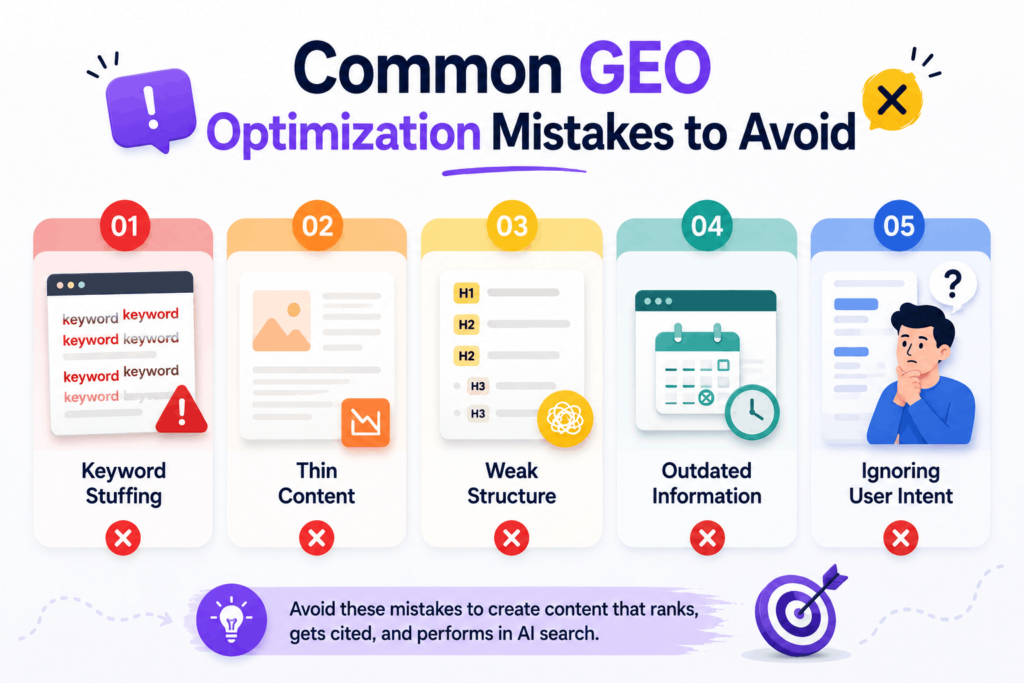
Keyword Stuffing:
Overusing keywords hurts readability and user experience.
Make sure GEO content optimization happens organically, don’t force it into every sentence.
Thin Content:
Short, shallow content rarely gets cited.
Give full answers and examples from daily life.
Weak Structure:
AI systems find it harder to extract information from large sections of text.
Use headings, bullets and tables.
Outdated Information:
Old data reduces credibility.
Update important pages regularly.
Ignoring User Intent:
It is hard to rank content that does not satisfy the search intent.
GEO optimization is still all about understanding user needs
How to Measure GEO Content Optimization Success?
Unlike traditional SEO, GEO success isn’t just about rankings.
Key metrics include:
- AI referral traffic
- Brand mentions
- Citation frequency
- Search visibility
- Engagement metrics
Track performance through:
- Google Analytics 4
- Search Console
- AI traffic reports
- Citation monitoring tools for measuring GEO performance
Measure results to help refine your GEO content optimization strategy over time.
The Future of GEO Optimization
AI search is still a work in progress.
Future directions may include:
- Multimodal search
- Personalized AI assistants
- Voice-first experiences
- Real-time citations
As search becomes increasingly conversational, GEO content optimization is going to become a core digital marketing strategy, rather than an option.
Businesses that adapt early will gain a competitive advantage in AI-driven search environments.
Final Thoughts
The future of search isn’t the death of SEO. It’s the growth of SEO.
Understanding how to optimize content for GEO helps websites remain visible as AI-generated search experiences continue to proliferate. Good GEO optimization is a combination of a solid SEO foundation, entity-driven content, structured information, authority signals, and citation-worthy insights.
Using these techniques allows enterprises to improve their visibility not only for search engines but also for AI systems that are increasingly determining how users discover information.
Websites that invest in GEO content optimization now will be in a better position for the future of search.
FAQs:
1. What is GEO content optimization?
GEO content optimization is the optimization of content for AI-powered search engines and generative AI systems. The likelihood that your content will be cited, summarized, or recommended in AI-generated answers is increased by this.
2. How do you optimize content for GEO?
To boost content for GEO, think about user intent, use entity-rich content, implement schema markup, build topical authority, strengthen E-E-A-T signals, and create citation-worthy content.
3. What is the difference between SEO and GEO optimization?
SEO primarily focuses on improving rankings in traditional search engines, while GEO optimization aims to increase visibility and citations in AI-powered search experiences.
4. Why is GEO content optimization important in 2026?
As AI search tools become more popular, GEO content optimization helps websites remain visible in AI-generated answers and improve brand discoverability.
5. Does schema markup help with GEO optimization?
Yes, schema markup provides structured information that helps search engines and AI systems better understand webpage content, which may improve AI visibility.
6. How can I measure GEO performance?
You can measure GEO performance by tracking AI referral traffic, brand mentions, citations, engagement metrics, and visibility in AI search experiences.
7. Can small websites benefit from GEO content optimization?
Yes. Even smaller websites can increase their visibility to AI by publishing high-quality, authoritative, well-structured content around specific topics.