The question is, “What is LLM Optimization?” If you’ve been tracking the rapid growth of AI-powered search tools such as Perplexity, Gemini, Claude, and ChatGPT, you’ve likely seen this term popping up more frequently in the last few months. With users turning to AI assistants to get answers, businesses and marketers are looking for ways to make sure their content is still found in these new search experiences.
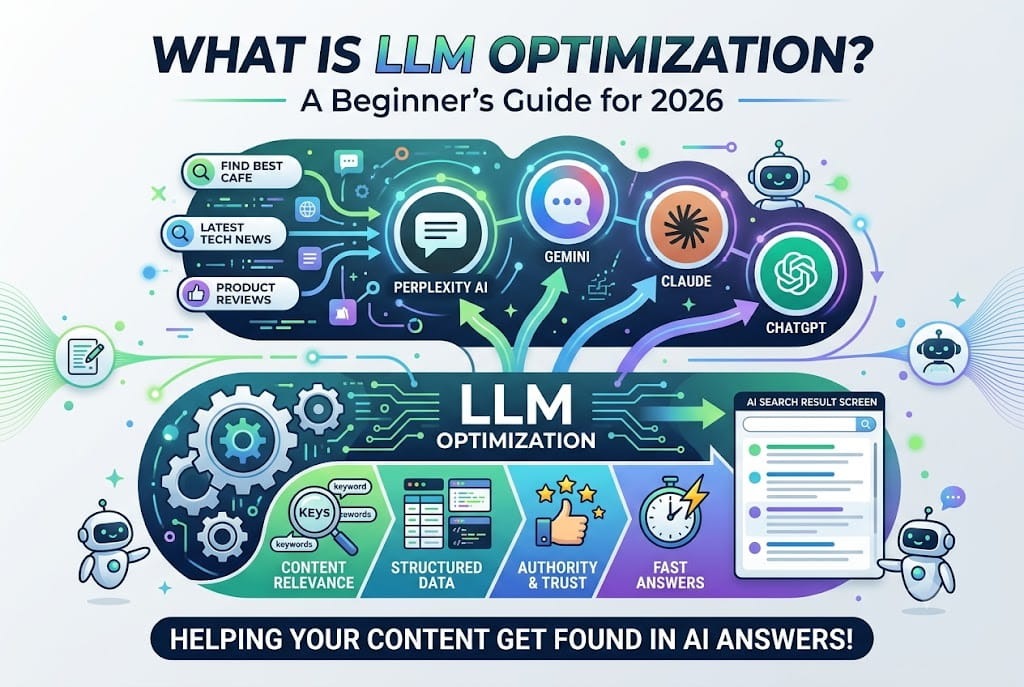
Traditional SEO is about ranking pages within a search engine, whereas GEO is about optimizing for the visibility of those pages in AI-generated search results. AI systems, however, require more than rankings and keywords. They need simple, trustworthy, well-structured, contextual content. That’s where LLM Optimization comes in.
LLMO (Large Language Model Optimization) is an increasingly important aspect of modern digital marketing. It allows AI systems to discover, understand, and possibly cite your content when generating responses. In this guide we’ll unpack what LLM Optimization is, why it matters, how it differs from SEO and GEO, and what you can do to optimize your content for the future of AI search.
What Is LLM Optimization and Why Does It Matter?
The process of structuring and creating content so that large language models can easily understand, interpret, retrieve, and use it is known as LLM Optimization, also known as Large Language Model Optimization.
Traditional SEO is about improving rankings in search engines, while LLM Optimization is about making content more accessible to AI-powered systems.
This is important as search behavior is changing. More and more users are now asking questions directly to AI assistants instead of typing short keyword phrases into search engines.
As AI-powered search grows, businesses can leverage LLM Optimization to:
- Improve AI search visibility
- Increase brand mentions
- Strengthen authority
- Improve content discoverability
- Future-proof content strategies
Websites that adapt early will be in a better position to benefit from AI-driven search experiences.
How Do Large Language Models Understand Content?
To grasp LLM Optimization, we need to understand how large language models process information.
Unlike traditional search engines primarily crawl, index and rank web pages, large language models analyze the relationships between concepts, entities, topics and context information.
Generally, when AI systems review content, they look to:
- Relevance
- Context
- Authority
- Accuracy
- Structure
- Clarity
This means that content that is logically structured and gives comprehensive answers is generally easier for AI systems to comprehend.
Entities Play a Critical Role
Entities are specific people, brands, organizations, products, places and ideas.
For instance, when an article about AI search is talking about it, it is natural to mention:
- ChatGPT
- Gemini
- Claude
- Perplexity
- AI Overviews
- Structured data
- E-E-A-T
The better the connection between these entities, the easier it is for AI systems to understand the content.
Context Matters More Than Keywords
Keywords are still useful, but context is more and more important.
AI systems attempt to understand meaning rather than just match exact words. This is one of the reasons why topical authority and semantic relevance have become so important.
What Is LLM Optimization in AI Search?
What does LLM Optimization mean in the context of AI Search?
It’s the process of helping AI systems to better understand and leverage your content for building responses.
Search experiences that are based on AI often pull information from multiple sources to answer.
Websites that offer:
- Clear explanations
- Strong expertise
- Accurate information
- Helpful examples
- Reliable sources
AI systems are more likely to trust reliable sources.
Good LLM Optimization improves the likelihood that your content will be used to generate AI answers.
What Is LLM Optimization for Content Creators?
LLM Optimization for content creators means creating content that is AI-friendly and human-friendly.
This includes:
- Answering questions directly
- Organizing information clearly
- Using descriptive headings
- Providing context
- Covering topics comprehensively
The goal is to make information easy to comprehend, whether the reader is a human or an AI system.
What Is LLM Optimization for Businesses?
LLM Optimization, for companies, is about getting better visibility into AI-powered experiences.
Benefits may include:
- More brand exposure
- Better authority signals
- Increased discoverability
- Stronger digital presence
As AI Search evolves, companies that embrace LLM Optimization can gain a competitive edge.
What Is LLM Optimization vs SEO vs GEO?
One of the most asked questions by marketers is how LLM Optimization compare to SEO and GEO.
There is some overlap here, but these are not the same concepts.
| SEO | GEO | LLMO |
| Focuses on rankings | Focuses on AI visibility | Focuses on AI understanding |
| Targets search engines | Targets generative search | Targets language models |
| Measures organic traffic | Measures citations | Measures AI discoverability |
| Keyword-focused | Citation-focused | Context-focused |
Think of it this way:
- SEO helps users find your content.
- GEO helps AI systems cite your content.
- LLM Optimization helps AI systems understand your content.
The strongest digital marketing strategies often combine all three approaches.
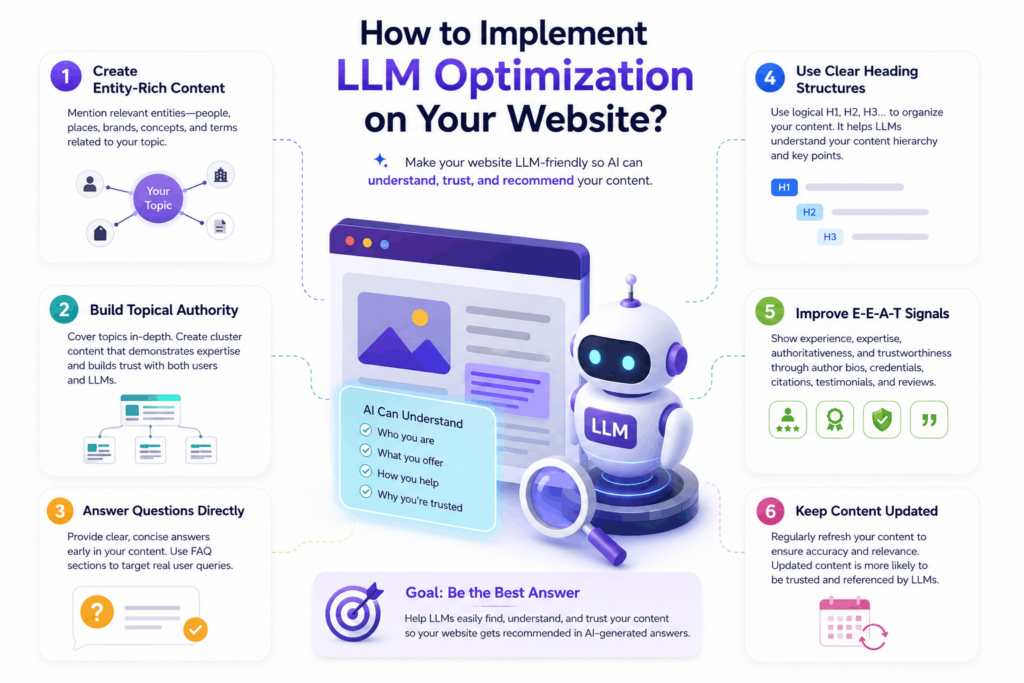
How to Implement LLM Optimization on Your Website?
With the “What Is LLM Optimization?” question answered, let’s turn to practical implementation strategies.
1. Create Entity-Rich Content
Entity rich content aids AI systems in establishing relations between topics.
The new film is a bit of a departure from the usual fare from this studio.
For example, an article about AI search might read:
- Search intent
- AI Overviews
- ChatGPT
- Structured data
- Knowledge graphs
- Citations
This strengthens semantic understanding.
2. Build Topical Authority
Publishing one article on a topic is rarely enough.
Enhance LLM Optimization by Creating Topic Clusters.
For example:
- What Is LLM Optimization?
- LLM Optimization vs GEO
- AI Search Optimization
- How AI Systems Choose Sources
- Entity SEO
Together, these articles help establish authority.
3. Answer Questions Directly
AI systems tend to prefer straightforward answers.
Consider including:
- Definitions
- Step-by-step explanations
- FAQs
- Summary sections
That makes information easier to find and understand.
4. Use Clear Heading Structures
Proper heading hierarchy helps readability for both users and AI systems.
A common logical structure consists of:
- H1 for the main topic
- H2 for major sections
- H3 for supporting details
- H4 where needed
Clear organization improves content accessibility.
5. Improve E-E-A-T Signals
Experience, Expertise, Authoritativeness, and Trustworthiness remain important.
Ways to strengthen E-E-A-T include:
- Author bios
- Industry experience
- Accurate information
- Credible references
- Updated content
Trust signals help both users and AI systems evaluate content quality.
6. Keep Content Updated
AI search is evolving quickly.
Regular updates to the content help maintain its relevance and accuracy.
Review:
- Statistics
- Examples
- Screenshots
- Industry trends
New content tends to perform better over time.
What Is LLM Optimization Doing Differently Than Traditional SEO?
Traditional SEO was mainly based on keywords, backlinks and rankings.
LLM Optimization expands the scope.
Rather than asking: “How can I rank for this keyword?”
LLM Optimization asks: “How can I create content that AI systems understand, trust, and potentially reference?”
This shift encourages:
- Better content quality
- More comprehensive coverage
- Improved user experience
- Greater topical authority
In many ways, LLM Optimization aligns closely with producing genuinely helpful content.
Common LLM Optimization Mistakes to Avoid
Many sites make avoidable mistakes trying to optimize for AI systems.
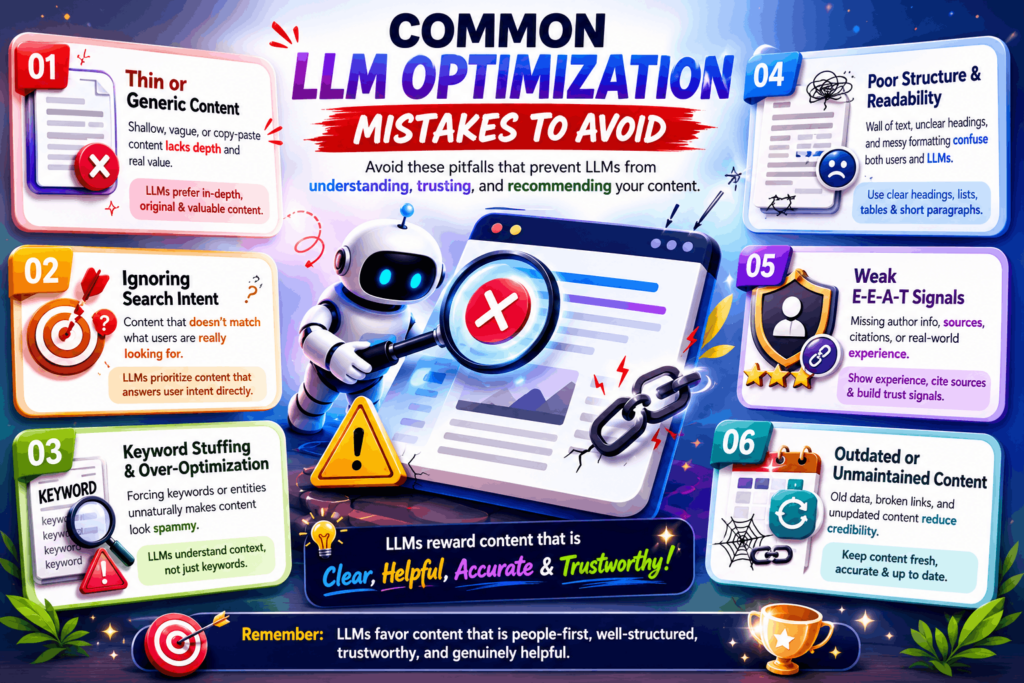
- Keyword Stuffing
Keyword stuffing can negatively affect content quality and readability.
- Thin Content
Superficial articles don’t tend to establish authority.
Content that is comprehensive tends to do better.
- Weak Content Structure
Content is difficult to understand when there are large walls of text.
Use headings, lists, and small paragraphs.
- Ignoring Entities
Entities and relationships are very important for AI systems.
Leaving out relevant entities can reduce contextual understanding.
- Outdated Information
AI systems like reliable and current information.
Regular updates help to maintain trust.
How to Measure LLM Optimization Success?
Measuring LLM Optimization is not mature yet, but there are a few indicators that can help.
Key metrics include:
- AI referral traffic
- Brand mentions
- Citation frequency
- Organic visibility
- User engagement
Useful tools include:
- Google Analytics 4
- Google Search Console
- AI visibility tools
- Citation tracking platforms
While no single metric fully captures LLM Optimization success, combining multiple indicators provides a clearer picture.
The Future of LLM Optimization
AI search is still in its infancy.
In the next few years we can expect the following:
- More personalized AI experiences
- Better multimodal search
- Increased use of AI assistants
- More sophisticated citation systems
- Greater emphasis on authority and trust
As these technologies continue to evolve, LLM Optimization is likely to become an important part of every content strategy.
Companies that start to adapt now will be in a better position for future search environments.
Final Thoughts
Exactly What Is LLM Optimization? In simple terms, it is the act of making content easier for large language models to understand, trust, retrieve and use.
As AI-powered search experiences become more prevalent, traditional search engine optimization may no longer be sufficient.
Businesses can increase their visibility in both traditional and AI-powered search environments by putting an emphasis on clear structure, topical authority, entity-rich content, E-E-A-T signals, and user-focused content.
LLM Optimization is not a substitute for SEO or GEO. Rather, it complements them by helping AI systems better understand and interpret your content.
The future of search is becoming increasingly AI-driven, and websites that embrace LLM Optimization today will be better prepared for the opportunities ahead.
FAQs
1. What is LLM Optimization?
LLM Optimization is optimizing content so large language models can easily understand, retrieve, and use information when generating responses.
2. How is LLM Optimization different from SEO?
SEO focuses on improving rankings in search engines, while LLM Optimization focuses on helping AI systems understand and interpret content more effectively.
3. Is LLM Optimization the same as GEO?
No. GEO focuses on improving visibility in AI-generated search experiences, while LLM Optimization focuses on making content easier for large language models to understand and use.
4. Why is LLM Optimization important?
LLM Optimization helps businesses improve visibility in AI-powered search experiences, increase brand discoverability, and strengthen authority.
5. How can I improve LLM Optimization?
Optimize for LLMs by creating entity-rich content, building topical authority, using clear structures, strengthening E-E-A-T signals, and keeping your content updated!
6. Can small websites benefit from LLM Optimization?
Yeah. Smaller websites can also improve their AI visibility by producing helpful, authoritative and well-structured content on specific topics.