Key Takeaways of Technical SEO Audit Tools
Technical SEO is the bedrock of a healthy website. If search engines have trouble crawling, understanding or indexing your site, the strongest backlink profile and best content won’t get you consistent rankings. That’s why the use of right technical SEO audit tools is a must. In this guide, I will compare Screaming Frog vs Sitebulb vs Ahrefs Site Audit based on features, usability, pricing, reporting, and real-world performance. If you’re a blogger, SEO expert, agency or business owner, this comparison will help you find the best SEO crawler 2026 for your needs.

Why Technical SEO Audits Are the Foundation of Every SEO Strategy
But great content and quality backlinks are useless if search engines can’t crawl or index your website.
I’ve audited websites where fixing a few technical issues produced better results than publishing several new blog posts. Broken internal links, redirect chains, duplicate pages, crawl errors These are all problems that you may not notice, but they can impact your website’s visibility in the search results.
That’s why I always recommend doing regular audits with good technical SEO audit tools.
A technical audit helps you identify issues like:
- Broken links and 404 errors
- Redirect chains and redirect loops
- Duplicate content
- Missing or incorrect canonical tags
- XML sitemap issues
- Robots.txt errors
- Orphan pages
- Poor internal linking
- Crawl depth problems
- JavaScript rendering issues
Technical SEO audit tools crawl your entire website, identify issues, and help you determine what to focus on first, rather than manually inspecting hundreds or thousands of URLs.
If you are serious about improving your website’s technical health and long-term SEO performance, then regular audits are essential.
Once you’ve taken care of technical issues, the next step is to improve the page experience on your website. Read our guide on Core Web Vitals 2026 to discover how speed and user experience impact SEO.
What to Look for in Technical SEO Audit Tools?
Not all crawlers are created equal. Some are designed for advanced technical analysis, others for visual reporting or ongoing website monitoring.
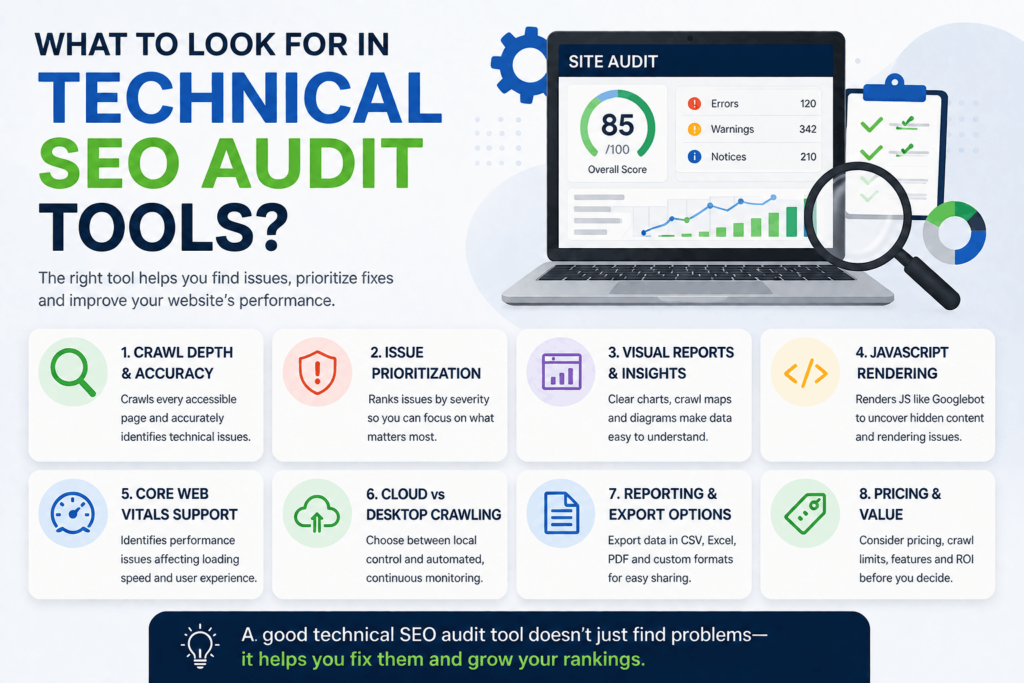
Here are the features I look for most when evaluating technical SEO audit tools:
- Crawl Depth and Accuracy
A good crawler will crawl all accessible pages and find important SEO issues without missing critical URLs.
I see if the tool can identify:
- Broken links
- Duplicate pages
- Redirect issues
- Canonical errors
- Missing metadata
- Indexability problems
The more precise the crawl, the easier it is to fix technical issues before they impact rankings.
- Issue Prioritization
Hundreds of issues are of no use if you don’t know which are urgent.
The best technical SEO audit tools will prioritize issues by severity, so you can tackle major fixes like crawl errors, broken pages, and indexability issues before tackling smaller optimizations.
- Reporting and Visualizations
Technical SEO data can be easy to get lost.
Clear reports, crawl maps, page depth charts and visualizations of website architecture make it much easier to understand how your website is structured and where you need to make improvements.
This is particularly useful when sharing audit reports with clients or developers.
- JavaScript Rendering
Modern websites frequently use JavaScript, so your crawler should be capable of rendering pages like Google does.
If your site doesn’t render JavaScript you might miss important indexing or content issues.
- Pricing and Scalability
Your budget and workflow also define the right tool for you.
Some technical SEO audit tools are ideal for one-off audits, others are designed for agencies managing multiple websites with scheduled cloud-based crawls.
You’ll get more long-term value by picking the right tool for your needs than by just going for the most expensive one.
Tool 1 – Screaming Frog SEO Spider
Whenever someone asks me what crawler I use most often, my answer is almost always Screaming Frog.
It’s part of the reason it comes up in almost every conversation around Screaming Frog vs Sitebulb. Fast, reliable, highly customizable, trusted by SEO professionals worldwide.
I have used Screaming Frog for auditing small blogs, local business websites and large enterprise sites. I go to a site, maybe 100 pages or a few thousand URLs, and it always gives me the technical information I need.
What Is Screaming Frog?
Screaming Frog SEO Spider is a desktop-based crawler that crawls your website like a search engine bot would.
It helps identify:
- Broken links
- Redirect chains
- Missing title tags and meta descriptions
- Duplicate content
- Canonical issues
- Response code errors
- Internal linking opportunities
- XML sitemap problems
- Missing image alt attributes
Its flexibility is what sets it apart from a lot of other technical SEO audit tools.
What I Like About Screaming Frog?
Screaming Frog’s biggest advantage is the amount of control it gives you.
You can modify crawl settings, render JavaScript, integrate with Google Analytics, Google Search Console, and PageSpeed Insights, and even extract custom data using XPath or CSS selectors. These features make it convenient for simple website audits as well as for advanced technical investigations.
Another reason I recommend Screaming Frog is the generous free version. You are allowed to crawl up to 500 URLs for free which is more than enough for many bloggers, freelancers and small businesses. This is one of the reasons it is still considered by many as the best SEO crawler 2026.
Pros
- Powerful and accurate crawler
- Free version available (up to 500 URLs)
- Excellent crawl customization
- Fast performance
- Integrates with Google tools
- Suitable for websites of all sizes
Cons
- Desktop software uses local system resources
- Interface can feel overwhelming for beginners
- Large crawls require more RAM
- Reporting isn’t as visual as some competitors
Despite its limitations, Screaming Frog is still my go-to whenever I want technical information in detail. It’s the one I trust the most for thorough website audits of all the technical SEO audit tools I’ve used.
Tool 2 – Sitebulb
Whereas Screaming Frog is optimized for in-depth technical analysis, Sitebulb is more geared towards making that data more digestible. It is usually the strongest competitor in the Screaming Frog vs Sitebulb argument as it provides in-depth website crawling, in addition to the clear visual reports and actionable recommendations.
I have used Sitebulb when presenting technical audit findings to clients that aren’t familiar with SEO terminology. The platform breaks down issues into digestible reports instead of overwhelming users with raw data, resulting in much more productive conversations.
What Is Sitebulb?
Sitebulb is a desktop-based SEO website audit tool SEO that crawls websites, detects technical issues, and displays them in visual dashboards and health scores.
It audits the key SEO factors including:
- Crawlability and indexability
- Internal linking
- Redirects
- Duplicate content
- Canonical tags
- Structured data
- Metadata
- JavaScript rendering
Some technical SEO audit tools just list issues, but Sitebulb goes the extra mile and explains why each issue is important and how to fix it.
What I Like About Sitebulb?
Sitebulb’s biggest strength lies in its reporting.
Its crawl maps, website architecture diagrams, and health scores greatly simplify the process of understanding the overall health of a website. These visualizations save a lot of time when sharing reports with clients or developers, since the issues are presented in a logical and easy to follow format.
I also love that Sitebulb prioritizes issues by impact and not all recommendations are treated equally. This makes it easier to prioritize the fixes that are most likely to improve SEO performance first.
Pros
- Excellent visual reports
- Website Health Score
- Clear issue prioritization
- JavaScript rendering support
- Beginner-friendly interface
- Great for agencies and consultants
Cons
- No permanent free version
- Less customizable than Screaming Frog
- Desktop software requires local resources
- Premium plans are more expensive for individual users
If you put a lot of emphasis on reporting and client communication in your workflow, Sitebulb is one of the best technical SEO audit tools you can find today.
Tool 3 – Ahrefs Site Audit
Ahrefs Site Audit is completely cloud-based, whereas Screaming Frog and Sitebulb are not. If you’re already using Ahrefs for keyword research or backlink analysis, adding its audit feature to your workflow is a no-brainer.
As I was preparing this Ahrefs site audit review, I was thinking about a couple of client projects where I used Ahrefs in conjunction with Screaming Frog. For ongoing monitoring I’ve found Ahrefs particularly useful, rather than one-off deep technical dives.
What Is Ahrefs Site Audit?
Ahrefs Site Audit is a cloud crawler that automatically crawls your website and monitors its technical health over time.
It checks for:
- Broken pages
- Redirect issues
- Duplicate content
- Internal linking problems
- HTTPS errors
- Indexability issues
- Performance recommendations
- Orphan pages
Since the crawls run on Ahrefs’ servers, you don’t have to keep your computer running when crawling large websites.
What I Like About Ahrefs Site Audit
The main advantage is convenience.
Schedule your recurring crawls, monitor your website’s Health Score, and see technical problems all from one dashboard. If you’re already using Ahrefs, you have everything you need – backlinks, keywords, technical audits, all in one place.
This is particularly helpful for agencies and marketing teams who have several sites to manage.
Pros
- Cloud-based platform
- Automatic scheduled crawls
- Website Health Score
- Easy collaboration
- Integrated with the Ahrefs SEO suite
- Excellent dashboard
Cons
- Requires an Ahrefs subscription
- Less crawl customization than Screaming Frog
- Limited flexibility for advanced technical analysis
- Premium pricing may not suit smaller websites
If you are already inside the Ahrefs ecosystem, this is one of the more convenient technical SEO audit tools available.
Screaming Frog vs Sitebulb vs Ahrefs Site Audit: Comparison Table
These technical SEO audit tools aren’t about choosing a “winner” between the two. Each tool has its strengths in different scenarios, and the best choice will depend on your workflow, your budget, and how technically proficient you are.
Here is my side-by-side comparison after using all three technical SEO audit tools:
| Feature | Screaming Frog | Sitebulb | Ahrefs Site Audit |
| Tool Type | Desktop Crawler | Desktop + Cloud | Cloud-Based |
| Free Version | Yes (500 URLs) | Trial Only | No |
| Ease of Use | Moderate | Easy | Easy |
| Crawl Speed | Excellent | Very Good | Excellent |
| JavaScript Rendering | Yes | Yes | Yes |
| Website Health Score | No | Yes | Yes |
| Visual Reports | Basic | Advanced | Good |
| Crawl Customization | Excellent | Very Good | Good |
| Internal Link Analysis | Excellent | Excellent | Very Good |
| Duplicate Content Detection | Yes | Yes | Yes |
| Redirect Analysis | Excellent | Excellent | Very Good |
| Orphan Page Detection | Yes (with GA/GSC integration) | Yes | Yes |
| Scheduled Crawls | Limited | Yes | Yes |
| Team Collaboration | Limited | Good | Excellent |
| Best For | Technical SEO Professionals | Consultants & Agencies | Businesses & Marketing Teams |
| Starting Price | Lowest | Mid-range | Requires Ahrefs Subscription |
| Overall Rating | Best for Deep Technical Audits | Best for Visual Reporting | Best for Continuous Website Monitoring |
My Verdict: Which Technical SEO Audit Tool Should You Choose?
Having looked at these technical SEO audit tools, one thing is clear there is no one-size-fits-all tool. The right choice depends on your experience, workflow and budget.
If you are a blogger, freelancer or SEO professional I would recommend starting with Screaming Frog. This is my most used as it is incredibly flexible, has accurate crawl data and one of the best free versions out there. After testing several other technical SEO audit tools, it’s still my go-to for in-depth technical audits.
If you are an SEO consultant or an agency that regularly shares audit reports with clients, then Sitebulb is worth investing in. Its visual reports, website health score and easy to understand recommendations make technical SEO much easier to communicate to non-technical stakeholders.
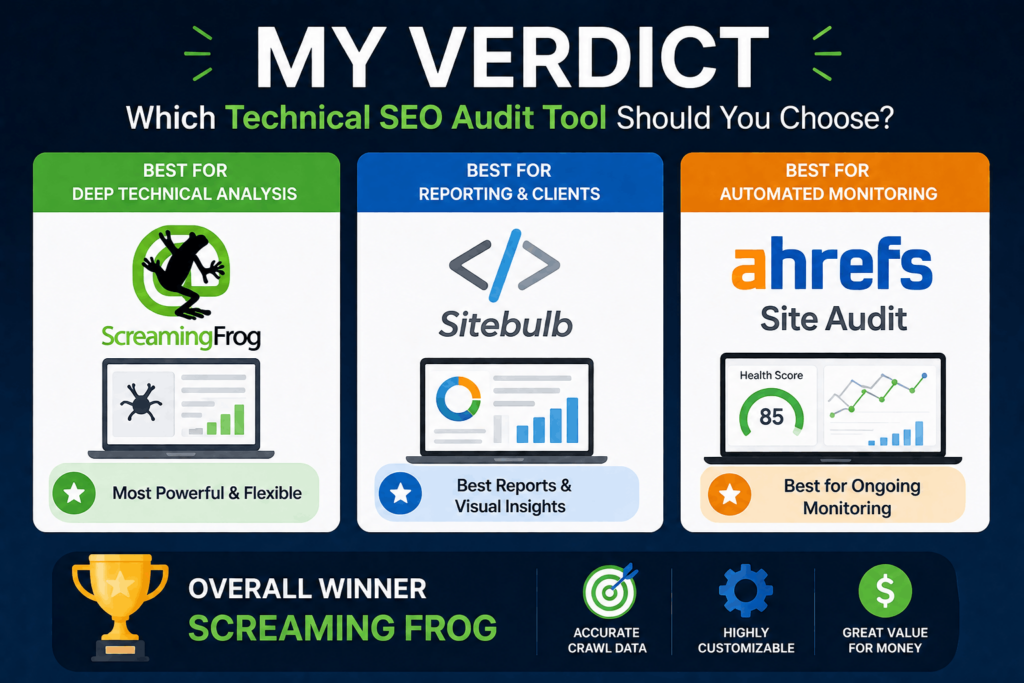
If you are already using Ahrefs for your keyword research and backlink analysis, then Ahrefs Site Audit is the easiest choice. Having all the technical audits, keywords, backlinks and competitor insights in one platform makes managing a website a lot easier.
For most users looking for the best SEO crawler 2026, however, my recommendation remains Screaming Frog. It has the best mix of features, performance, flexibility and pricing, so it’s the best all-round option.
Conclusion
Step one, pick the right technical SEO audit tools. The real progress happens when you act on the insights these tools provide.
Regular technical audits are a great way to build a stronger foundation for long-term SEO success, whether you’re cleaning up crawl errors, improving internal linking, resolving duplicate content or optimizing your website structure.
If you’re new to all of this, start with the free version of Screaming Frog and make technical audits a regular part of your SEO workflow. As your site grows you can look at tools like Sitebulb or Ahrefs Site Audit depending on your reporting needs and workflow.
Merge your technical audits with regular Core Web Vitals optimization and crawl budget analysis to keep your website performing at its best.
Frequently Asked Questions
1. What are the best technical SEO audit tools in 2026?
The best technical SEO audit tools in 2026 are Screaming Frog, Sitebulb, and Ahrefs Site Audit. Each tool offers unique strengths, from detailed desktop crawling to cloud-based website monitoring and visual reporting.
2. Is Screaming Frog free to use?
Yes. Screaming Frog offers a free version that lets you crawl up to 500 URLs. It’s a great option for bloggers, freelancers, and small businesses that want to perform technical audits without an upfront investment.
3. Screaming Frog vs Sitebulb: Which one is better?
If you need advanced crawl customization and detailed technical insights, choose Screaming Frog. If your priority is client-friendly reports and visual dashboards, Sitebulb is the better choice. Both are excellent technical SEO audit tools, but they’re designed for slightly different workflows.
4. Is Ahrefs Site Audit worth paying for?
If you already have an Ahrefs subscription, then yes. Based on my Ahrefs site audit review, it’s an excellent solution for automated website monitoring and ongoing technical SEO maintenance. However, if your primary goal is deep technical analysis, Screaming Frog offers better value.
5. Which website audit tool SEO is best for beginners?
For beginners, Sitebulb is the easiest website audit tool SEO because it explains technical issues in a simple and visual way. However, Screaming Frog is also a great option if you’re willing to spend a little time learning its interface.
6. How often should I run a technical SEO audit?
For most websites, performing a technical audit once a month is enough. Larger websites, eCommerce stores, or websites that publish content frequently should consider weekly or bi-weekly audits to catch issues before they impact organic performance.
7. Can technical SEO audit tools improve SEO rankings?
Technical SEO audit tools don’t directly improve rankings. Instead, they help you identify crawl, indexing, and website issues that may prevent search engines from understanding your content. Fixing these issues creates a stronger technical foundation, which can contribute to better search visibility over time.