If you are searching for the SEO learning roadmap 2026, you might be asking yourself where to start. There are thousands of videos, blogs, and courses online, so it can be easy to feel overwhelmed. The biggest problem is that a lot of SEO learning roadmap 2026 teach strategies that were meant for search engines five or ten years ago. The fundamentals are the same, but how people search has changed. In 2026, SEO isn’t just about ranking on Google anymore. It’s about building content that AI-powered search experiences and answer engines can comprehend. If I were starting SEO today from scratch, I wouldn’t try to learn everything at once. I would have a structured roadmap and learn one skill at a time while building a strong foundation before diving deeper into complex topics. That is what this manual will assist you to do.
Why SEO Learning Roadmap 2026 Is Different From Older Roadmaps
Old SEO guides were mostly about how to rank webpages in Google’s search results. That’s still an important goal, but today the search landscape is much wider.
People search on traditional search engines, AI-generated answers, voice assistants and conversational search experiences. Thus, SEO professionals need to understand not only how websites rank, but how content is interpreted, summarized and recommended.
The good news is you don’t have to learn all the advanced stuff on day one. The best way to learn SEO is to build your knowledge gradually. Once you have your fundamentals down, it’s much easier to learn the advanced topics.
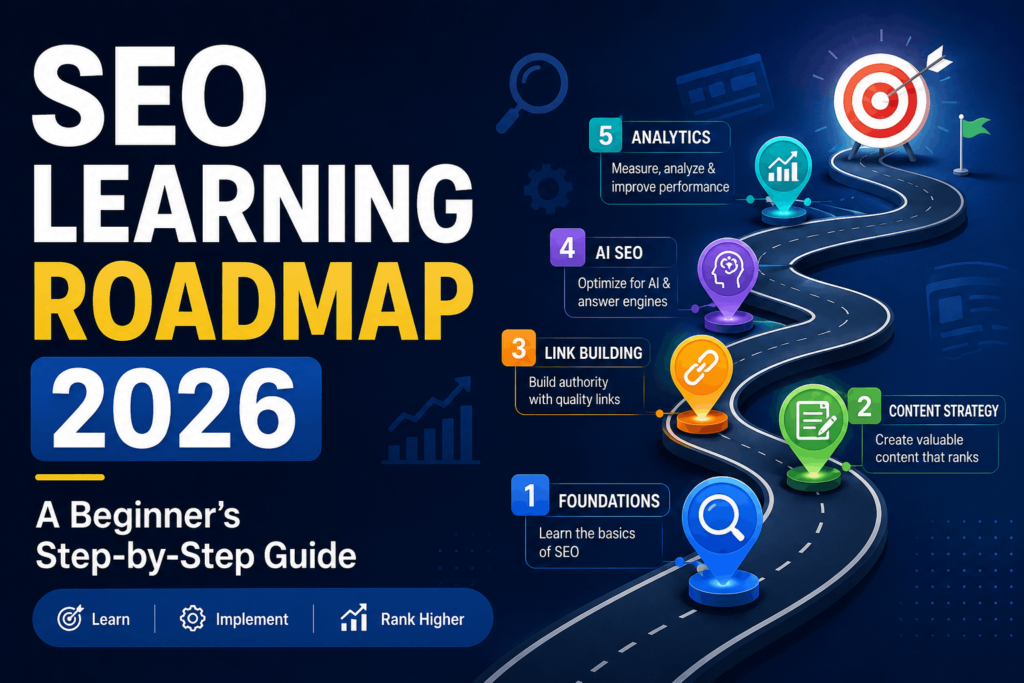
Thus, this roadmap is broken into five stages, each building on the last.
Stage 1: SEO Learning Roadmap 2026 Foundations
Every successful SEO professional begins with understanding the basics. Before we get into backlinks or AI SEO, it’s important to understand how search engines work and how webpages appear in search results.
- Understand How Search Engines Work
Search engines work in three basic ways:
- Crawling
Crawling is the process of finding webpages. Search engine bots crawl the web, following links to discover new or updated pages.
- Indexing
When a search engine finds a page it looks at the content on the page and stores it in its database. This process is known as indexing. Search results are limited to pages that have been indexed.
- Ranking
When a person does a search, the search engine decides which of the indexed pages are the best to answer that search. Ranking involves many different factors such as relevance, content quality, page experience and authority of the website.
Understanding these three concepts gives you the foundation for every other SEO skill.
- Learn Keyword Research
Keyword research is the process of finding the words and phrases your audience uses when they search online. You don’t create content based on assumptions, you create content based on actual search demand.
Learn these concepts first as part of your SEO roadmap, step by step:
- Primary Keyword
The primary keyword you want a page to rank for.
- Secondary Keywords
Related phrases that support the primary topic. For this guide, examples include how to learn SEO 2026, SEO for beginners guide, and best way to learn SEO.
- Search Intent
Search intent is the reason someone searches. It may be informational, navigational, commercial or transactional. Relevancy is one of the most important ranking factors – matching your content to what the user intends.
- Master On-Page SEO
On-page SEO is the process of optimizing elements within your own website so that users and search engines can understand what your content is about.
Focus on learning:
- Writing keyword-focused title tags
- Creating compelling meta descriptions
- Using a proper H1, H2, H3, and H4 heading structure
- Optimizing images with descriptive alt text
- Creating clean, readable URLs
- Building internal links between related pages
These are skills you’ll use on every page you put out.
- Learn Basic Technical SEO
Technical SEO makes sure that search engines can crawl your site the right way. You don’t have to be an expert as a beginner. Begin with the fundamentals:
- XML sitemaps
- Robots.txt
- HTTPS
- Mobile-friendly design
- Core Web Vitals
- Page loading speed
These basics help search engines crawl your website efficiently and improve the overall user experience.
- Before You Move to Stage 2
Before moving on in this SEO learning roadmap 2026, be sure you can confidently answer the following:
- How do search engines crawl, index, and rank webpages?
- What is keyword research, and why does it matter?
- What is search intent?
- What are the core elements of on-page SEO?
- Why is basic technical SEO important?
Once you have these basics down, you are ready to move on to the next level, learning how to create content that builds topical authority instead of just targeting individual keywords.
Stage 2: SEO Learning Roadmap 2026 Content Strategy – Learn to Build Topical Authority
The next step in this SEO learning roadmap 2026 is learning to create content strategically after you have learned the basics. Many newbies think that SEO is all about publishing as many articles as possible. Actually, most of the time publishing random blog posts doesn’t lead to consistent growth.
If I was starting from scratch learning how to learn SEO 2026, I would take more time to understand how content works together instead of just individual articles.
- Understand Search Intent Before Creating Content
Every search is for something. That purpose is called search intent.
For example:
- Someone searching “What is technical SEO?” wants an explanation.
- Someone searching “best SEO tools” wants recommendations.
- Someone searching “buy SEO course” is ready to make a purchase.
Your content should match the expectation of the user. If the intent is informative then educate the reader, not sell a service. Matching search intent improves search visibility and user experience.
- Learn Topical Authority
Topical authority isn’t just about publishing one-off articles about a topic. It’s about being a reliable source of information on that topic.
For example, if your site is about SEO, don’t just write a single article on keyword research. You can cover related topics, such as:
- On-page SEO
- Technical SEO
- Link building
- Content optimization
- Entity SEO
- AI SEO
- SEO analytics
If you link to these articles internally, search engines will know that your website is covering the topic in-depth.
- Build Content Clusters
A content cluster is a set of articles that are related to one another with a central theme.
This roadmap can be a pillar guide to which, for example, further detailed articles are attached:
- How to Do Keyword Research
- On-Page SEO Guide
- Technical SEO Basics
- Entity Optimization SEO
- Google AI Mode SEO
This structure makes it easier for readers to find your content and builds your website’s topical authority.
- Focus on Helpful Content
And a modern SEO learning roadmap 2026 for beginners guide should always be about helping, not just targeting keywords.
Every time you create content, ask yourself:
- Does this answer the user’s question clearly?
- Have I explained technical terms simply?
- Would a beginner understand this without searching elsewhere?
If yes, you’re writing content that will be loved by users and search engines.
Stage 3: SEO Learning Roadmap 2026 Link Building – Build Trust Naturally
The next step is to gain trust by backlinks after you have created valuable content.
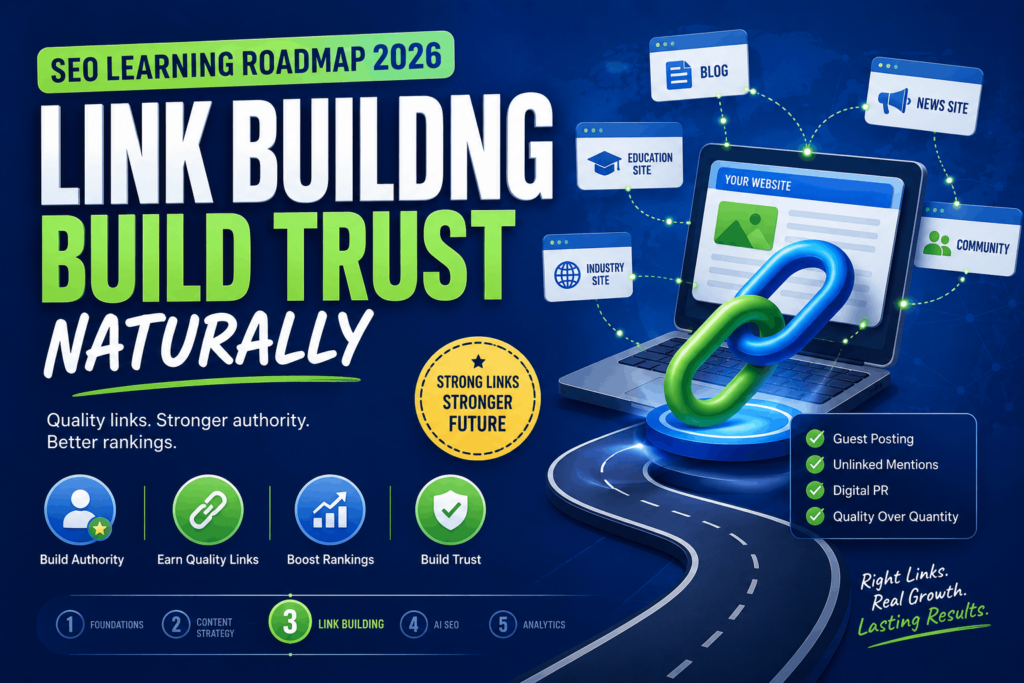
A backlink is a link from another website to your site. Search engines treat quality backlinks as endorsements from other sites for your content.
But beginners often make the mistake of focusing on quantity rather than quality.
- Learn Guest Posting
Guest posting is the practice of writing content for another relevant website in exchange for exposure and in many cases a backlink.
Focus on sites relevant to your niche. A few relevant backlinks are far better than hundreds of unrelated ones.
- Understand Unlinked Brand Mentions
Sometimes brands are mentioned in websites without linking to the brand’s website.
These are known as unlinked brand mentions.
Your content is already on the site, making it one of the easiest ways to get quality backlinks just reach out politely and ask for a link.
- Learn Digital PR Basics
Digital PR is about getting links by publishing content that people want to link to naturally.
Examples include:
- Original research
- Industry statistics
- Case studies
- Surveys
- Expert insights
Create something so valuable other people want to link to it, don’t ask for backlinks.
- Avoid These Common Link Building Mistakes
As part of your SEO learning roadmap 2026 step by step, avoid shortcuts that can harm your website over time.
Don’t:
- Buy large numbers of backlinks.
- Use automated backlink software.
- Spam blog comments for links.
- Prioritize quantity over relevance.
Quality, relevance and consistency will always beat quick wins.
Stage 4: SEO Learning Roadmap 2026 AI SEO – The Skill Every Beginner Should Learn
The biggest difference between learning SEO today and learning SEO a few years ago is THIS.
Traditional SEO involves ranking web pages in search results. AI SEO makes your content understandable and reference-worthy for AI-powered search experiences.
Learning AI SEO is not a replacement for traditional SEO, it’s an extension.
What Is GEO?
Generative Engine Optimization (GEO) is the practice of optimizing content to be understandable and referable by AI-powered search engines and assistants in their responses.
It is not about ranking, GEO is about clarity, completeness and trust.
Best practices for GEO are:
- Covering topics in depth.
- Using clear headings.
- Answering questions directly.
- Including relevant entities.
- Demonstrating first-hand knowledge.
- Keeping content updated.
These practices improve visibility in both traditional and AI search.
What Is AEO?
Answer engine optimization involves optimizing content so that it can answer users’ questions quickly and accurately.
For example, if someone types in “What is keyword research?” don’t make them read five paragraphs to find out. Provide a detailed explanation and a brief definition.
This approach makes it more readable and increases your chances of appearing in snippets and AI-generated answers.
Learn Entity Optimization
Entity optimization is a concept that every newbie should be aware of.
An entity is a unique and identifiable person, place, organization, product or concept that search engines understand.
For example, Google Search Console, Core Web Vitals, XML sitemaps, and ChatGPT are entities.
Modern search engines know about relationships between entities, not just keywords. That’s why your content should naturally contain relevant concepts supporting the main topic instead of repeating the same keyword over and over.
Structure Content for AI and Users
A clear structure always helps, no matter if it is read by a human or processed by an AI system.
Best practices include:
- Use descriptive H2, H3, and H4 headings.
- Keep paragraphs short.
- Explain technical terms in simple language.
- Use numbered steps where appropriate.
- Add FAQ sections for common questions.
- Update important articles regularly.
If I had to do SEO from scratch today, I’d learn AI SEO side by side with normal SEO rather than leave it as an advanced topic.
Stage 5: SEO Learning Roadmap 2026 Analytics and Measurement
Without measuring results, it’s difficult to know if your SEO efforts are working.
Analytics allows you to understand what’s driving traffic, which pages are performing well and where you need to improve.
Learn Google Search Console
Google Search Console is one of the first SEO tools you should learn because it gives you valuable insights directly from Google.
Monitor these critical metrics:
- Impressions
- Clicks
- Click-through rate (CTR)
- Average position
- Indexed pages
These reports help you find opportunities to improve on your existing content.
Learn Google Analytics 4
Google Analytics 4 (GA4) tells you what visitors do when they get to your website.
Concentrate on learning:
- Organic traffic
- User engagement
- Landing pages
- Conversions
- Traffic sources
Use Search Console and GA4 side-by-side to get the full picture of how you’re doing with SEO.
Start Measuring AI Visibility
Also, you’ll want to pay attention to the growing prevalence of AI-powered search:
- AI referral traffic
- Brand mentions
- AI citations
- LLM traffic sources
These metrics are changing, but learning to measure them early will help you adapt as search continues to evolve.
What to Skip or Deprioritize
The biggest mistake beginners make is to try and learn everything at once.
Here’s what I’d skip until you’ve got the basics down.
| Skip for Now | Learn Instead |
| Buying backlinks | Earning relevant backlinks |
| Keyword stuffing | Matching search intent |
| Publishing low-quality AI content | Creating helpful content |
| Advanced JavaScript SEO | Technical SEO basics |
| Obsessing over algorithm updates | Consistent SEO best practices |
| Chasing Domain Authority | Building topical authority |
Master the basics first. Advanced techniques become much easier once your foundation is strong.
Recommended Free Resources
You don’t have to pay for an expensive course to begin with SEO.
Below are some of the best free resources:
- Google Search Central for official SEO documentation.
- Google Analytics Academy for learning GA4.
- Google Search Console Help for understanding search performance.
- Ahrefs and Semrush YouTube channels for practical tutorials.
- Your own website, where you can apply everything you learn.
There is nothing better than learning by working on a real project.
How Long Does It Take to Learn SEO?
The most common question in any SEO for beginners guide is how long it takes to get comfortable with SEO.
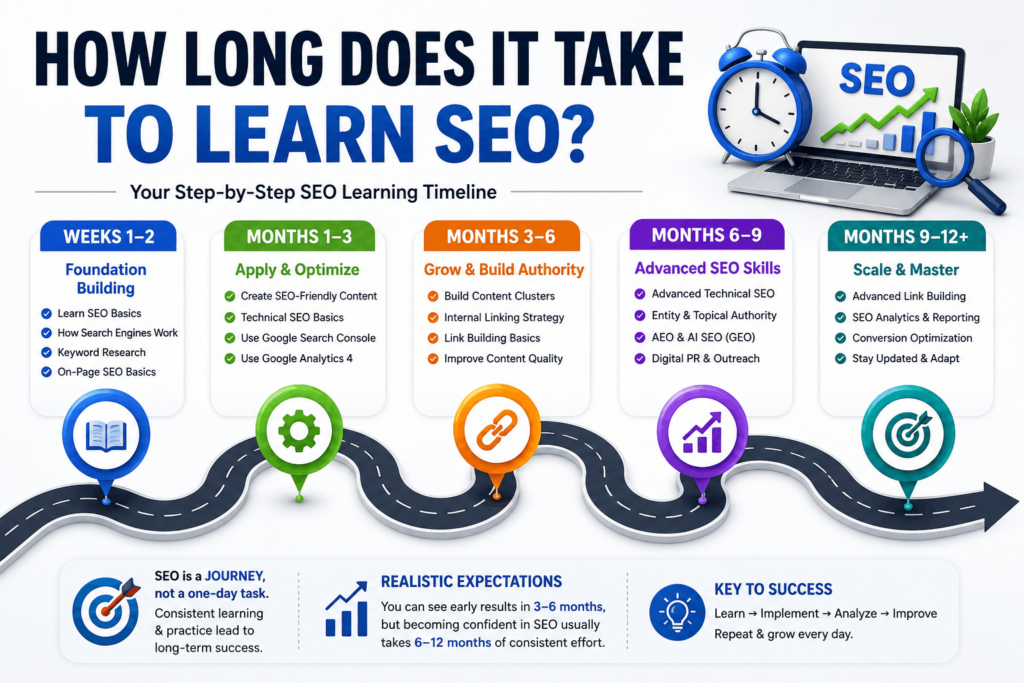
A realistic timeline would be like this:
Weeks 1–2
- Learn how search engines work.
- Understand keyword research.
- Study on-page SEO.
Months 1–3
- Create optimized content.
- Learn technical SEO basics.
- Use Search Console and GA4.
Months 3–6
- Build content clusters.
- Practice internal linking.
- Learn link building.
Months 6–12
- Develop topical authority.
- Learn GEO, AEO, and entity optimization.
- Improve analytics and reporting skills.
SEO is an ongoing learning process. The more you practice, the faster you’ll improve.
Final Thoughts
If I were starting today, I would learn one stage at a time, instead of trying to master all SEO topics in one week. The building blocks for long-term success are strong fundamentals, clear content strategy, ethical link building, AI SEO knowledge, and data-driven decision-making.
The best way to learn SEO isn’t to memorize algorithms or to chase shortcuts. It’s about applying what you learn constantly, measuring the results and improving with every piece of content you publish. This SEO learning roadmap 2026 will help you develop skills that will continue to be valuable as search evolves.
Frequently Asked Questions
1. What is the best way to learn SEO in 2026?
Begin with the fundamentals such as keyword research, on-page SEO, and technical SEO. Once you feel good on the basics, start looking into content strategy, link building, AI SEO and analytics.
2. Can I learn SEO without paying for a course?
Yes. There are plenty of great free resources out there, and practicing on your own website is one of the best ways to build SEO skills.
3. How long does it take to become good at SEO?
Most beginners learn the basics in a few months, but it generally takes six to twelve months of consistent learning and hands-on experience to build real SEO skills.
4. Should beginners learn AI SEO?
Yes. Traditional SEO has to be your first step, but learning GEO, AEO, and entity optimization will prepare you for the future of search.
5. Is SEO still worth learning in 2026?
Absolutely, businesses continue to invest in organic search, and modern SEO skills now extend to traditional search engines and AI-powered search platforms.
6. What should I learn first in SEO?
Understand how search engines crawl, index, and rank web pages. Then learn keyword research, on-page SEO, and basic technical SEO before diving deeper into complex topics.
7. Do I need coding knowledge to learn SEO?
No, most beginners can lay a solid SEO foundation without knowing how to program, but having some basic knowledge of HTML can help.
8. Can AI tools replace learning SEO?
While AI tools can accelerate research and content creation, they cannot replace a good understanding of SEO basics, search intent, user experience, and real-world testing.