A practical guide for SEO professionals, digital marketers, and website owners navigating the biggest algorithm shifts of 2026.
Last updated: April 2026
Key Highlights of Latest SEO Updates 2026
- Keyword-first SEO is fading fast – problem-first, user intent-led content is now the baseline Google expects from every site.
- Google’s March 2026 Core Algorithm Update began rolling out on 27 March and refined how content is ranked based on user intent and quality – nearly 80% of top-three results shifted positions.
- The 2026 SEO landscape rewards domain-level topical authority, real-world experience, content quality, UX, and Core Web Vitals – not keyword repetition.
- AI Overviews and conversational search are reducing click-through rates on generic content while increasing the value of structured, trustworthy, citable pages.
- Off-site signals – reviews, community mentions, and digital PR – now directly influence what AI systems surface in answer results.
- A hard deadline of 15 June 2026 applies to back button hijacking violations. Any site using manipulative navigation patterns must remediate before that date.
Why 2026 Is a Turning Point for SEO?
Google performs an average of nine to ten algorithm updates every day. Core updates – the ones that matter most – happen roughly once every two to three months and can affect 5% to 10% of all search results. That is why treating SEO as a one-time setup has never worked – and in 2026, it is more costly than ever.
The March 2026 Core Update was one of the most volatile in recent memory. Nearly 80% of top-three search results shifted positions, with Google clearly prioritising official first-party sources, brand-owned domains, and content backed by real-world experience. Sites relying on keyword-heavy, thin, or unreviewed AI-generated content saw significant drops.
This guide breaks down nine of the most important changes across content strategy, AI-driven search, off-page signals, UX, technical SEO, and reporting – and translates each one into practical steps you can act on today.
Latest SEO Updates 2026: The End of Keyword-First SEO
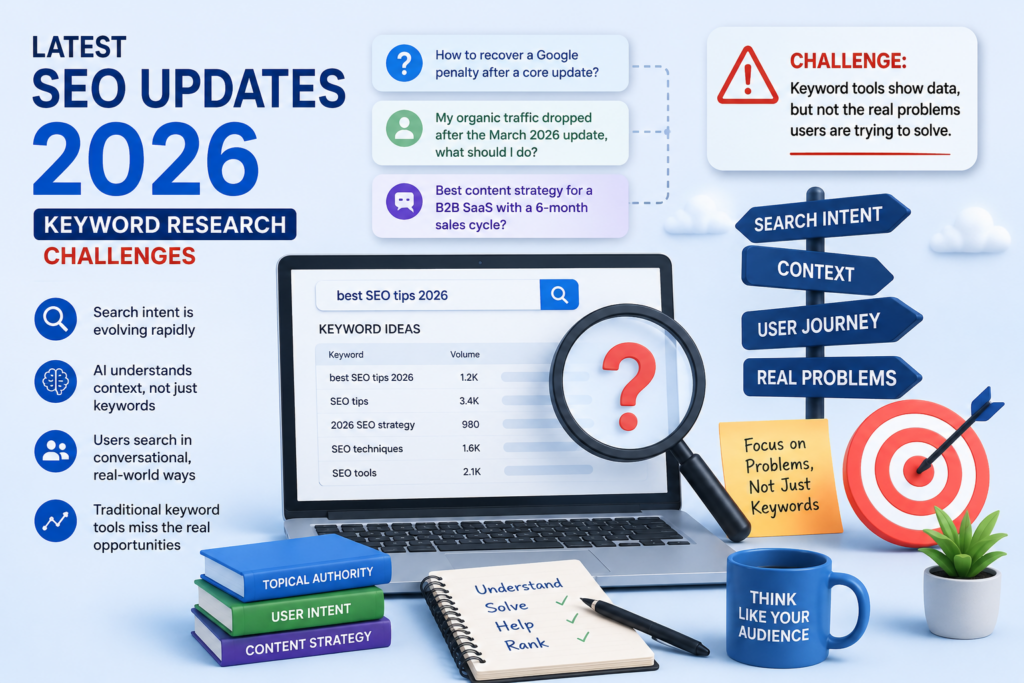
One of the biggest shifts in the latest SEO updates for 2026 is the move away from keyword-first strategies. Core updates in 2024, 2025, and 2026 built on BERT, MUM, and Helpful Content signals now understand search queries as tasks, problems, and real scenarios – not just isolated words.
Why Keyword Research Alone Is Not Enough?
Keywords still matter – but they are now topical signals, not the whole strategy. Modern ranking systems parse entities, relationships, and search intent. Real users search in ways keyword tools often miss entirely:
- Questions: “how to recover a Google penalty after a core update”
- Problems: “my organic traffic dropped after the March 2026 update”
- Real scenarios: “best content strategy for a B2B SaaS with a 6-month sales cycle”
None of those queries show up neatly in a keyword volume report. The intent behind them – the problem, the context, the decision stage – is what Google is now reading.
What You Should Do Instead?
- Start with customer pain points from support tickets, comment sections, and community forums – before opening any keyword tool
- Use search intent mapping: group topics into awareness, evaluation, comparison, and decision stages
- Build topical clusters around core problems, not just core keywords – five strong related pages will outperform five disconnected keyword-targeted ones
- Treat keyword tools as a signal for volume and competition, not as the source of truth for what to write
| Example for innovativeseo.in: instead of targeting “SEO tips 2026”, build a cluster around “how to recover organic traffic after a core update” – intro article, checklist, case study, FAQ page, and a before/after analysis. |
AI Overviews SEO and AI-Driven Search Experience
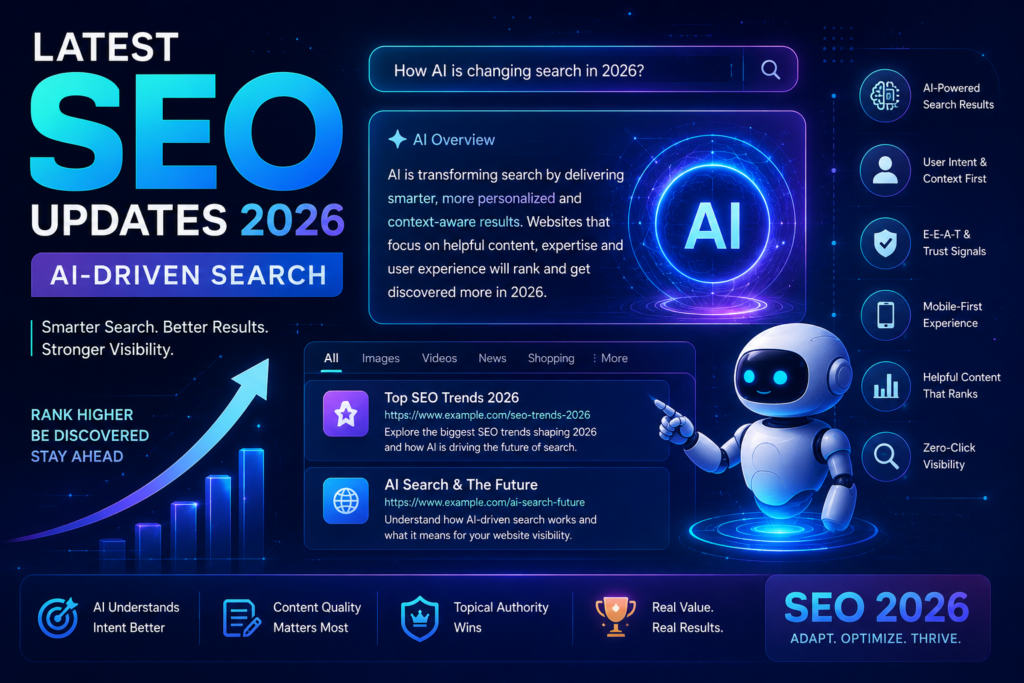
AI Overviews now appear for a significant and growing share of queries. They provide instant answers directly on the search page – reducing click-through rates on generic content while making well-structured, authoritative pages more likely to be cited as sources.
How AI Is Changing Search?
With AI interpreting search intent, users can now compare content, analyse options, and make decisions without leaving the results page. AI systems blend information from multiple sources – your pages, competitor pages, forums, reviews, and documentation. This means:
- A user comparing two SEO tools may never click through to either website if AI summarises the key differences
- A blogger researching content strategy gets an AI-generated answer drawing from five different sources – including yours, if it is structured correctly
- Decision-makers evaluate options faster, compressing the awareness-to-action journey
How to Optimise for AI Search?
You do not need a separate AI optimisation strategy. You need content that AI systems can trust, parse, and quote. That means:
- Open every article with a three to five point summary of what the reader will learn or gain
- Use descriptive, question-style headings: “What is back button hijacking and why does it matter?”
- Add comparison tables, pros and cons sections, and clear differentiation points
- Implement FAQPage and HowTo schema where relevant – these directly increase AI citation eligibility
- Write for a specific reader – not a generic audience. “SEO professionals managing client sites” is a reader. “Anyone interested in SEO” is not.
H4: What AI Search Means for SEO Professionals
| Answer Engine Optimisation (AEO) is now part of every content brief. If your page cannot be summarised in two sentences without losing its value, it needs structural work before it will be cited in AI Overviews. |
SEO Algorithm Updates 2026: Decline of Generic Content
Recent Google algorithm updates have made low-quality, generic content significantly less visible. Google’s Helpful Content System is now integrated into core updates – assessing a site’s overall helpfulness, not just individual pages. A site with many thin or unhelpful pages will see ranking drops across its entire domain, including on pages that are individually strong.
What No Longer Works?
- Generic listicles: “Top 10 SEO tools for 2026” with no evaluation criteria, testing, or original opinion
- Rewritten versions of content that already ranks, with no added insight or perspective
- Surface-level “ultimate guides” that cover everything at a shallow depth
- AI-generated content published without expert review, original data, or first-hand experience
- Pages created purely to rank for a keyword, with no genuine purpose for the reader
What Works in the Latest SEO Updates 2026?
- First-hand experience: what you personally tested, found, fixed, or learned — not what you read elsewhere
- Case studies with real numbers: traffic change, ranking shift, time to recover, revenue impact
- Named authors with visible credentials — a linked About page, a consistent publishing history, professional context
- Genuine trade-offs: not “here are ten tools” but “here is why we chose this one and rejected these three”
- Updated content with new data: superficial rewrites do not count — add new findings, current examples, or changed recommendations
Example of Content Shift:
| ? What Used to Rank | ? What Google Rewards Now |
| “Top 10 SEO audit tools for 2026” – generic list, repeated public features, no testing, no original opinion. | “How I audited 23 client sites using 4 tools — what each found, what each missed, and which one I actually recommend now.” |
| The second version has an evaluation framework, rejected options, a clear recommendation, and a real-world basis. That is the standard to aim for on innovativeseo.in. |
Latest SEO Updates April 2026: Off-Page SEO Signals
The latest SEO updates confirm that search engines – and especially AI systems – increasingly use external sources to validate what your website claims. If your brand is invisible off-site, Google’s AI has no third-party evidence to work with. Algorithm updates impacting off-page signals mean that owned media alone is no longer enough.
Where AI Gets Its Information From?
- Reddit threads and specialist community discussions
- Third-party review platforms: G2, Trustpilot, Capterra, and niche directories
- Industry publications, newsletters, and digital PR mentions
- LinkedIn commentary, podcast appearances, and expert Q&A contributions
- Analyst reports and institutional references
What This Means for Your SEO?
For a blog like innovativeseo.in, off-page presence means being part of the conversation in the communities your readers already trust. Practical steps:
- Contribute genuine answers in SEO communities: Reddit r/SEO, LinkedIn, Twitter/X, and specialist Slack groups
- Earn mentions in newsletters and round-up posts by publishing original data, tools, or frameworks others want to reference
- Get listed in relevant directories and resource pages in the SEO and digital marketing space
- Maintain consistent authorship: your name, your site URL, and your area of expertise should be recognisable across platforms
| Avoid link spam, paid placements disguised as editorial, and any tactic designed to manipulate rather than earn. Google’s spam updates are specifically built to detect these patterns – and penalties can take months to recover from. |
Latest SEO Updates 2026: Reporting and Visibility Changes
Traditional SEO reports focused on traffic and keyword rankings. In 2026, those metrics alone tell an incomplete story. Google’s search results now include AI Overviews, Discover, entity panels, video carousels, and rich results – visibility in these formats does not always appear in a standard position-tracking report.
H3: Old vs New SEO Metrics
| Old SEO Reporting | New SEO Reporting |
| Search traffic | Search visibility across all result types |
| Individual keyword rankings | Topic and entity visibility |
| Average position | AI citations and brand mentions |
| Last-click conversions | Assisted influence: newsletter signups, return visits, referrals |
For innovativeseo.in, track impressions and CTR in Google Search Console, monitor which pages are referenced in AI Overviews, and watch for branded search growth as a signal of audience trust. Compare your visibility against similar blogs and publications — not just your own historical data.
| If your reporting only shows sessions and average position, you are missing how your content actually performs in 2026. Add brand visibility, AI citation eligibility, and content helpfulness signals to your monthly review. |
Technical SEO 2026: UX and Core Web Vitals
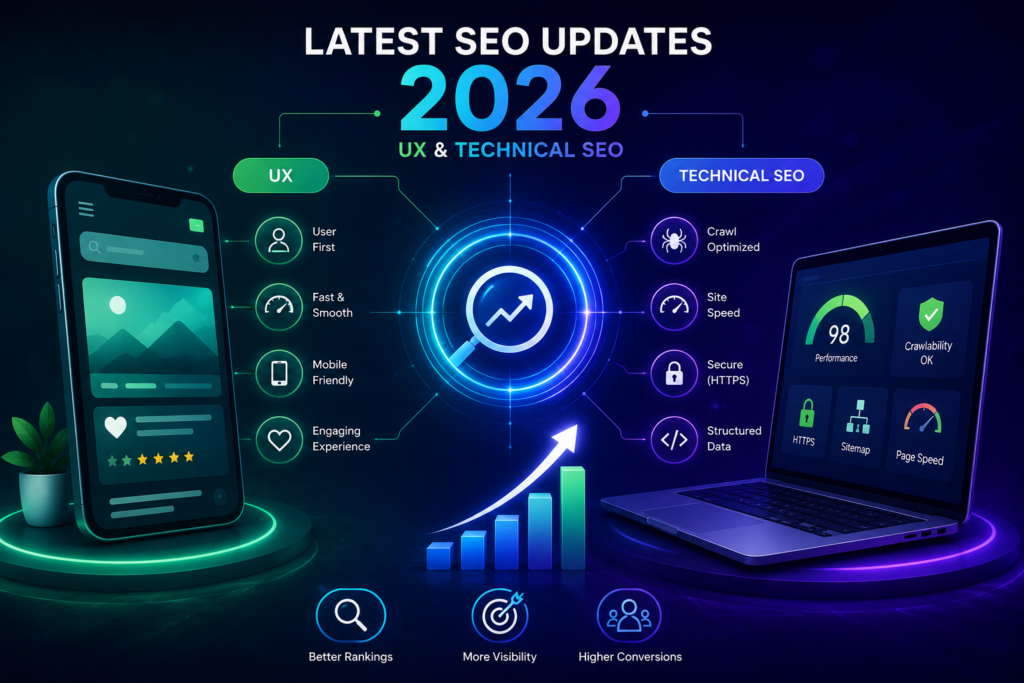
Technical SEO is not separate from content strategy in 2026 – it is part of the same ranking signal. Page experience now acts as a tie-breaker between equally relevant content. Sites with better UX, faster loading, and cleaner structure earn the edge.
Deep Linking and UX Best Practices
- Keep all important content visible on initial page load – do not hide it behind tabs, accordions, or expandable sections if you want it indexed and deep-linked
- Avoid using JavaScript to control the scroll position on page load
- Do not strip hash fragments using the history API or window.location.hash – this breaks Google’s ability to create deep links to your content
- Use descriptive, unique URLs for every piece of content /google-core-update-march-2026, not /post?id=47
- Use clean semantic HTML with a logical heading hierarchy on every page
Improve Core Web Vitals and Performance
- Audit and eliminate Cumulative Layout Shift (CLS): identify elements that move after load and fix them
- Reduce Time to First Byte (TTFB) with server-side rendering or fast hosting
- Convert all images to WebP or AVIF and implement lazy loading below the fold
- Defer non-critical JavaScript and avoid render-blocking resources
- Use a CDN for global delivery and enable HTTP/2 or HTTP/3 where available
Why UX Now Impacts SEO More
Better UX produces stronger engagement signals – lower bounce rates, longer sessions, more return visits – all of which feed into Google’s quality assessment. Accessible, semantic HTML means crawlers can index content reliably. And faster pages earn more links, because readers are more likely to share and reference content they can actually use.
| Target: LCP under 2.5 seconds, INP within Google’s “good” threshold. Run PageSpeed Insights on your most important pages every month – not just after a redesign. |
SEO Algorithm Updates 2026: Back Button Hijacking Penalty
A critical update in the 2026 SEO landscape is Google’s move to actively penalise back button hijacking – a pattern where users are prevented from navigating back to search results normally. This degrades trust and violates page experience standards. Stricter enforcement begins 15 June 2026.
What Is Back Button Hijacking?
- Redirecting users to a page they never visited when they press the browser back button
- Inserting extra pages into browser history to trap users in a navigation loop
- Blocking back navigation with overlays, interstitials, or forced subscription prompts
- JavaScript redirect patterns on landing pages that prevent users from returning to search results
What You Should Do?
- Audit your site for history API manipulation, JS-based redirects, and aggressive interstitial patterns
- Remove any scripts that interfere with standard browser back-button behaviour
- Review all popups, email capture overlays, and mobile lead-generation flows for navigation interference
- Test manually: press back from every key page and confirm it returns to the expected previous destination
Important Deadline
| ? Hard Deadline: 15 June 2026: Stricter enforcement of back button hijacking penalties begins on this date. Any site using manipulative navigation patterns – including third-party scripts and ad network injections – risks manual action under Google’s page experience and spam policies. Audit and remediate before this deadline. |
Page Speed SEO and Performance in 2026:
Page speed is back in sharp focus in the 2026 core algorithm context. Average page weight has tripled over the last decade, and slower pages continue to cost sites rankings, conversions, and reader trust — especially on mobile.
Why Page Speed Matters?
- Sites with an LCP over 3 seconds saw 23% more traffic loss than faster competitors in recent core update cycles
- Every 100ms of additional load time costs approximately 1% in conversion rate — whether that is a click, a signup, or a share
- Slow pages are less likely to be cited in AI Overviews and less likely to surface in the Discover feed
- Mobile users — still a majority of blog traffic in most niches — abandon slow pages faster than desktop users
How to Improve Performance?
- Compress and convert all images to WebP or AVIF – this alone typically produces the biggest gains
- Serve all assets via CDN and enable browser caching with appropriate expiry headers
- Defer all non-critical JavaScript and load third-party scripts asynchronously
- Inline only the CSS needed for above-the-fold content – load the rest after the page is visible
- Audit your third-party script load: analytics, ad networks, social embeds, and chat widgets all add weight
| Run Lighthouse on your top 10 pages today. If any score below 70 on performance, treat that as urgent – not a future sprint item. |
Latest SEO Updates: AI-Generated Content and SEO Trends 2026
The rise of generative AI has made it trivially easy to produce large volumes of content. Google has been explicit: AI-generated content is acceptable only when it provides genuine value and originality. Mass-produced, unreviewed AI content is penalised — not because it was written by AI, but because it is typically low quality, generic, and unhelpful.
Risks with AI-Generated Content
- Unedited AI drafts often contain vague, unverifiable claims and no original perspective – exactly what Google’s quality signals are designed to detect and demote
- Sites with a high proportion of AI-only content face domain-wide quality drops, not just page-level penalties
- AI cannot replicate first-hand experience, original data, or the credibility that comes from a named expert with a track record
How to Use AI Safely
- Use AI for research, outlines, and first drafts – then apply your own expertise, examples, and original perspective before publishing
- Every published piece on innovativeseo.in should reflect your actual knowledge and experience – not just a well-structured AI summary of what already exists
- Cite real data, real tools, and real results: “I tested this on three client sites and here is what happened” is something AI cannot write for you
- Add author context to every article: who wrote it, what their background is, and why they are qualified to write on this topic
| The question is not whether AI was involved. The question is whether the published content reflects genuine expertise and original insight. If it does not, it carries ranking risk regardless of how it was produced. |
Latest SEO Trends 2026: E-E-A-T and Core Updates
Every update in this guide points toward the same conclusion: SEO in 2026 is about experience, authority, trust, and brand – not technical shortcuts and keyword volume. Google’s broad core updates have consistently rewarded original content that genuinely serves the reader, and penalised anything built to manipulate rankings rather than help people.
What SEO Looks Like Now?
- Experience: real-world testing, personal case studies, and first-hand insight – not rephrased summaries of other articles
- Authority: a visible publishing track record, verifiable credentials, consistent authorship, and citations from sources your audience already trusts
- Trust: accurate, transparent content – clean navigation, honest recommendations, and no manipulative patterns
- Brand: recognition beyond your own website – being mentioned, cited, and recommended by others in your space
H3: The Role of AI in SEO
AI now interprets complex, multi-part queries, personalises results, and raises the bar for what counts as a satisfying answer. For SEO professionals and bloggers, this means content needs to match intent at a deeper level than keyword matching ever required. AI tools can help with research and structure – but the judgement, the experience, and the original perspective must still come from you.
| A blog with genuine expertise and consistent original insight is more resilient through any core update than a site built on keyword-optimised thin content. Build for the reader first, and the algorithm rewards follow. |
Final Thoughts on the Latest SEO Updates (April, 2026)
- Focus on real user problems – write content that mirrors how your readers actually search, not how keyword tools suggest they might.
- Create content with first-hand experience: personal testing, real results, named authors, and honest trade-offs.
- Build authority beyond your blog through community participation, earned mentions, and consistent thought leadership.
- Remediate any back button hijacking or navigation manipulation before 15 June 2026.
- Monitor performance monthly, not quarterly – core updates happen every two to three months and each one can move significant traffic.
Google makes SEO more demanding with every update – but also more valuable for creators willing to invest in quality. If your traffic has been volatile through 2024 to 2026, the answer is almost always the same: better content, cleaner UX, stronger off-site presence, and more honest measurement. Start with whichever of those is weakest on innovativeseo.in right now.
Frequently Asked Questions
Common practical questions from SEO professionals and bloggers adapting to the 2026 algorithm landscape.
How long does it take to see results after adapting to the latest SEO updates 2026?
Most sites see meaningful improvement within 3 to 6 months after genuine content, UX, and technical changes. Thin or AI-heavy sites may need to wait for a full core update cycle — roughly 2 to 3 months — before recovery is confirmed. There are no shortcuts: Google’s quality signals build over time.
Can I still use AI to write blog posts without being penalised?
Yes, if the published content reflects genuine expertise and original insight. AI-assisted drafting is fine — AI-only publishing without expert review is a risk. The test is not whether AI was involved; it is whether the finished article adds something a reader cannot find in three other places.
What is the best way to audit my existing content for 2026 SEO readiness?
Classify every page as keep, improve, consolidate, or remove. Evaluate each one for depth, intent match, first-hand evidence, author credibility, Core Web Vitals, and whether it adds something beyond what already ranks. Pages that only restate existing results are your highest consolidation priority.
How do I know if my site is affected by back button hijacking?
Test manually: navigate to a key landing page from a Google search result, then press the back button. If you land anywhere other than the search results page, something is interfering. Also audit for third-party ad scripts, aggressive interstitials, and JS redirect patterns — the most common culprits.
How should I report SEO performance in 2026?
Move beyond sessions and average position. Report on search visibility across all result types, brand mention growth, AI Overview citation eligibility (visible in Search Console impressions for informational queries), and assisted influence on goal completions. Position these as leading indicators — traffic is a lagging one.