I didn’t expect to see anything weird.
To be honest, I expected AI Overviews to work a lot like traditional search: the most cited top-ranking pages, the strongest domains win, and SEO authority is most important.
But there was something bothering me.
In some SEO searches I started noticing the same pattern repeating: some pages were regularly getting cited inside Google’s AI Overviews even when they weren’t the top organic result.
In a few cases they were even further away.
That contradiction didn’t make sense when you looked at SEO only through the traditional lens of rankings and backlinks.
So I decided to stop guessing.
I reviewed 50 AI Overview results for SEO to answer one simple question: “What types of pages is Google actually choosing to cite in AI generated answers?”
After enough queries, the repetition stopped looking random.
Certain structural behaviors appeared repeatedly across unrelated searches, though not in the way most SEO frameworks would expect them to be.
Why I Did This (And What Didn’t Add Up)
AI Overview Citations are not a “feature update” anymore.
They are changing what visibility means in search.
Because now users not only see “ranked links.”

They see:
- summary responses
- extracted passages
- cited sources within AI-generated responses
This provides a second layer of visibility: “visibility of citation”
And citation visibility does not always correlate with rank position.
That’s the tension that I kept noticing.
If SEO were still purely ranking driven, the top positions should consistently be the dominant ones in citations.
But they did not.
So I wanted to know:
- what is getting selected
- what is getting ignored
- and what patterns sit underneath that decision
Methodology (How I Analyzed 50 AI Overview Citations)
To identify recurring citation behaviors, I tracked ranking positions, citation inclusion, and structural formatting patterns across multiple AI Overview citations result.
Query Categories Included
| Query | Organic Rank of Cited Page | Cited in AI Overview? | Observed Structure Pattern |
| What is GEO in SEO | #4 | Yes | Direct definition at beginning |
| AI SEO tools | #1 | No | Long generic introduction |
| How AI Overviews choose sources | #5 | Yes | Short answer blocks + bullet formatting |
| Semantic SEO for AI search | #3 | Yes | Modular sections with clear subheadings |
| Best SEO strategies for AI-generated results | #2 | No | Broad overview with delayed intent match |
| How to optimize for AI search | #6 | Yes | Concise summaries + semantic clarity |
| Programmatic SEO explained | #1 | No | Dense paragraphs with little structure |
| EEAT for AI search | #4 | Yes | Experience-led insights + examples |
| Internal linking for AI search | #7 | Yes | Chunked formatting with direct explanations |
| Schema markup for AI Overview Citations | #3 | Yes | FAQ-style formatting + extractable answers |
Across multiple queries, citation inclusion appeared more closely tied to extractability and structural clarity than ranking position alone.
What I Recorded for Each Result
I followed each AI Overview citation:
| Signal | Why I tracked it |
| Content structure | To see how information is formatted |
| Direct answer blocks | To measure extractability |
| Author/entity signals | To evaluate trust cues |
| Domain authority | To compare rankings vs citations |
| Freshness | To detect recency influence |
| Forum inclusion | To check community content presence |
| Schema usage | To identify structured data patterns |
| Opinion vs neutral tone | To test memorability |
| Formatting style | To assess retrieval clarity |
I also compared:
- cited vs non-cited pages
- ranking position vs citation presence
- structured vs unstructured content
This was not a controlled experiment or formal dataset but a pattern that emerged repeatedly across real AI Overview Citations result.
But you couldn’t deny the regularity of the patterns.
1st Observation – AI Overviews Prefer Immediate Answer Blocks
One of the most obvious patterns was that: “pages that started with direct, self-contained answers were cited more often.” This aligns closely with how AI systems evaluate extractability and semantic clarity in content designed for AI-driven search systems like AI search optimization for better visibility.
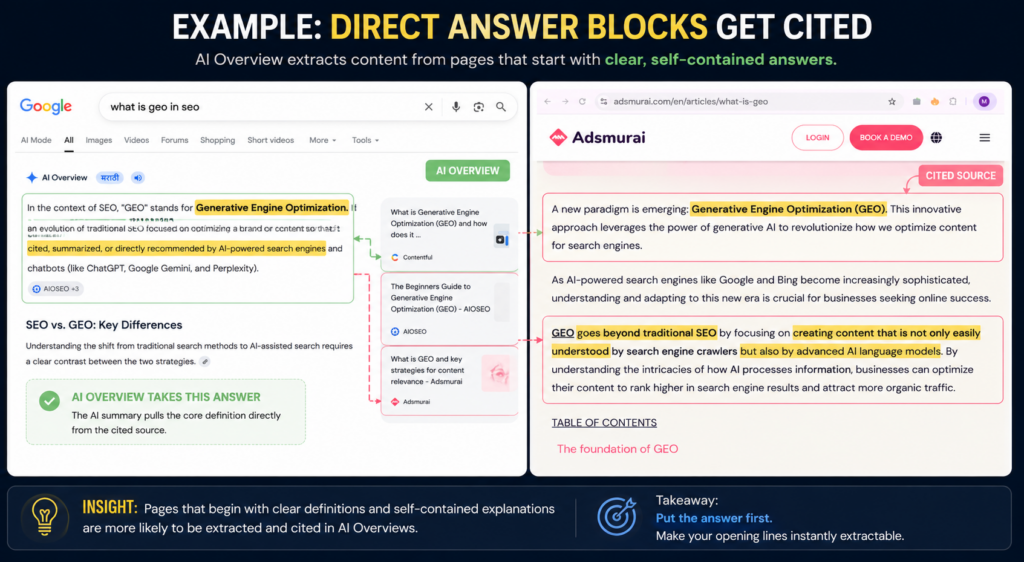
For example:
“AI Overview Citations are AI-generated summaries, combining multiple sources of information.”
This kind of structure was repeated.
In the meantime, pages that:
- opened with storytelling
- used long SEO introductions
- delayed answering the question
appeared less frequently in citations.
Why This May Be Happening?
AI systems appear to prefer content that can be directly lifted, split, and reused inside a generated answer without needing reprocessing.
In other words: The more “citation – ready” the more quickly a page responds to the question.
Insight Summary
Direct-answer structure can be a citation trigger for AI-generated search result.
2nd Observation – Authority Alone Did Not Guarantee Citation
That was one of the more surprising findings.
Some high-authority domains (DR80-90+ sites) ranked well organically but weren’t consistently mentioned inside AI Overview Citations.
Meanwhile, smaller niche sites were being cited more frequently when their content was:
- clearly structured with modular formatting
- direct in matching search intent
- semantically precise in language and topic focus
- informationally dense without unnecessary padding
Comparison: Authority vs Citation Behavior
| Type of Site | Authority (DR) | Organic Ranking | Structure Quality | AI Overview Citations |
| High-authority domains | High (DR80–90+) | Strong | Often generic / broad | Inconsistent |
| Niche structured sites | Low–Medium | Moderate | Highly structured + direct | More frequent |
What This Suggests
AI citation systems may prioritize:
- usefulness over authority
- clarity over size
- structure over domain strength
Authority still influences visibility, but it no longer appeared sufficient on its own
Insight Summary
Citation selection does not appear strongly tied to domain strength. Instead, it aligns more with how cleanly a section can be extracted and reused in an AI-generated response without ambiguity.
3rd Observation – Author and Entity Signals Appeared More Consistently on Cited Pages
One pattern that stood out across multiple queries was the presence of clear author identity on pages that were cited more frequently.
These pages tended to have:
- a named author with a consistent byline
- author bio pages linking to published work or social profiles
- demonstrated topic expertise through related content clusters
- E-E-A-T signals visible at both the page and domain level
In contrast, pages with no visible author, generic “Editorial Team” credits, or thin about pages appeared less often in AI Overview citations – even when their content was structurally strong.
Why This May Be Happening
AI systems likely need more than readable content. They may also need a trust layer – something that signals the information comes from a source that can be identified, verified, and attributed.
An author with a consistent entity footprint across the web may provide exactly that signal.
Insight Summary
Author identity and entity clarity may function as a trust layer for AI citation systems – not just for human readers, but for retrieval itself
4th Observation: Forum and Experience-Based Content Appears More Than Expected
And another surprise:
AI Overview Citations often referenced forum style content (especially experience posts).
This included:
- Reddit threads
- community discussions
- personal experience posts
- troubleshooting conversations
Even with polished SEO articles existed in the same SERP.
Why This Matters
Forums contain:
- real-world usage context
- contradictory opinions
- first-hand experimentation
- nuanced problem-solving
This creates something most SEO content struggles to replicate: informational uniqueness
Insight Summary
Content based on experience might be especially valuable for AI systems, because it contains non-repetitive information.
5th Observation – Some Top Ranking Pages Were Completely Ignored
In multiple queries a consistent pattern was found: Some pages that ranked high were not mentioned at all in AI Overview Citations.
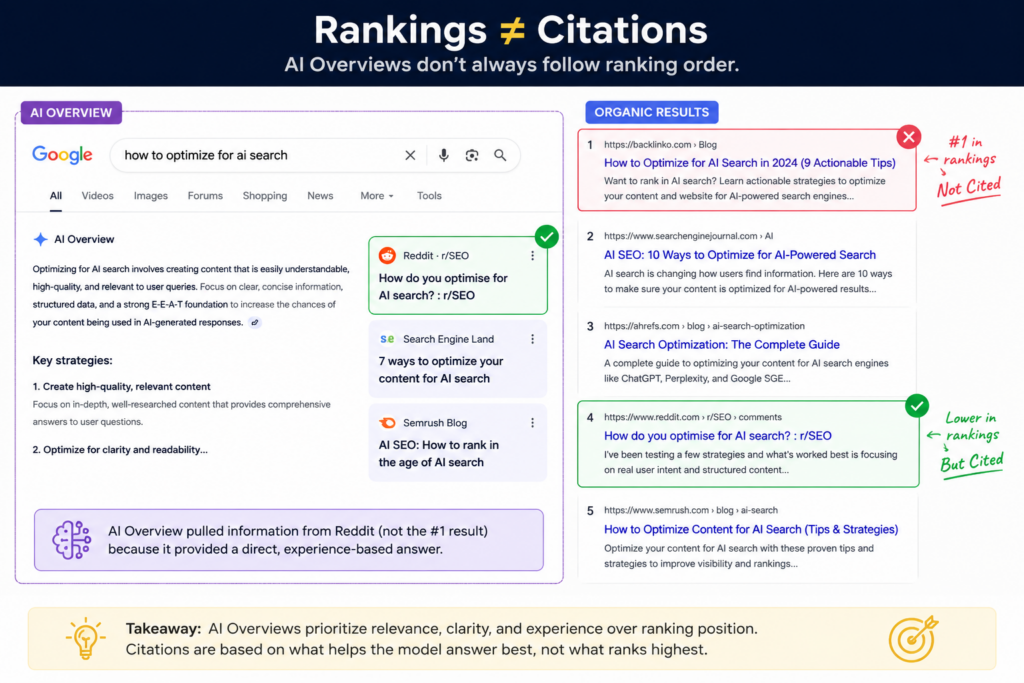
This was not a one time thing-it happened often enough to be noticeable.
Interestingly, these pages tended to have things in common, such as:
- long introductions
- generic SEO explanations
- lack of structured answer blocks
- minimal distinct perspective
Meanwhile, lower-ranking pages with:
- tighter formatting
- clearer answers
- more focused insights
were sometimes selected instead.
What This Suggests
Ranking position and AI citation selection are not perfectly aligned systems.
They do overlap – but they are not the same.
Insight Summary
Being highly ranked doesn’t mean you get into AI-generated answers.
6th Observation – Opinion-Led Content Was More Memorable in Citations
There was a greater likelihood of interpretive content than of purely neutral content.
Not extreme opinions – but structured perspectives like:
- “This may indicate a shift toward semantic retrieval signals.”
- “AI Overviews could reduce the importance of CTR optimization.”
- “Structured clarity may outperform keyword density.”
These pages were more original than stock explanations.
Why This Might Matter
When multiple pages explain the same concept, only those with a distinct framing or interpretation seem to get reused in AI summaries.
Alternate framing might be a selective advantage.
Insight Summary
Interpretation and perspective could enhance an AI retrieval system to increase semantic distinctiveness.
7th Observation – Structured Formatting Dominated Cited Pages
Most of the most cited pages had similar structural characteristics:
- short paragraphs
- bullet summaries
- clear subheadings
- modular sections
- direct definitions
- segmented explanations
On the other hand, pages with dense, unstructured writing happened less frequently.
What This Suggests
Pages that are cited tend to already be structured in a way that matches how AI breaks content into answer segments.
Insight Summary
Formatting may no longer be just a readability decision; it may influence retrieval itself
8th Observation – Freshness Helped Only When It Added Meaning
Fresh content was not automatically favored.
Instead:
- updated content with meaningful changes performed better
- superficial updates (timestamps, minor edits) did not influence citations much
Evergreen pages still performed well when they were:
- structurally strong
- semantically clear
- informationally stable
Insight Summary
Updating a page without changing its informational substance did not seem to influence whether it was cited.
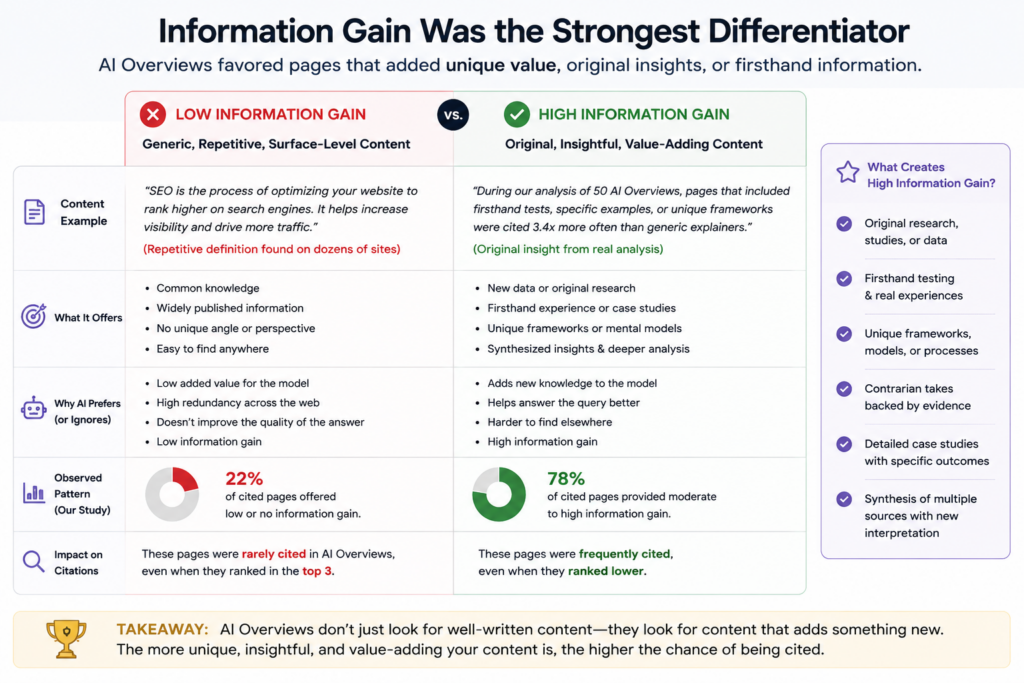
9th Observation – Information Gain Was the Strongest Differentiator
This was the most consistent pattern across all 50 AI Overview Citations:
Pages that added something new were cited more often.
Not earth-shattering research, necessarily, but:
- unique observations
- practical examples
- firsthand insights
- comparisons
- synthesis of ideas
On the other hand, pages with repetitive and widely available definitions rarely appeared.
This causes a significant change in content value: much repetition, little information gain
And scarcity seems to affect which citations we choose.
Insight Summary
AI Overview Citations might prefer content that adds new information value over content that just repeats existing ideas.
What This May Mean for SEO (Emerging Pattern Layer)
If these trends continue, SEO may eventually divide into two overlapping systems:
| Traditional SEO | AI Citation Layer |
| Rankings | Extractability |
| Backlinks | Semantic clarity |
| CTR | Information structure |
| Keywords | Meaningful content chunks |
| Authority | Contextual usefulness |
This does not replace SEO, but it brings a new dimension: visibility into AI-generated synthesis systems.
And that system seems to work differently than traditional ranking systems.
What I’m Testing Next?
This analysis has generated more questions than answers.
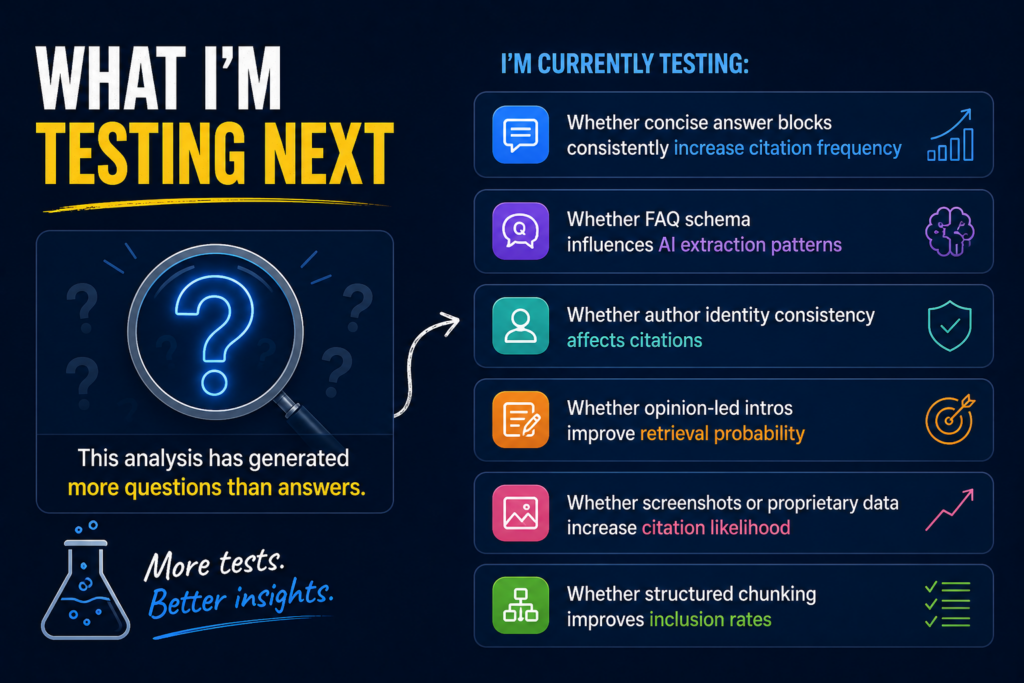
I’m currently testing:
- whether concise answer blocks consistently increase citation frequency
- whether FAQ schema influences AI extraction patterns
- whether author identity consistency affects citations
- whether opinion-led intros improve retrieval probability
- whether screenshots or proprietary data increase citation likelihood
- whether structured chunking improves inclusion rates
The big question I’m still working on is what combination of structure + originality reliably increases AI citation visibility.
Because the patterns are strong now but still evolving.
Final Thesis
After looking at 50 AI Overview citations patterns, one idea kept coming up again and again, in different forms.
The future of SEO may not be for the pages that rank the highest.
It may be one of the pages that give the hardest to replace.
Because in an AI-driven search world content is not just indexed or ranked.
It is interpreted, distilled, and selectively quoted.
And in that system, it’s not just volume or authority, but clarity, structure and originality of insight that count.
Or more simply:
In AI search, the most visible content may not be the most published but the most irreplaceable.
Quick Pattern Summary
- Direct answers increase citation likelihood
- Authority alone is not decisive
- Forums contribute high-value experiential data
- Some top-ranking pages are not cited
- Opinion adds semantic distinctiveness
- Structure improves extractability
- Freshness must be meaningful, not cosmetic
- Information gain is the strongest recurring factor
If you’ve been tracking AI Overview citations in your own niche, I’d be interested to hear how your patterns compare because the selection behavior doesn’t look consistent across topics.