If you’ve been doing SEO for a while, you’ve probably noticed that keyword rankings aren’t as easy to track as they used to be. A few years ago the main goal was to get on the first page of Google and ranking #1 generally translated into more clicks and more traffic. That’s no longer a certainty in 2026.
Today’s search results are much more dynamic. Google has rolled out AI Overviews, featured snippets, People Also Ask boxes, local packs, shopping listings, video results and other SERP features that often appear before the traditional organic listings. Even if you are #1 in organic rankings, users may never scroll far enough to see you.
This change has made rank tracking tools SEO professionals rely on more critical than ever. Instead of just delivering keyword position reports, today’s tools allow you to get a sense of your overall search visibility, learn where your competitors are gaining ground and track how your performance is being impacted by AI-powered search experiences.
Whether you run your own blog, an eCommerce store or do SEO for multiple clients, choosing the right keyword position tracking tool can make a big difference to your strategy.
In this guide we’ll look at three of the most trusted platforms around today:
- Semrush Position Tracking
- Ahrefs Rank Tracker
- AccuRanker
We will review each tool on ranking accuracy, update frequency, SERP features tracking, local SEO features, pricing and tracking of AI Overview. By the end of this comparison, you’ll know which platform deserves the title of the best rank tracker 2026 for your business.
Why Rank Tracking Tools SEO Is Harder Than It Looks in 2026
Keywords rankings have never been static, but the way Google delivers search results has changed dramatically over the past couple of years.
There are now multiple factors affecting search results including:
- AI-generated search experiences
- User location
- Device type
- Search history
- Search intent
- Local relevance
- SERP features
Which means that two people searching for the same keyword might get different results.
If someone is looking for a “digital marketing agency” in Pune, the results will be very different from someone looking in Delhi. Likewise, a user on a mobile device may see a different layout than a user on a desktop.
These differences significantly complicate the process of tracking rankings compared to simply knowing where your page appears on Google.
Then we got AI Overviews and that added a new layer of complexity. Rather than a list of ten blue links, Google is increasingly offering up artificial intelligence-generated answers that draw on information from multiple sources. This helps users find answers faster but also changes the distribution of organic search traffic.
A website might still be number one in the organic results but get fewer clicks because users get their answers right inside the AI Overview.
That’s why seasoned SEO professionals don’t just look for rankings. Instead, they look at overall search visibility and track how often their content is showing up in all aspects of the search results page.
Traditional Rankings vs Search Visibility
A mistake businesses are making too often is thinking keyword rankings are the only measure of SEO success.
In practice, the first ranked position is not always the first thing the user sees.
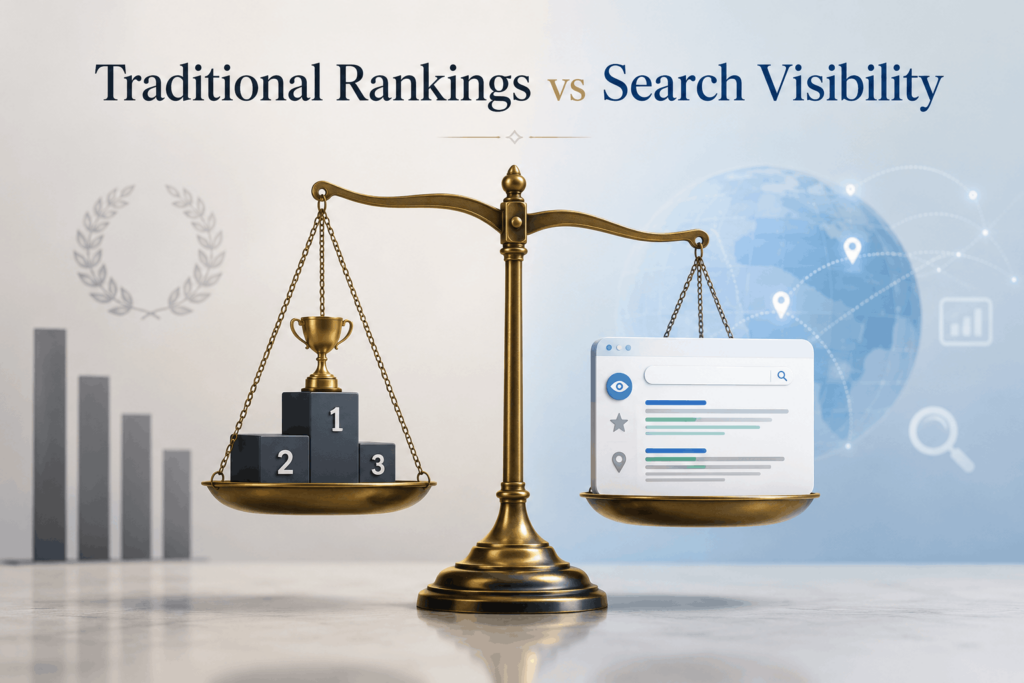
Imagine your page is #1 for an important keyword, but the search results include:
- An AI Overview
- A featured snippet
- A Local Pack
- A video carousel
- People Also Ask questions
Your listing could be on the second page, your chances of getting users to click through to your website will drop.
This is why modern SEO is shifting from monitoring rankings to measuring visibility.
The best rank tracking tools SEO experts recommend will do more than tell you where a keyword ranks but also help you understand how visible your website is on the entire search results page. Many of today’s top platforms are capable of tracking featured snippets, Local Packs, AI Overview appearances, image results, and other SERP features that impact real-world traffic.
If you look at visibility instead of rankings, you get a much clearer picture of your SEO performance and are able to make smarter optimization decisions.
Why Do Tracking AI Overview Appearances Matter?
One of the largest differences between older rank trackers and the latest generation of SEO platforms is their ability to track AI-powered search experiences.
While Google is rolling out AI Overviews, keyword reports don’t tell the full story.
Let’s say you are doing well in organic rankings but aren’t being included in AI-generated summaries. Then you can slowly lose clicks even if your rankings stay the same.
However, if you’re not in the top organic position but are in an AI Overview, your brand will get a ton of visibility.
This is the reason why businesses should opt for a keyword position tracking tool that goes beyond the normal ranking reports.
A modern platform should help to answer questions such as:
- Which keywords trigger AI Overviews?
- Is my content appearing in AI-generated summaries?
- Which SERP features are affecting my visibility?
- How has my visibility changed after a Google update?
- Are competitors gaining more exposure through AI search?
These insights can help you evolve your SEO strategy to Google’s evolving search experience instead of relying solely on traditional keyword rankings.
What Makes a Rank Tracker Reliable?
Now that we’ve seen why tracking rankings has become harder, the obvious next question is:
What actually makes one rank tracker better than another?
Not all platforms score things the same way. Some update data daily, others provide on-demand refreshes. Some only track keyword positions, while others combine rank tracking tools SEO with AI Overview monitoring, competitor analysis and local SEO insights.
Before we compare Semrush, Ahrefs and AccuRanker, it’s important to understand the key features every reliable rank tracker should have.
In the next section we will review the key factors you need to consider before you choose the right tool for your SEO strategy.
1. Ranking Accuracy
Accuracy is the most important feature in a rank tracker.
No tool can replicate every user’s experience perfectly because Google customizes search results based on things like location, search history, and device. But the best platforms collect data from neutral environments to provide rankings very similar to the real search results.
A good tracker also will avoid you seeing unnecessary fluctuations in your rankings and will help you to separate the wheat from the chaff when it comes to everyday movement vs. real SEO movement.
2. Update Frequency
SEO is always changing.
A competitor may release new content, Google may release a core update, or your latest optimization may start affecting rankings within a few days.
That’s why how often you update matters.
The majority of modern rank tracking tools SEO professionals use offer daily updates, which are enough for most businesses. But enterprise sites and agencies often find value in platforms that offer on-demand ranking refreshes, so they can see performance right after big SEO changes.
3. SERP Feature Tracking
Ranking first is no longer enough if your listing appears beneath multiple SERP features.
A good rank tracker should track elements such as:
- AI Overviews
- Featured snippets
- People Also Ask
- Local Packs
- Image results
- Video carousels
- Shopping listings
Tracking these features will help you understand why clicks and impressions may change, even if keyword positions remain stable.
4. Local vs National Rank Tracking
This is an area many companies are missing.
If you own a local business such as a dental office, law firm or restaurant, your city rankings are much more important to you than your national rankings.
For instance, a bakery in Pune should consider the ranking for customers searching from Pune, not from all over India.
SaaS companies, eCommerce stores and national brands, however, are more likely to focus on national or international exposure.
The best keyword position tracking tool will let you track local and national rankings, giving you a more accurate view of your performance based on your target audience.
5. Pricing and Overall Value
Price should not be the only thing to decide.
Some are solely for rank tracking tools SEO, while others provide a full-fledged SEO suite with keyword research, backlink analysis, competitor monitoring, site audits, and reporting.
Before you choose a tool, ask yourself:
- Do I just want accurate keyword rankings?
- Or do I want an all-in-one SEO platform?
The answer will often determine which solution is the best value over the long term.
Tool 1: Semrush Position Tracking
When SEO professionals talk about the best rank tracker 2026 will offer, Semrush is almost always the name that comes up and for good reason.
Unlike standalone rank trackers that only track keyword rankings, Semrush rank tracking tools SEO is part of a wider SEO platform that includes keyword research, competitor analysis, backlink monitoring, site audits, content optimization, and reporting.
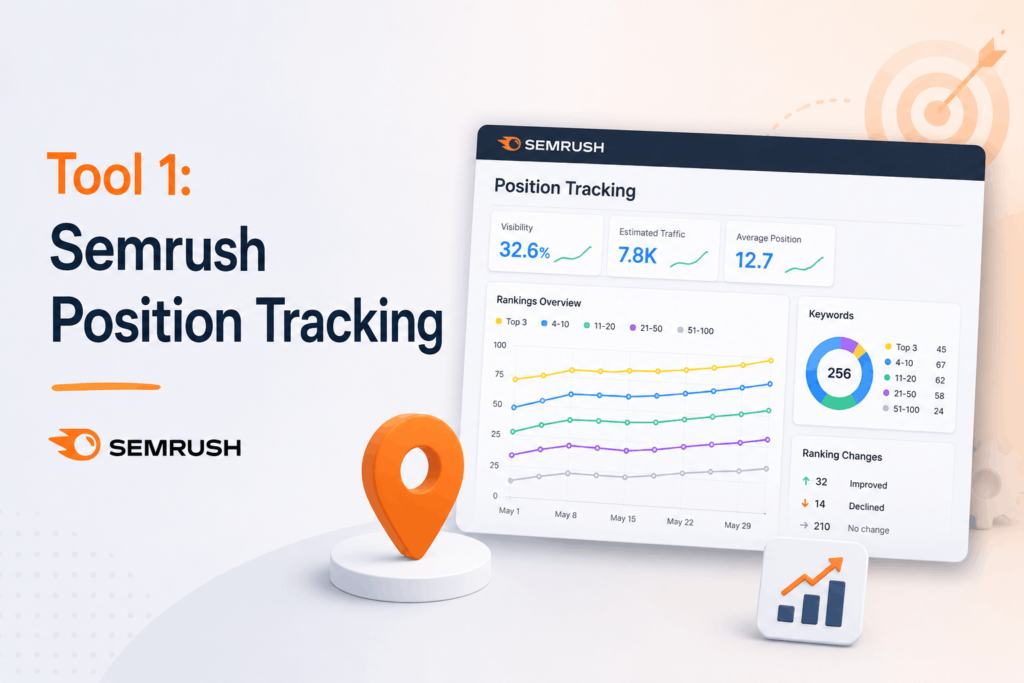
Semrush is a good choice for companies wanting to manage their entire SEO strategy from one dashboard.
Why Semrush Stands Out
One of the biggest advantages of Semrush rank tracking tools SEO is that it focuses on search visibility and not just rankings.
Instead of just telling you that a keyword jumped from Position 5 to Position 3, Semrush gives you more context by showing you:
- Visibility Score
- Estimated traffic
- Average position
- SERP feature ownership
- Competitor rankings
- Share of Voice
- Keyword movement over time
These metrics will help you understand if your SEO strategy really is working better or if the rankings are changing without creating meaningful business results.
For agencies working with multiple clients, these reports also greatly facilitate monthly performance reviews.
AI Overview and SERP Feature Monitoring
One reason Semrush continues to be one of the best rank tracking tools SEO professionals recommend is its continued investment in modern search features.
Semrush has updated its reporting to help users understand the impact of AI Overviews and other SERP features on visibility as Google integrates AI-generated answers into search results more and more.
But you can also look for opportunities to get featured snippets and monitor SERP ownership and understand why organic CTRs change, not just traditional rankings.
These insights are becoming increasingly valuable for businesses planning for the future of AI-powered search.
Local Tracking Capabilities
Semrush is also extremely strong when it comes to local SEO.
You can track keyword rankings for cities, states, regions or even ZIP codes, so it’s easy to see how your business is doing in the areas that matter most.
This is particularly useful for:
- Local service businesses
- Multi-location companies
- Franchises
- Marketing agencies managing local SEO campaigns
You can see exactly how visible your business is in the market you choose, not looking at broad national rankings.
Pros
- Excellent ranking accuracy
- Daily keyword updates
- Comprehensive competitor tracking
- Strong AI Overview and SERP feature monitoring
- Outstanding local SEO capabilities
- Easy-to-understand reporting dashboards
- Integrates with the complete Semrush SEO toolkit
Cons
- More expensive than some standalone rank trackers
- The large number of features can feel overwhelming for beginners
- On-demand ranking refreshes are more limited than specialist tools
Who Should Use Semrush?
Semrush is ideal for:
- SEO professionals
- Marketing agencies
- In-house marketing teams
- Growing businesses
- Companies that want an all-in-one SEO platform instead of purchasing multiple tools
If your workflow requires keyword research, technical SEO, competitor analysis, content optimization, and reporting, Semrush is a great value overall.
However if all you want is hyper-specific rank tracking tools SEO with instant updates, you’ll want to check out how it stacks up against the next two tools in this guide.
Next, we’ll take a closer look at Ahrefs Rank Tracker and compare it to Semrush, focusing on accuracy, usability, and overall performance.
Tool 2 – Ahrefs Rank Tracker
If you’re already using Ahrefs for keyword research and backlink analysis then it makes sense to add Ahrefs Rank Tracker to your workflow. Ahrefs is known for having one of the largest backlink databases, but lately, it has also proven to be a reliable alternative for businesses who’d like to track specific keywords accurately with no extra hassle.
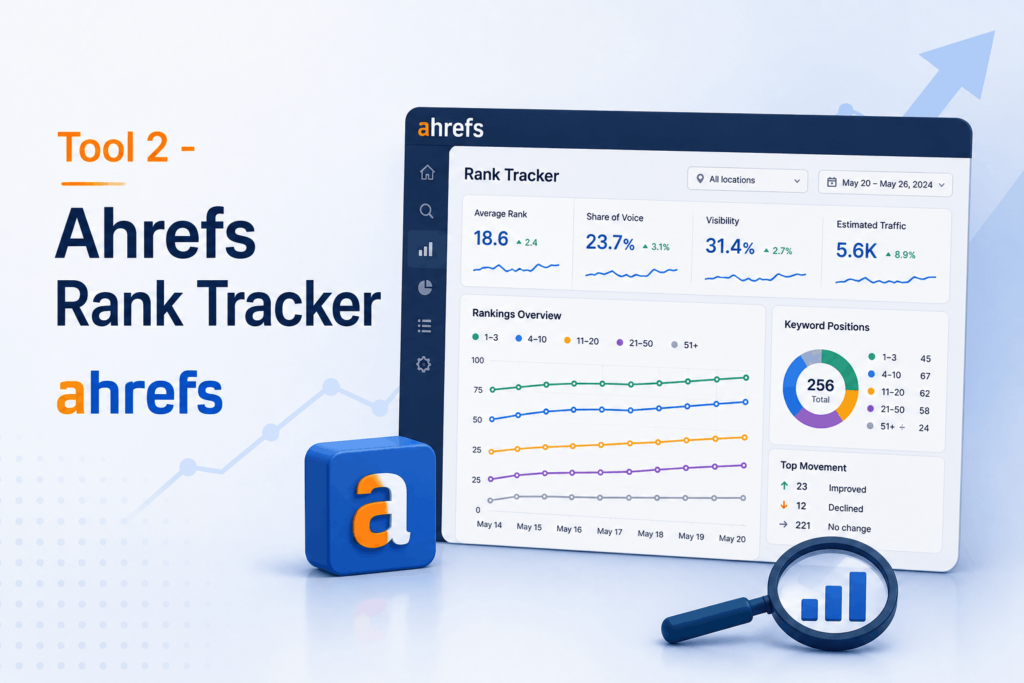
Some platforms bombard you with dozens of reports, but Ahrefs presents ranking data in a clean, intuitive interface. This makes it particularly attractive to content marketers, in-house SEO teams and companies that want actionable insight, not just an overload of metrics.
Key Features
- Daily keyword rank updates
- Mobile and desktop tracking
- Country-specific ranking data
- Competitor comparison
- Historical keyword trends
- Visibility metrics
- Keyword movement reports
One of the strongest aspects of Ahrefs Rank Tracker is its historical reporting. Instead of looking at rankings in isolation, you can look at how keywords have performed over weeks or months, making it easier to tie ranking improvements to content updates or Google algorithm changes.
Pros
- Clean and beginner-friendly dashboard
- Accurate daily ranking updates
- Excellent historical performance reports
- Seamless integration with Ahrefs’ keyword research tools
Cons
- Local SEO tracking isn’t as comprehensive as Semrush
- AI Overview monitoring is still developing
- Reporting options are more limited for agencies
Best For
- Content marketers
- Bloggers
- In-house SEO teams
- Businesses already subscribed to Ahrefs
Ahrefs Rank Tracker is a good choice if content creation and backlink building are the foundations of your SEO strategy. But for companies that rely on local SEO or agency reporting, Semrush offers more flexibility.
Tool 3 – AccuRanker
When it comes to ranking accuracy, AccuRanker is frequently the benchmark against which other tools are measured.
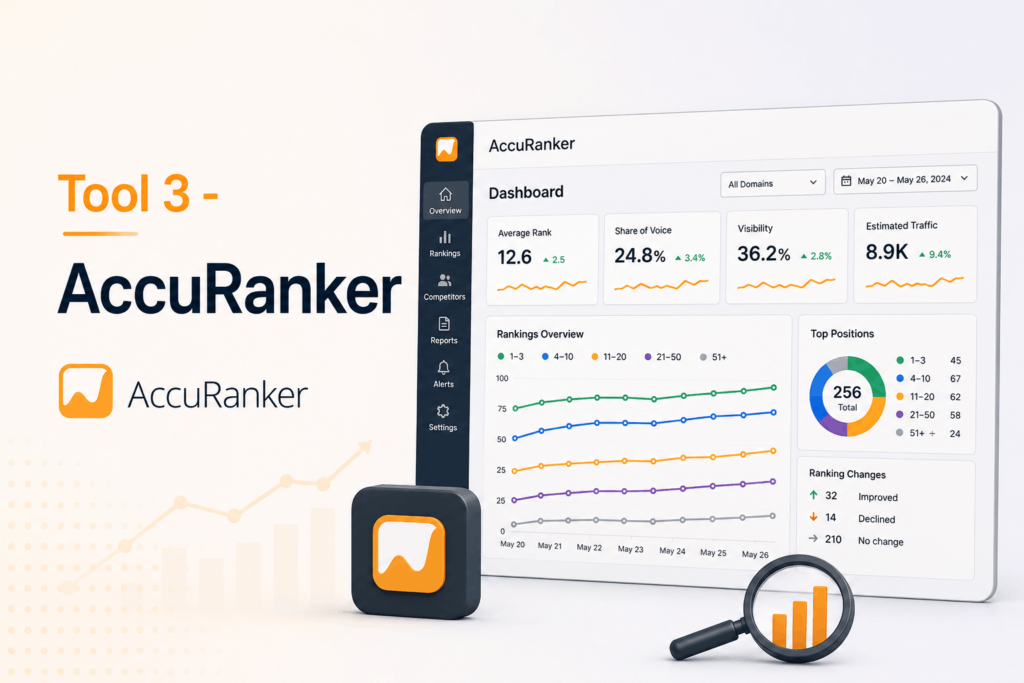
AccuRanker is built specifically for keyword tracking, whereas Semrush and Ahrefs are full SEO suites. This focused approach enables them to provide highly accurate ranking data, faster updates and advanced reporting capabilities for businesses managing large SEO campaigns.
If your primary focus is to track keyword rankings in the most accurate manner, AccuRanker is worth considering.
Key Features
- Daily keyword tracking
- Instant ranking refreshes
- Local and national tracking
- AI Overview monitoring
- Pixel-level SERP analysis
- Competitor tracking
- Share of Voice reporting
One of AccuRanker’s biggest strengths is its on-demand updates. Instead of waiting until the next day to see ranking changes, you can refresh your keywords whenever you need them. This is especially valuable after publishing new content, implementing technical SEO fixes, or monitoring the impact of a Google algorithm update.
Pros
- Outstanding ranking accuracy
- Fast on-demand updates
- Excellent local SEO capabilities
- Detailed SERP feature reporting
- Enterprise-grade reporting dashboards
Cons
- More expensive than most alternatives
- Doesn’t include keyword research, backlinks, or technical SEO tools
Best For
- Enterprise SEO teams
- Large marketing agencies
- Businesses tracking thousands of keywords
- SEO professionals who need instant ranking updates
If your only concern is to find the most advanced keyword position tracking tool, then AccuRanker is hard to beat. However, businesses looking for an all-in-one SEO platform may find better overall value with Semrush.
AccuRanker vs Semrush: Which One Should You Choose?
One of the most popular comparisons in the SEO industry is AccuRanker vs Semrush.
Both platforms have highly accurate keyword tracking, but they’re built for different audiences.
AccuRanker is nearly purely a rank tracking tools SEO. Its instant refreshes, detailed SERP analysis and enterprise level reporting make it perfect for agencies and large organizations managing thousands of keywords.
Semrush, on the other hand, combines Semrush rank tracking tools SEO with keyword research, backlink analysis, technical site audits, content optimization, competitor research and reporting. This means many businesses can avoid subscribing to a bunch of SEO tools.
Here is the easiest way to decide:
- Choose AccuRanker if your top priority is the fastest and most accurate keyword tracking.
- Choose Semrush if you want a complete SEO platform that supports your entire optimization strategy.
Unless you’re doing enterprise-scale SEO campaigns, Semrush is a better all-around value-for-money option in most cases.
Comparison Table
| Feature | Semrush | Ahrefs | AccuRanker |
| Ranking Accuracy | Excellent | Excellent | Excellent |
| Daily Updates | Yes | Yes | Yes |
| On-Demand Updates | Limited | No | Yes |
| AI Overview Tracking | Yes | Limited | Yes |
| SERP Feature Tracking | Excellent | Good | Excellent |
| Local Rank Tracking | Excellent | Good | Excellent |
| Competitor Tracking | Excellent | Very Good | Very Good |
| Historical Data | Excellent | Excellent | Excellent |
| Ease of Use | Very Good | Excellent | Excellent |
| Best For | All-in-One SEO | Content Teams | Enterprise SEO |
Verdict by Use Case
| Use Case | Recommended Tool | Why? |
| Small businesses | Semrush | Best balance of features and value |
| Content marketers | Ahrefs | Excellent keyword and backlink integration |
| Agencies | Semrush | Strong reporting and client management |
| Enterprise SEO | AccuRanker | Fastest updates and highest tracking accuracy |
| Local businesses | Semrush | Excellent local rank tracking |
| Large websites tracking thousands of keywords | AccuRanker | Enterprise-grade performance |
Semrush is the one tool I’d recommend to most businesses in 2026. AccuRanker is great for ranking accuracy, Ahrefs is great for content workflows, and Semrush has the most complete SEO ecosystem. It is the best all-in-one tool for companies that want to do keyword research, technical SEO, competitor analysis, and rank tracking tools SEO from one dashboard.
Which Rank Tracker Do I Use for Innovative SEO?
I use Semrush Position Tracking for Innovative SEO, mainly because it does much more than just keyword rankings. I can view visibility trends, competitor activity, SERP features and local rankings in one dashboard, so it’s easy to measure the overall effect of my SEO efforts.
Semrush is an all-in-one platform for rank tracking tools SEO, keyword research, site audits and competitor insights. It saves me time and makes my reporting consistent by handling most of my SEO workflow from one dashboard rather than juggling a bunch of different tools.
But if I were only interested in monitoring keyword rankings with the best possible accuracy and instant updates, I would seriously consider AccuRanker. It is one of the best specialist rank trackers today.
But Semrush for innovativeseo.in is the best balance of accuracy, reporting and all-in-one SEO functionality and it’s my top pick.
Final Thoughts: Which Is the Best Rank Tracker in 2026?
If I had to pick one platform for the average business, it’s Semrush.
AccuRanker is great for dedicated rank tracking, Ahrefs has a great user experience, but Semrush is the most complete SEO toolkit. It’s a mix of exact rank data, keyword analysis, competitive insights, technical SEO, backlink data and AI-powered SERP tracking.
Here’s what I’d recommend for various use cases:
- Choose Semrush if you want an all-in-one SEO platform.
- Choose Ahrefs if your focus is content marketing and backlink analysis.
- Choose AccuRanker if precise keyword tracking is your highest priority.
As AI search evolves, #1 will not be the only key to success anymore. It will come down to understanding your visibility in AI Overviews, featured snippets, Local Packs, and other SERP features. The right rank tracking tools SEO pros use should help you measure all of these, not just traditional keyword positions.
Frequently Asked Questions
1. Does rank tracking tools SEO still matter in the AI search era?
Yes. While AI Overviews have changed how users interact with search results, rank tracking tools SEO professionals use are still essential for monitoring organic visibility, SERP features, competitor performance, and long-term SEO growth.
2. Which is the best rank tracker in 2026?
For most businesses, Semrush offers the best balance of ranking accuracy, reporting, local SEO tracking, and all-in-one SEO functionality. AccuRanker is an excellent choice if your primary focus is specialist rank tracking.
3. Can I track local keyword rankings?
Absolutely. Both Semrush and AccuRanker provide robust local rank tracking tools SEO, allowing businesses to monitor keyword performance in specific cities or regions.
4. Is Semrush better than Ahrefs for rank tracking tools SEO?
Both platforms are reliable, but Semrush generally offers stronger local tracking, broader reporting capabilities, and more comprehensive SERP feature monitoring, making it the better choice for most businesses.