Introduction:
If you’ve been using traditional keyword rank trackers to measure your SEO performance, it’s time to rethink your approach. While GEO tracking tools are key for AI visibility, keyword tracking is equally important as AI-powered search experiences continue to evolve. With the way your audience is finding your content now through Google AI Overviews, Perplexity, Claude, or Gemini, it is now a must to know your presence on these platforms to measure your overall search performance.
Old school SEO tools were designed to track rankings on search engine results pages (SERPs). They tell you where your website ranks for a keyword, but they don’t tell you if your content is cited in AI-generated answers or recommended by large language models. This is why businesses and marketers are investing more and more in GEO tracking tools AI visibility solutions that help measure AI search visibility across multiple AI search platforms.
As AI-powered search expands, brands will need greater transparency into how frequently they come up in AI responses. Using the right GEO measurement tools, you can observe your visibility in Google AI Overviews, measure citations in Perplexity, and find brand mentions across popular LLMs. Without these insights you’re only measuring part of your online visibility.
In this guide I will compare three of the best GEO tracking tools and AI visibility platforms of 2026. I’ll cover what each tool has to offer, who it’s best for, how it handles AI overview tracking, and if it’s worth the investment for bloggers, agencies, or enterprise businesses. By the time you finish reading this article, and you will know which platform is best for your brand to measure AI search visibility.
Why Traditional Rank Tracking Is No Longer Enough
For years, SEO success was measured using a few familiar metrics:
- Organic keyword rankings
- Click-through rate (CTR)
- Organic traffic
- Impressions
- Backlinks
These metrics are still useful, but they don’t tell the whole story anymore.
So nowadays people get direct answers from AI systems before they even click on a website. Google AI Overviews compile data from multiple sources, while ChatGPT, Perplexity, Claude, and Gemini deliver responses in a conversational style, citing reliable web sources.
That change means your website could be impacting thousands of users without ever landing on your page.
For example:
- Your article may be cited inside Google AI Overviews.
- ChatGPT may recommend your guide when users ask a related question.
- Perplexity might quote your research while linking back to your website.
- Gemini may summarize your content as part of an AI-generated response.
These interactions simply cannot be picked up by traditional rank trackers.
Instead of asking, “What rank position do I have for this keyword?”
Marketers now wonder, “How often does AI recommend my content?
GEO tracking tools AI visibility platforms make a difference in this situation. Instead of just focusing on rankings, they help measure AI search visibility by tracking your brand’s presence across modern AI-powered search experiences.
What Does GEO Tracking Actually Mean?
Generative Engine Optimization (GEO) isn’t just about optimizing for traditional search rankings; it’s about making your content more knowable, quotable, and referenceable for AI search engines.
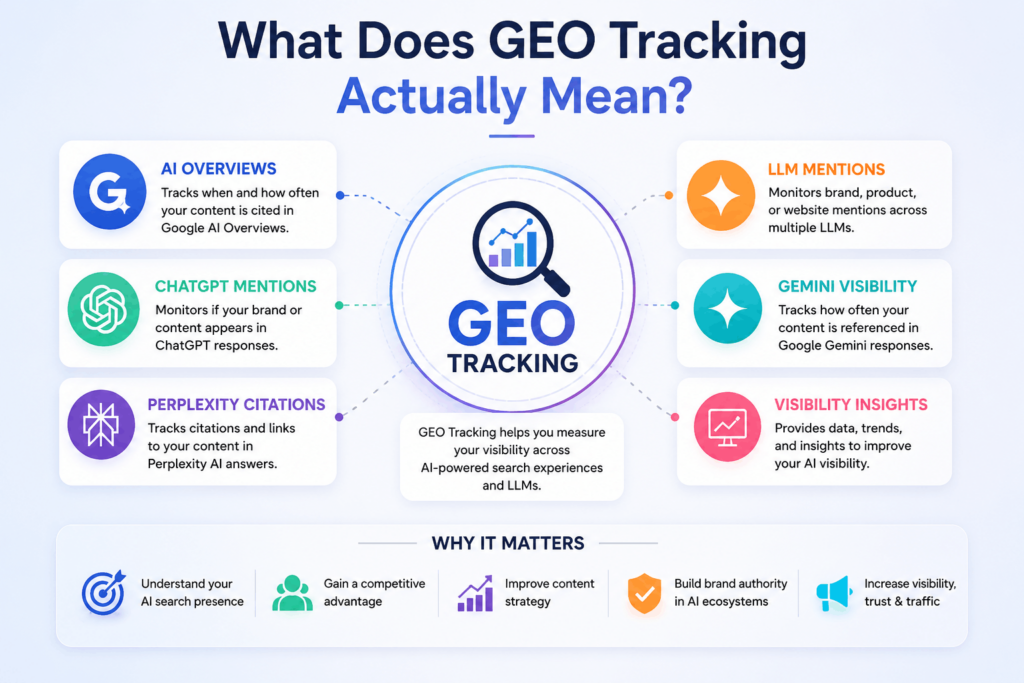
So, GEO tracking tools AI visibility is meant to track signals that conventional SEO software can’t quantify.
These tools typically measure several key metrics, including:
- AI Overview Appearances
One of the most valuable features is AI Overview tracking. These tools don’t look to see if your page ranks #1 on Google, they look to see if your content is included in Google’s AI-generated summaries.
If your website appears consistently in AI Overviews, it indicates that Google considers your content authoritative and trustworthy enough to support its AI-generated answers.
- ChatGPT Mentions
Although ChatGPT doesn’t provide a traditional search results page, businesses increasingly want to know whether their brand or content appears in ChatGPT-generated responses.
There are now several modern GEO measurement tools which simulate prompts and record the number of times your site is mentioned for specific topics.
- Perplexity Citations
Perplexity typically cites its sources, unlike many AI assistants.
That makes it easier to track:
- Which pages are being referenced
- Which competitors receive more citations
- Which topics generate the highest AI visibility
Monitoring Perplexity citations helps marketers better measure AI search visibility while identifying opportunities to improve content authority.
- LLM Brand Mentions
Another emerging metric is LLM mention tracking tools 2026 support.
Instead of monitoring only backlinks, these platforms track whether your
- Brand
- Products
- Authors
- Website
are cited in several large language models.
As AI continues to influence purchasing decisions, these mentions are becoming increasingly valuable indicators of online authority.
What to Look for in GEO Tracking Tools?
Not all GEO platforms are created equal. Some are for enterprise reporting; others are for bloggers and small businesses looking for affordable insights.
Consider these points before you decide on the solution.
1. AI Platforms Covered
The first thing I look at is platform coverage.
A good GEO tracking tools AI visibility solution should monitor a variety of AI search platforms, not just one.
Ideally, it should provide visibility into:
- Google AI Overviews
- ChatGPT
- Perplexity
- Claude
- Gemini
- Microsoft Copilot (where supported)
The broader the platform coverage, the better you can measure AI search visibility across today’s AI ecosystem.
2. AI Overview Tracking Accuracy
Reliable AI Overview tracking should be a priority, as Google AI Overviews are becoming one of the main sources of information discovery.
Look for tools that can identify:
- Keywords triggering AI overviews
- Whether your website appears
- Which competitors are cited
- Citation frequency over time
This data allows you to see if your GEO strategy is truly increasing your visibility.
3. LLM Mention Tracking
Modern LLM mention tracking tools 2026 should go further than keyword rankings.
Instead, they should keep track of
- Brand mentions
- Product mentions
- Website citations
- Author references
- Competitor mentions
This gives a much better idea of how AI models see your authority in your industry.
4. Reporting and Historical Trends
AI visibility changes quickly.
Choose GEO measurement tools that offer:
- Daily or weekly tracking
- Historical reports
- Visibility trends
- Competitor comparisons
- Share of AI voice
Historical data makes it easier to identify which content updates actually improve your AI presence.
5. Pricing and Scalability
Finally, think about your budget.
Some GEO platforms are built for enterprise companies with significant marketing budgets, while others are accessible for freelancers, bloggers, and small businesses.
Most of the time, if you’re running a small website, it’s not worth paying for enterprise software. I’ll compare the two in the sections below and tell you which tools provide the best value to different types of users.
Tool 1: Semrush AI Overview Tracking
When most marketers think of Semrush, they think of keyword research, backlink analysis and rank tracking. However, in 2026, Semrush has evolved beyond traditional SEO by introducing features that help marketers monitor their presence in Google’s AI-powered search experiences.
Semrush is not a dedicated GEO platform, but it has become one of the most practical GEO tracking tools AI visibility solutions for businesses already using its SEO suite. Its AI reporting allows marketers to start measuring AI search visibility without buying an entirely separate enterprise platform.
If you’re already using Semrush for SEO, the AI Overview reports are a natural extension of your existing workflow.
Key Features
- AI Overview Tracking
The AI Overview tracking feature of Semrush is one of its strongest features.
Instead of simply telling you where a keyword ranks, it identifies keywords that trigger Google AI Overviews and shows whether your website appears as one of the cited sources.
And here’s a little help to understand:
- Which keywords generate AI overviews
- Whether your website is cited
- Which competitors appear alongside you
- How your AI visibility changes over time
For a business that is focused on Generative Engine Optimization (GEO), this data is invaluable as it highlights opportunities where your content is already trusted by Google’s AI.
- Traditional SEO + GEO in One Dashboard
Semrush is different from niche GEO tools, mixing classic SEO metrics with AI visibility data.
You can analyze :
- Organic rankings
- Keyword performance
- Backlinks
- Technical SEO
- Site health
- AI Overview appearances
It makes reporting a lot easier for SEO professionals and agencies to have everything on one dashboard.
- Competitor AI Analysis
Another feature I like is monitoring of competitors.
Semrush helps you to find:
- Which competitors appear most frequently in AI overviews?
- Which pages receive AI citations
- Which keywords they’re dominating
This information can help discover content gaps that may not be evident through traditional keyword rankings alone.
- Keyword Opportunity Discovery
Semrush also allows you to prioritize your content updates easily.
Rather than trying to rank for every keyword, you can find queries where AI overviews are already showing up and optimize your content to improve your chances of being cited.
This is particularly useful if you’re trying to measure AI search visibility while growing your authority within a specific niche.
Pros
- Excellent AI overview tracking capabilities
- Combines traditional SEO with AI visibility monitoring
- Easy-to-use interface
- Strong competitor analysis
- Great keyword research and technical SEO tools
- Suitable for agencies and in-house marketing teams
Cons
- Doesn’t yet provide extensive ChatGPT monitoring
- Limited support for cross-platform AI tracking
- Premium plans can be expensive for beginners
Pricing
Depending on your needs, Semrush provides multiple subscription plans.
For bloggers and freelancers, the entry-level plan might be sufficient to start tracking GEO-tracking tools AI visibility alongside traditional SEO metrics.
Bigger companies and agencies will benefit more from higher-tier plans that provide additional reporting and competitive analysis.
Best For
Semrush is best suited for:
- SEO professionals
- Digital marketing agencies
- In-house marketing teams
- Businesses already using the Semrush ecosystem
My Verdict on Semrush
If your primary goal is AI overview tracking, Semrush is one of the strongest options currently available.
It won’t replace dedicated GEO measurement tools that monitor multiple AI assistants, but it offers an excellent starting point for businesses looking to combine traditional SEO with AI search optimization.
For most websites, Semrush provides enough insights to start improving and measure AI search visibility without entirely changing existing SEO workflows.
Tool 2: BrightEdge AI Presence Monitoring
If Semrush is a great all-around SEO platform, BrightEdge is built for organizations that need enterprise-level AI search intelligence.
BrightEdge has invested heavily in Generative Engine Optimization, making it one of the most advanced GEO tracking tools AI visibility platforms available in 2026.
Instead of rankings alone, BrightEdge helps businesses understand how their content performs across Google’s AI-powered search experiences and provides detailed competitive intelligence.
This sort of reporting can be very valuable for larger brands with thousands of pages.
Key Features
- Enterprise AI Presence Monitoring
BrightEdge continuously tracks the frequency with which your brand appears in AI-powered search experiences.
Instead of simply tracking rankings, it measures:
- AI citations
- Brand visibility
- Competitor visibility
- Content performance
- Search intent coverage
It is simpler to measure AI search visibility across large content libraries thanks to this broader perspective.
- Advanced AI Overview Tracking
AI overview tracking is robust with BrightEdge.
Marketers use its reporting to understand:
- Which pages appear inside AI Overviews
- Which competitors are referenced
- How frequently AI overviews are triggered
- Which industries experience the highest AI visibility
Enterprise SEO teams can use this data to inform content strategies and prioritization.
- Large-Scale Reporting
Scalability is one of BrightEdge’s biggest advantages.
The platform offers:
- Executive dashboards
- Team reporting
- Historical AI visibility trends
- Competitive benchmarking
- Automated reporting
These features make it ideal for organizations managing multiple websites or international SEO campaigns.
- Content Optimization Recommendations
BrightEdge not only tells you where you stand but also gives you actionable recommendations.
The platform identifies opportunities to improve content quality, topical authority, and semantic relevance, helping increase the likelihood of being referenced by AI search engines.
These insights can help businesses investing heavily in GEO to achieve long-term visibility growth.
Pros
- Excellent enterprise reporting
- Advanced AI overview tracking
- Strong competitive intelligence
- Comprehensive historical reporting
- Scalable for large organizations
- Powerful content optimization insights
Cons
- Expensive for freelancers and small businesses
- Steeper learning curve
- More features than many smaller websites actually need
Pricing
BrightEdge doesn’t publish standard pricing.
Otherwise, businesses are generally quoted custom enterprise pricing based on their needs, website size, and reporting needs.
That’s why it’s not the most practical choice for the independent blogger or the smaller company in general.
Best For
BrightEdge is best suited for:
- Enterprise organizations
- Large e-commerce brands
- International SEO teams
- Fortune 500 companies
- Agencies managing enterprise clients
My Verdict on BrightEdge
BrightEdge is one of the most comprehensive GEO tracking tools AI visibility platforms for enterprise.
With its advanced reporting, competitor intelligence and AI Overview tracking capabilities, it’s a great investment for organizations that depend on large-scale SEO operations.
But if you’re a solo blogger, freelancer, or small business, the platform is probably more powerful (and more expensive) than you really need. In those cases, a simpler GEO measurement tools solution might deliver more value and still allow you to measure AI search visibility effectively.
Tool 3: Otterly.ai – Built Specifically for GEO Tracking
Otterly.ai was built with Generative Engine Optimization (GEO) as a core concept, unlike legacy SEO platforms that recently tacked on AI visibility capabilities. The platform is not about treating AI search as an extension of SEO, but rather about helping businesses monitor their appearance in AI-powered search engines and large language models.
Otterly.ai deserves serious consideration if your main goal is to increase AI visibility for GEO tracking tools. It allows marketers to measure AI search visibility across multiple AI platforms without the complexity or cost of enterprise SEO suites.
For bloggers, startups, and small marketing teams, this focused approach makes the platform much easier to adopt.
Key Features
- Cross-Platform AI Visibility Monitoring
One of Otterly.ai’s biggest strengths is that it doesn’t confine tracking to a single AI search experience.
Instead, it tracks your visibility across a range of AI-powered platforms, showing you where your content is being surfaced and recommended.
Visibility can be tracked for: Based on the integrations and updates supported
- Google AI Overviews
- ChatGPT
- Perplexity
- Gemini
- Other emerging AI search experiences
Instead of relying solely on traditional search rankings, this broader coverage makes it easier to measure AI search visibility.
- AI Prompt Monitoring
With Otterly.ai you can track the AI prompts users are actually asking for, not just keywords.
For example, instead of just checking your ranking for:
“Best SEO tools” you can monitor things such as:
- What are the best SEO tools for beginners?
- Which SEO platform should small businesses use?
- How can I improve AI search visibility?
This approach provides a much more realistic picture of how people interact with AI assistants.
- LLM Mention Tracking
One feature that is notable is its support for LLM mention tracking tools 2026.
Otterly.ai does much more than track backlinks to see whether your
- Brand
- Website
- Products
- Authors
are mentioned inside AI-generated responses.
As AI assistants increasingly shape buying decisions, these brand mentions become valuable indicators of online authority.
If you’re investing in GEO, monitoring these mentions is one of the best ways to measure AI search visibility beyond traditional SEO metrics.
- Simple Dashboard
Unlike enterprise software that often requires extensive onboarding, Otterly.ai keeps reporting straightforward.
Its dashboard typically focuses on:
- AI visibility trends
- Brand mentions
- Citation frequency
- Prompt performance
- Competitor comparisons
For smaller teams, this simplicity is a major advantage.
Pros
- Purpose-built for Generative Engine Optimization
- Excellent support for LLM mention tracking tools 2026
- Monitors multiple AI platforms
- Beginner-friendly interface
- More affordable than enterprise solutions
- Great for bloggers, startups, and agencies
Cons
- Doesn’t include full technical SEO capabilities
- Smaller feature set compared to enterprise platforms
- Traditional keyword research is limited
Pricing
Otterly.ai generally offers pricing that is significantly more accessible than enterprise SEO platforms.
This makes it an attractive option for:
- Bloggers
- Freelancers
- Small businesses
- Content creators
- Marketing consultants
If your main goal is to improve GEO Tracking Tools AI visibility, the pricing is often easier to justify than a full enterprise SEO suite.
Best For
Otterly.ai is best suited for:
- Bloggers
- Content marketers
- Startup companies
- Small SEO agencies
- Businesses beginning their GEO journey
My Verdict on Otterly.ai
If your focus is specifically on GEO tracking tools AI visibility, Otterly.ai is one of the strongest dedicated solutions available today.
Unlike traditional SEO software that treats AI search as an additional feature, Otterly.ai was built around helping businesses measure AI search visibility and monitor how AI assistants reference their content.
It offers a good combination of functionality, usability and price for most small and medium-sized businesses.
Comparison Table: Which GEO Tracking Tool Is Right for You?
| Feature | Semrush | BrightEdge | Otterly.ai |
| Best For | SEO professionals & agencies | Enterprise organizations | Bloggers & SMBs |
| AI Overview Tracking | Excellent | Excellent | Good |
| ChatGPT Monitoring | Limited | Moderate | Strong |
| Perplexity Monitoring | Limited | Moderate | Strong |
| LLM Mention Tracking | Basic | Advanced | Excellent |
| Traditional SEO Features | Complete Suite | Enterprise Suite | Limited |
| Competitor Analysis | Excellent | Excellent | Good |
| Reporting | Excellent | Enterprise-level | Simple & Clean |
| Ease of Use | Easy | Moderate | Very Easy |
| Pricing | $$$ | $$$$ | $$ |
| Ideal Business Size | Small to Large | Enterprise | Small to Medium |
Which GEO Tracking Tool Should You Choose?
Depending on your goals, budget, and size of business, you may opt for one platform or the other. All three tools can help improve GEO tracking tools AI visibility, and they are targeted to different audiences.
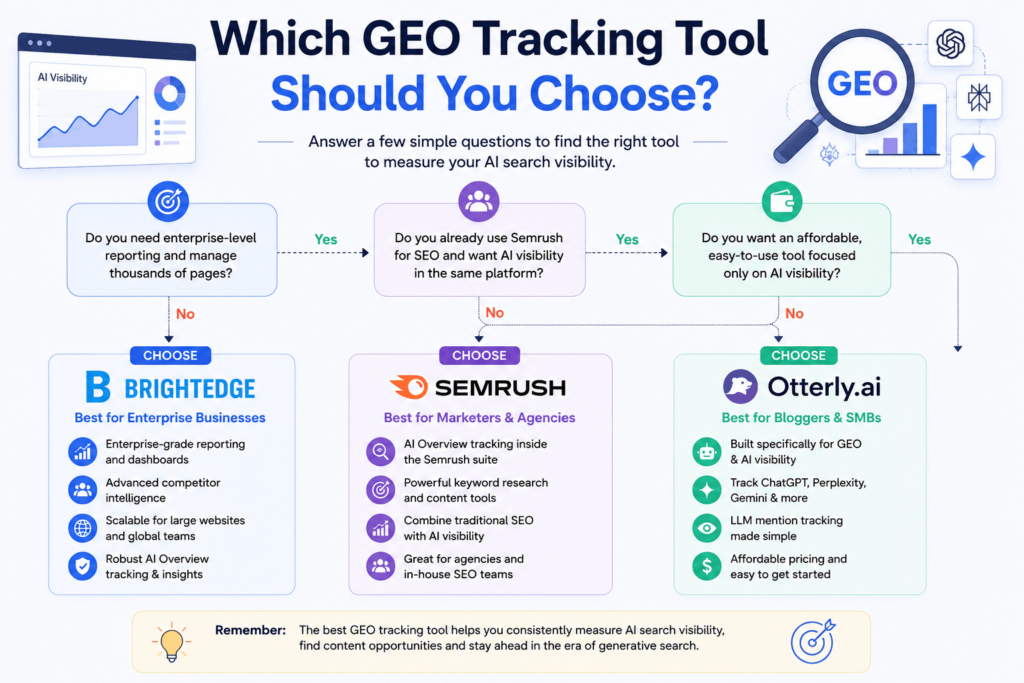
- Choose Semrush if…
- You already use Semrush for SEO.
- You want traditional SEO and AI visibility in one platform.
- Your main focus is AI overview tracking.
- You need strong keyword research alongside GEO insights.
Semrush has the best balance between traditional SEO and the ability to measure AI search visibility without having to learn a whole new platform.
- Choose BrightEdge if…
- You manage an enterprise website.
- Your company publishes thousands of pages.
- Executive reporting is essential.
- You require large-scale competitive intelligence.
BrightEdge is one of the more sophisticated GEO measurement tools out there. Pricing makes it best for enterprise organizations.
- Choose Otterly.ai if…
- You’re a blogger or content creator.
- You run a startup or small business.
- You want dedicated LLM mention tracking tools 2026 capabilities.
- Your primary objective is improving GEO tracking tools AI visibility.
Otterly.ai offers focused GEO functionality without the complexity of enterprise software, making it an excellent choice for businesses beginning to measure AI search visibility across AI-powered search platforms.
My Overall Recommendation
Here’s what I would recommend if I had to recommend one tool for each type of user:
- Best Overall: Semrush
- Best Enterprise Solution: BrightEdge
- Best Value for Bloggers & Small Businesses: Otterly.ai
Each platform has its strengths, but the correct choice depends on how you plan to measure AI search visibility and whether you need a complete SEO suite or a dedicated GEO solution.
Final Verdict
Which right GEO tracking tools AI visibility platform you need will depend on your business goals, budget, and how much you want to analyze your performance in AI-powered search.
If you’re already in SEO and want AI visibility data along with keyword rankings, Semrush is the most balanced option. Its AI Overview tracking features easily fit into an existing SEO workflow, and are great for marketers who don’t want to use multiple tools.
Large organizations needing enterprise reporting, advanced competitive intelligence and executive dashboards will find BrightEdge offers one of the most complete GEO measurement tools in the industry. It’s not for every business, but it does provide the level of reporting that enterprise teams expect.
Otterly.ai is the most pragmatic solution for bloggers, startups, freelancers, and small businesses. It’s built for Generative Engine Optimization, so it provides targeted insights into LLM mention tracking tools 2026, AI citations, and brand visibility, without the complexity of a full enterprise SEO suite.
Ultimately, there is no one perfect tool for everyone. The best GEO tracking tools AI visibility solution is the one that helps you consistently measure AI search visibility, identify opportunities to improve your content and understand how AI search engines perceive your brand.
AI-powered search is changing and tomorrow the companies who are tracking and optimizing their AI presence will have a huge competitive advantage.
Conclusion:
Search is changing faster than it ever has. #1 on Google still matters, but it’s not the only way to win. More users are learning things through answers generated by AI from large language models like Google AI Overviews, ChatGPT, Perplexity, Gemini, and others. This means companies need to broaden how they measure their online footprint.
With the right GEO tracking tools AI visibility platform helps you go beyond traditional rankings and measure AI search visibility across the platforms where users are increasingly finding answers. Whether you’re monitoring AI Overview tracking, analyzing citations in Perplexity, or using LLM mention tracking tools 2026 to understand how often your brand appears in AI-generated responses, these insights help you make smarter content decisions.
You don’t need the most expensive platform if you’re just getting started. Pick the tools that suit your immediate needs, keep tabs on your AI visibility on a regular basis, and use the data you gather to improve your content strategy. Today, companies using GEO measurement tools will be better positioned to gain trust, visibility and traffic down the road as AI search becomes more powerful.
Remember, GEO isn’t about replacing SEO, it’s about building on it. By combining traditional optimization with AI visibility tracking, you’ll create content that performs well in both search engines and AI-powered search experiences.
Frequently Asked Questions
1. Can small blogs realistically track GEO visibility?
Yes. Enterprise platforms may offer advanced reporting, but smaller websites can also measure AI search visibility using affordable GEO tracking tools AI visibility platforms like Otterly.ai. These tools offer valuable insights into AI citations, brand mentions, and prompt visibility without an enterprise budget.
2. What is the difference between SEO rank tracking and GEO tracking?
Traditional SEO rank tracking will tell you where your pages rank in search engine results. GEO tracking tools AI visibility focuses on whether your content is cited or referenced in AI-generated responses such as Google AI Overviews, ChatGPT, Perplexity, and other AI search platforms.
3. Why is AI Overview tracking important?
AI Overview tracking shows you whether Google is using your content to inform their AI-generated summaries. Being featured in AI Overviews can boost your brand authority and visibility, even if users don’t click through to your site.
4. Which GEO tracking tool is best for beginners?
Otterly.ai is one of the simplest GEO measurement tools available for beginners and small businesses. If you already use Semrush for SEO, its AI visibility features are also an excellent starting point for learning how to measure AI search visibility.
5. Are GEO tracking tools replacing traditional SEO tools?
No, GEO tracking tools AI visibility does not replace traditional SEO, but complements it. Keywords, technical SEO, backlinks, and content optimization are still important. GEO tools add another layer of insight by helping you measure AI search visibility across AI-powered search platforms.