Publishing several articles on the same topic doesn’t necessarily improve your site’s visibility in search results. Occasionally this approach leads to unnecessary content duplication, because different pages target almost the same search queries. Keyword clustering SEO is helpful in these cases.
Keyword clustering allows you to group related search terms into meaningful groups rather than considering each keyword as an individual content opportunity. Then you can take each group and build a tight, thorough page that satisfies many related searches.
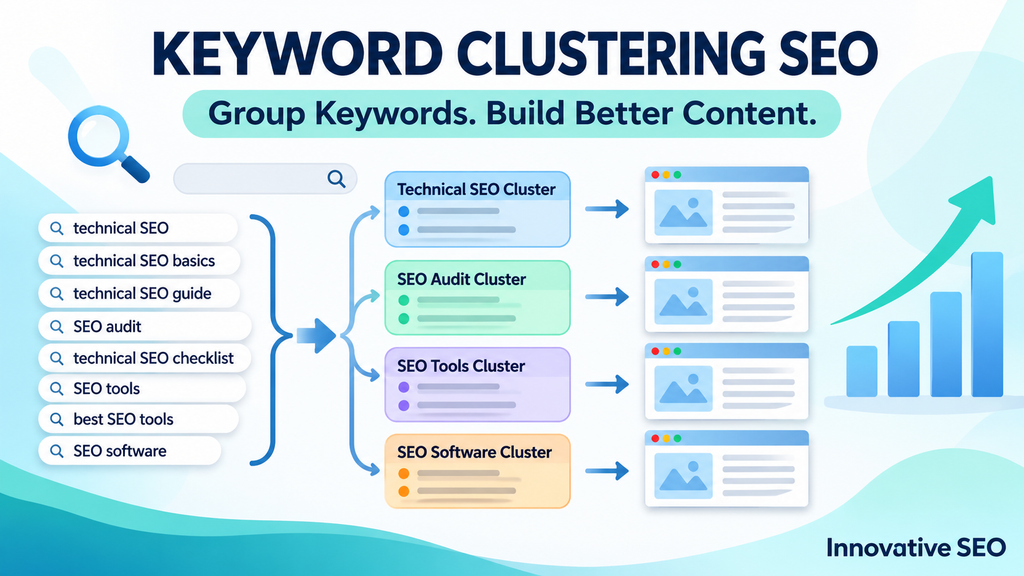
For example, rather than creating separate articles for every variation of a technical SEO question, you can identify keywords with the same search intent and cover them in one article.
In this guide we’ll cover how to group keywords, figure out search intent, pick the right pages for each cluster and create a more structured SEO content strategy.
What Is keyword clustering SEO?
Keyword clustering SEO is the grouping of related keywords by their meaning, relevance and search intent to target several closely related search queries with one well-optimised page.
You don’t write an article for every keyword but find terms that you can cover in the same content.
For example, here are some keywords:
| Keyword | Relationship |
| What is technical SEO? | Main informational topic |
| Technical SEO basics | Closely related query |
| Technical SEO guide | Supporting query |
| Technical SEO checklist | Related supporting query |
These keywords may naturally fit into one big technical SEO guide because the users searching for them are looking for closely related information.
The main goal is to develop relevant groups of keywords, choose one main keyword for each group and use other terms as supporting keywords.
However, not all keywords with similar wording belong in the same cluster. The ultimate decision should be based on search intent and the actual search results.
Why Is Keyword Clustering Important for SEO?
Organising keywords into relevant groups makes content planning more efficient and helps prevent unnecessary overlap between website pages.
Here are some important benefits.
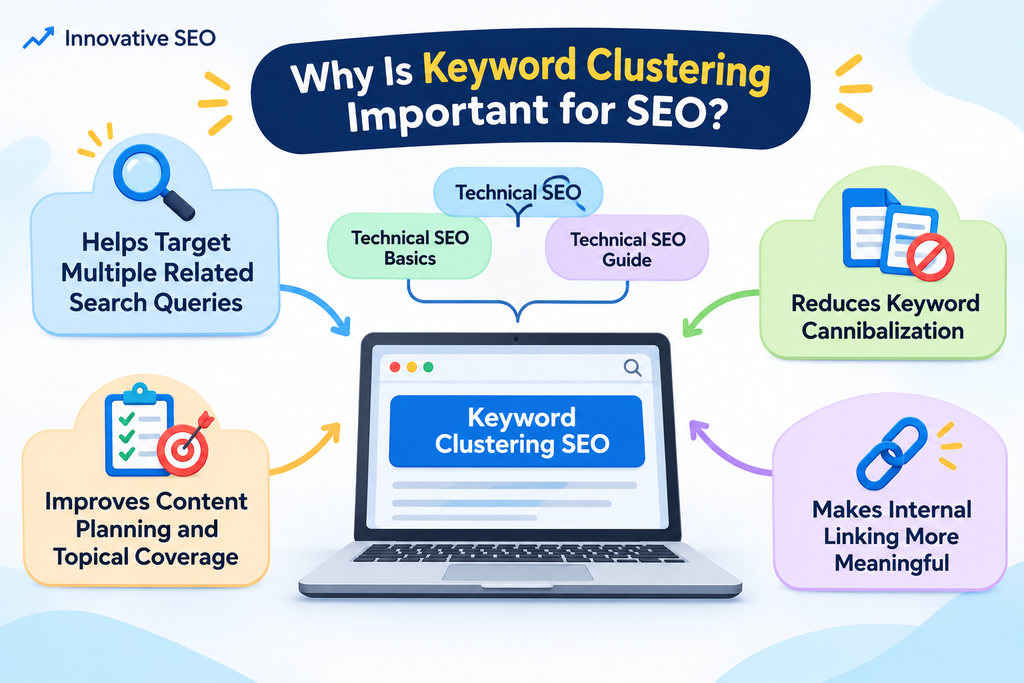
1. Helps Target Multiple Related Search Queries
A good article can address several related search queries, so you don’t need a separate page for each keyword variation.
For example, an article about the basics of technical SEO can naturally contain related questions, checklists and explanations for beginners.
This allows you to cover a subject comprehensively, keeping the content reader’s needs focused.
2. Reduces Keyword Cannibalisation
Keyword Cannibalisation is where you have several pages on your website optimised for similar keywords, competing for similar search intent.
If you have a page on the basics of technical SEO and a page on a beginner’s guide to technical SEO, you may have unnecessary overlap if both pages are answering the same questions.
Keyword clustering can help you find these opportunities before you create new content. Then you can decide to merge related topics or split pages based on actual search intent.
3. Improves Content Planning and Topical Coverage
The groups of keywords also help decide which topics should have their own articles and which should be covered in existing articles.
You can group related clusters into bigger topic areas, and you can find information gaps on your website.
This gives a more structured content plan rather than posting random articles based on the whims of individual keyword opportunities.
4. Makes Internal Linking More Meaningful
If you cluster related pages together around certain keyword groups, you can link them together with the right internal links.
For instance, a technical SEO guide could link to separate articles about website crawling, indexing, and site speed.
A good internal linking strategy for SEO can help readers find related information and can make your website easier to navigate.
How to Group Keywords for SEO: A Step-by-Step Process
Understanding the concept is just the start. The real value lies in knowing how to organise keywords and turn them into useful content opportunities.
Here’s a practical process for how to group keywords for SEO.
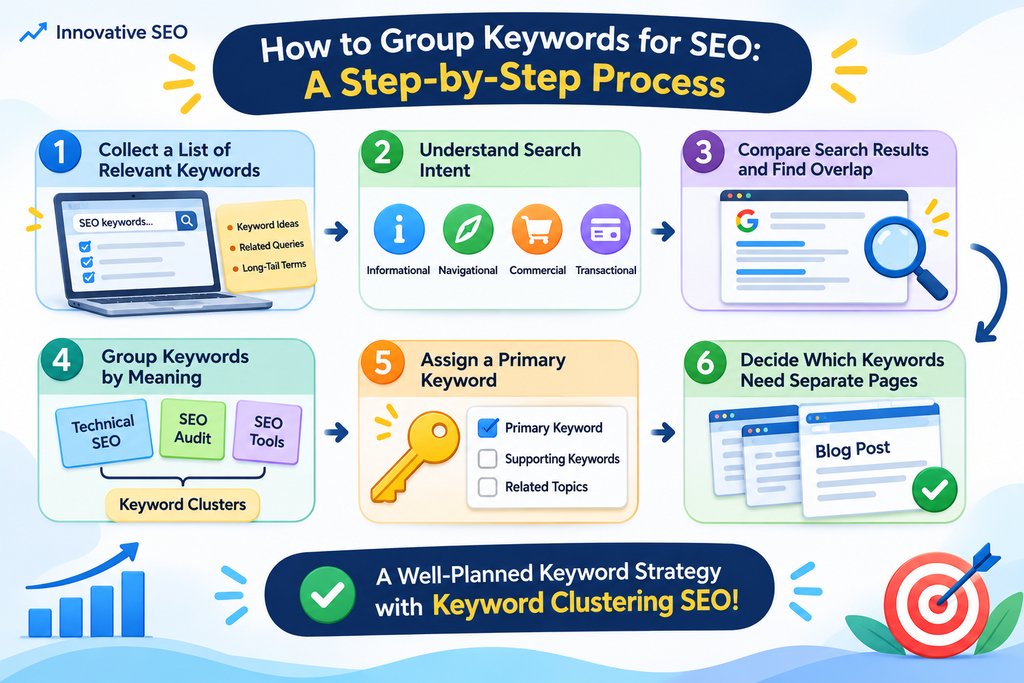
Step 1: Collect a List of Relevant Keywords
Create a list of keywords that relate to the primary topic you’ll be covering first.
Don’t pick a few keywords. Gather various search variations, related questions and long-tail queries to get the full spectrum of searches around the topic.
Here are some sources for keyword discovery:
- Google Keyword Planner: Discover keyword ideas and review available search volume and competition data.
- Google Search Console: Identify queries that already generate impressions and clicks for your website.
- Semrush: Find related keywords, competitor rankings and additional keyword opportunities.
- Google Auto-complete: Discover search suggestions based on common query patterns.
- People Also Ask: Find questions that can help identify supporting topics and content gaps.
You can also perform competitor keyword research to identify relevant keywords that competitor websites are currently targeting.
The idea now is to collect related keywords, not to determine which keywords go together just yet.
Step 2: Understand Search Intent Behind Each Keyword
When you have your list of keywords, look at what the user is actually looking for when they search for each word.
Search intent is generally broken down into 4 flavours:
| Search intent | What the user wants | Example |
| Informational | Learn something or find an answer. | What is keyword research? |
| Navigational | Find a particular website or page. | Semrush login |
| Commercial | Compare products or services. | Best keyword research tools |
| Transactional | Complete an action or purchase. | Buy SEO software. |
Why does this matter?
Consider these two keywords:
- What is keyword research?
- Best keyword research tools
Although both are related to keyword research, they have different search intents.
The first searcher wants to know why, and the second searcher wants to compare the tools available.
If all are put on one page without considering their different requirements, the content could be less focused.
Effective keyword grouping by search intent helps you determine which queries you can answer collectively and which warrant separate pages.
Step 3: Compare Search Results and Identify Keyword Overlap
A very useful way to validate keyword groups is to look at the search engine results pages (SERPs).
Search for each keyword separately and examine the pages that appear in the top search results.
Search for:
- Similar URLs that rank for multiple keywords.
- Pages covering the same subject from a similar perspective.
- Similar content formats, such as guides, tutorials or comparison articles.
- Common questions and subtopics addressed by ranking pages.
If multiple pages rank for “technical SEO basics” and “technical SEO guide,” the overlap may be significant enough to warrant creating a single, thorough article that targets both keywords.
However, if the results are very different, it might be better to create separate pages.
There’s no universal SERP-overlap percentage that tells us if two keywords belong together. Make the decision using the similarity of ranking pages overall and search intent.
Step 4: Group Keywords by Meaning and Relevance
Check search intent and SERP overlap, then group your keywords into meaningful groups.
For example, let’s say you’ve collected 12 keywords on technical SEO.
You could lay them out like this:
| Keyword cluster | Keywords included |
| Technical SEO basics | What is technical SEO, technical SEO basics, and a technical SEO guide? |
| Technical SEO audit | Technical SEO audit, technical SEO audit checklist, technical SEO audit steps |
| Technical SEO tools | Best technical SEO tools, technical SEO auditing tools, technical SEO software |
Each group is a unique content opportunity.”
Note that the keywords are not grouped simply because they contain the term “technical SEO”. They are organised by subject, and the information users are looking for.
This is the foundation of effective clustering.
Step 5: Assign a Primary Keyword to Each Cluster
Once your groups are ready, select one primary keyword for every cluster.
The primary keyword should accurately represent the main subject of the page.
Consider the following factors:
- Relevance: Does the keyword accurately describe the page?
- Search intent: Does it match what the target audience wants?
- Search demand: Is there meaningful search interest?
- Competition: Can your website realistically compete for the query?
- Business relevance: Does the topic support your website’s overall objectives?
The remaining keywords become supporting terms.
For example:
| Keyword cluster | Primary keyword | Supporting keywords |
| Cluster 1 | Technical SEO | Technical SEO basics, technical SEO guide |
| Cluster 2 | Technical SEO audit | Technical SEO audit checklist, technical SEO audit steps |
| Cluster 3 | Technical SEO tools | Best technical SEO tools, technical SEO software |
Use supporting keywords naturally in relevant headings, paragraphs and examples. Do not force every keyword into the article if it does not fit the explanation.
Step 6: Decide Which Keywords Need Separate Pages
This is an important step because stuffing too many keywords into one article can be just as damaging as creating too many individual pages.
Ask yourself before you assign keywords to a page:
- Do these keywords have similar search intent?
- Are the ranking pages substantially similar?
- Can one article answer all these queries properly?
- Would combining them make the content confusing or unnecessarily broad?
For example:
Keywords that may fit one page:
- What is technical SEO?
- Technical SEO basics
- Technical SEO guide
Keywords that may need separate pages:
- Technical SEO audit checklist
- Best technical SEO tools
- What is technical SEO?
The second group has different content requirements. Each of a checklist, a software comparison, and an introductory explanation might each need its own page.
Remember, the goal is not to stuff as many keywords as you can into one article. It is to build the most relevant page for each meaningful search topic.
What Are the Best keyword clustering tools?
A small list of keywords can be sorted by hand. But for sites that want to rank for hundreds or thousands of keywords, a good SEO tool can be helpful.
Some good options are:
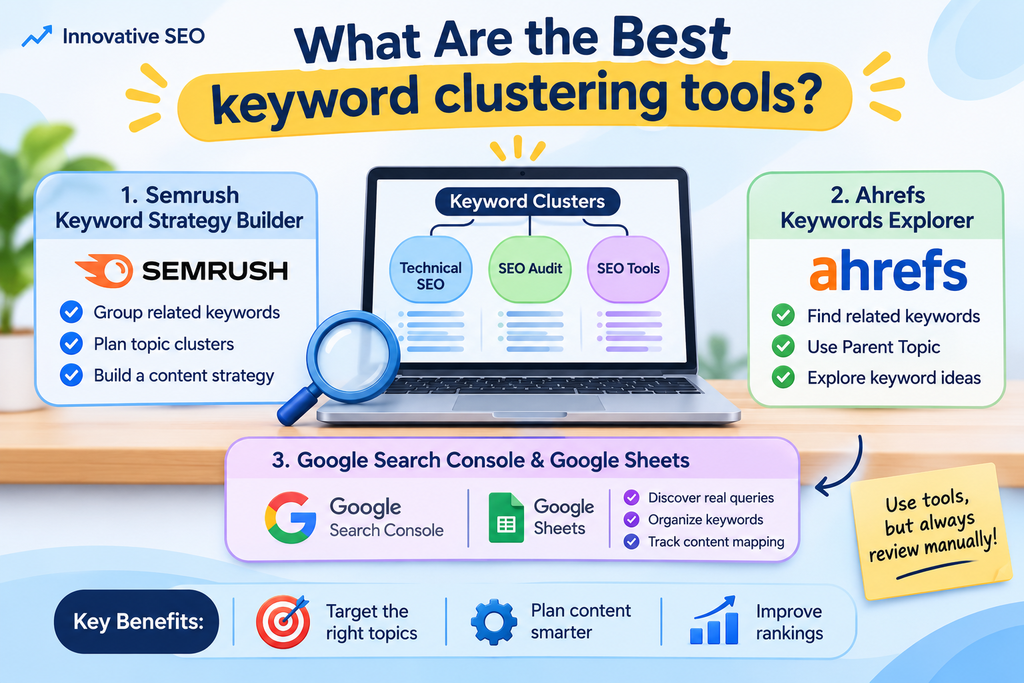
1. Semrush Keyword Strategy Builder
Marketers use Semrush to research keywords and organize content opportunities.”
Its Keyword Strategy Builder clusters keyword ideas into topics to help you plan your content.
This is very handy if you have long lists of keywords.
2. Ahrefs Keywords Explorer
Ahrefs has keyword research tools that can help you find related search terms and assess their ranking potential.
The Parent Topic feature can help you discover a broader search topic that might be covered by the same page as a specific keyword.
This is useful when deciding whether to target several variants of a keyword together.
3. Google Search Console and Google Sheets
You don’t always need a paid subscription to start organizing your keywords.
Google Search Console helps you discover queries that your existing pages get impressions and clicks for.
This data can be exported to Google Sheets, and keywords can be sorted by:
- Main topic.
- Search intent.
- Primary keyword.
- Supporting keywords.
- Target URL.
Google Sheets is especially useful for maintaining a simple keyword database and tracking content assignments.
My recommendation: Use SEO tools to speed up keyword discovery and grouping, but always review the final clusters manually. Automated suggestions cannot replace your understanding of search intent and content relevance.
Keyword mapping for SEO: Turning Clusters into a Content Plan
After you have your keyword clusters, you need to decide which page on your website to target each cluster.
This is called keyword mapping for SEO.
Assigning a primary keyword and its related terms to a specific URL. So every page has a clear search objective.
Here’s a simple example:
| Target page | Primary keyword | Supporting keywords |
| Blog 1 | Technical SEO | Technical SEO basics, technical SEO guide |
| Blog 2 | Technical SEO audit | Technical SEO audit checklist, audit steps |
| Blog 3 | Technical SEO tools | Best technical SEO tools, SEO auditing tools |
Once the mapping is complete, follow these practices:
- Assign one main keyword to each page.
- Include relevant supporting keywords naturally throughout the content.
- Optimise headings around the questions and subtopics users are searching for.
- Connect related articles through contextual internal links.
- Review existing URLs before creating new content.
How to Maintain Your Keyword Map
Keyword mapping should not be treated as a one-time activity.
As your website grows, new keywords, search trends and content opportunities will emerge.
Review your keyword map periodically to identify:
- New search queries that belong to existing clusters.
- Pages targeting overlapping keyword groups.
- Content that needs updating or consolidation.
- New topics that deserve dedicated articles.
- Changes in search intent or ranking URLs.
Keeping this information organised makes planning future content easier.
keyword clustering SEO Checklist Before Publishing
Before publishing a new article, check the following:
- Does the page have one clearly defined primary keyword?
- Do the supporting keywords match the same search intent?
- Have you checked the SERPs for keyword overlap?
- Have you reviewed existing website URLs?
- Is the content sufficiently comprehensive for the target topic?
- Are relevant pages connected through internal links?
- Does the article provide a useful answer to the search query?
Completing these checks can help you avoid unnecessary content duplication and maintain a more organised SEO strategy.
Common Keyword Clustering Mistakes to Avoid
Even with the right tools and process, certain mistakes can reduce the effectiveness of keyword clustering.
Here are some common issues to be aware of:
- Grouping keywords only because they contain similar words: Two queries can use the same terms but have entirely different search intent. Always examine what users expect to find.
- Ignoring search intent: Combining informational, commercial and transactional queries without considering their differences can result in unfocused content.
- Creating clusters without checking SERPs: Similar-looking keywords may require separate pages if their search results differ significantly.
- Creating too many small clusters: Splitting every keyword into a separate group can lead to unnecessary articles and overlapping content.
- Targeting the same cluster across multiple URLs: Assigning similar keyword groups to different pages without a clear content distinction can create cannibalization issues.
- Depending entirely on automated tools: Tools can suggest keyword relationships, but manual evaluation is essential to confirm whether the groups make sense.
Avoiding these mistakes will help you build keyword clusters that support a clear and useful content strategy.
Conclusion: Build a Smarter Content Strategy with keyword clustering SEO
SEO success isn’t about writing a different article for every keyword you find. Simply put, you need to understand how different search queries relate to each other and create the right content for them.
Keyword clustering SEO lets you group related keywords, understand search intent, assign the right terms to the right pages, and cut down on unnecessary content overlap.
Take your current list of keywords and group related searches together and associate the cluster with a relevant URL.
If you take a more structured approach to keyword targeting, it can make content planning easier and help you build a site that gives your audience meaningful answers.
Frequently Asked Questions About keyword clustering SEO
1. What is keyword clustering in SEO?
Keyword clustering in SEO is the process of grouping related search terms based on their meaning and search intent. It helps website owners target multiple relevant queries through appropriately structured pages instead of creating separate content for every keyword variation.
2. How many keywords should be included in one cluster?
There is no fixed number of keywords for every cluster. A group might contain a few closely related terms or several dozen variations. The important factors are search intent, topical relevance and SERP overlap, not the total number of keywords.
3. What is the difference between keyword clustering and topic clustering?
Keyword clustering groups related search queries that a single page can target. Topic clustering organizes multiple related pages around a broader subject, usually connecting them through a central pillar page and supporting articles.
4. Can keyword clustering help prevent keyword cannibalization?
Yes. Keyword clustering helps you identify similar search queries that one page may better address. When combined with keyword mapping and regular content audits, it can help identify overlapping pages and reduce unnecessary competition between URLs.
5. Can I do keyword clustering without paid SEO tools?
Yes. You can use Google Search Console, Google Autocomplete, Google search results and Google Sheets to collect, compare and organize keywords manually. Paid tools can make the process faster, especially when managing large keyword lists, but they are not essential for getting started.