I wouldn’t start by adding more keywords or writing more articles if I had to create one E-E-A-T checklist for content authority on my website. So I’d start with a simpler question: Why should a reader or search engine or AI system trust this content? E-E-A-T (Experience, Expertise, Authoritativeness, and Trustworthiness) helps me because it gives me a framework for answering that question.
E-E-A-T isn’t just one Google ranking factor with one score I can see in Search Console. Instead, it is a set of qualities that Google wants its systems and its human quality raters to consider when evaluating content quality.
That distinction is important.
Even if a page is technically SEO optimized, it can still look weak if people don’t know who wrote it, why that person is qualified to discuss the topic, whether the info is based on real experience, or where key claims came from.
E-E-A-T became much more useful for me when I stopped thinking of it as a theoretical SEO thing and started thinking of it as a content authority checklist.
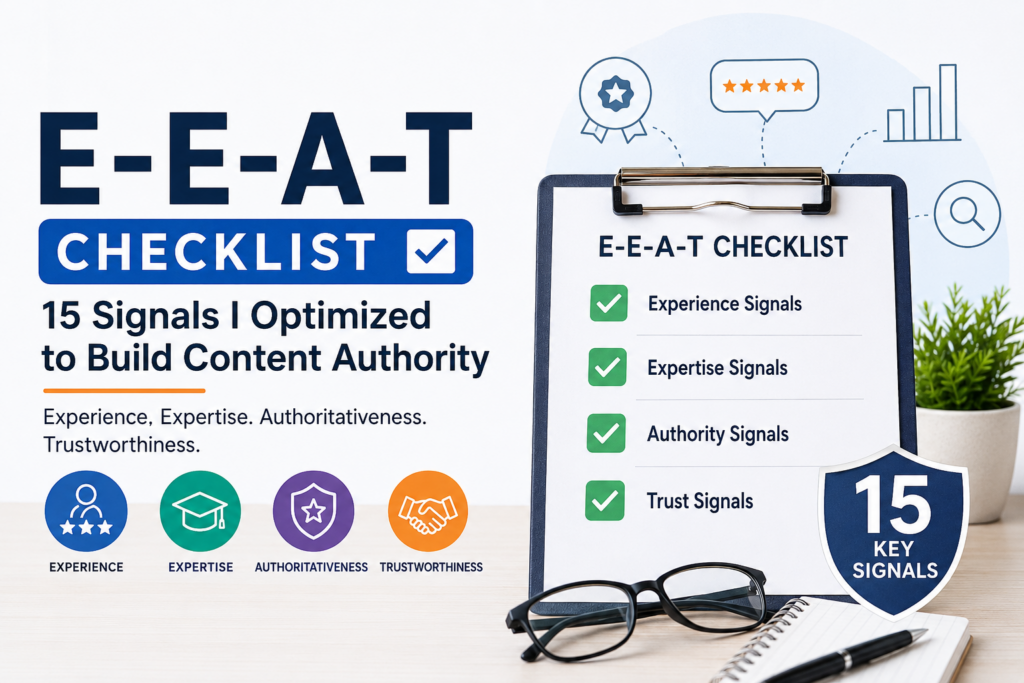
These are the 15 signals I examined.
What Does E-E-A-T Mean?
E-E-A-T stands for:
- Experience: Does the creator demonstrate first-hand experience with the subject?
- Expertise: Does the creator demonstrate relevant knowledge or skill?
- Authoritativeness: Is the creator or website recognized as a reliable source on the topic?
- Trustworthiness: Is the content, website, and organization transparent and reliable?
Trust is important, because Google says it’s the most important part of E-E-A-T.
The four concepts also intersect. A detailed case study, for example, can demonstrate both experience and expertise. A strong authorship profile can help support expertise and trust. Relevant backlinks can boost authority, independent brand mentions can boost brand recognition.
And so I don’t think of these as four different containers.
I see them as alternate ways of showing that my content is worthy of attention and trust.
Why E-E-A-T Matters More in AI Search
Traditional search is no longer the sole way people discover information.
Users are increasingly asking questions in AI-powered search experiences, AI Overviews, AI assistants and conversational search tools. The systems must be able to find useful and credible sources for the answers they generate.
That makes content authority all the more important.
That said, I would hesitate to say E-E-A-T is a direct ranking or AI citation factor. There is no simple “E-E-A-T score” that will ensure an AI citation.
Instead, the practical goal is to make content clear, credible, original, attributable and trustworthy so that search systems have better reasons to understand and surface it.
That’s why my E-E-A-T optimization in 2026 is less about checking boxes for Google and more about building evidence around the content.
Group 1: Experience Signals
Experience shows that the person producing the content has actually used, tested, studied, worked with, or interacted with the subject.
These are the 4 experience signals that I focus on.
1. Write First-Person Content When It Adds Value
One of the easiest changes I made was to allow myself to write from real life.
Don’t write:
SEOers should be looking at organic traffic.
“I can tell you what I actually monitored, what changed, what I learned, what I would do differently.
Writing in the first person isn’t automatically better. I don’t add ‘I’ to an article to try to make it sound personal.
I use it when I’ve got something real to add.
Regarding SEO audits, content updates, keyword research, or Search Console analysis, it’s often more helpful to talk about my actual workflow than to repeat generic advice.
My checklist:
- Include first-person observations where genuinely relevant.
- Explain what I actually did rather than only recommending what others should do.
- Avoid manufacturing personal experiences.
2. Add Original Observations
Experience counts for more when it yields observations that can’t be replicated by just copying the top-ranking pages.
When I do my own SEO work, I can detect trends with impressions, rankings, indexing, content performance, internal links, or AI search visibility.
Those observations are original content.
I can explain what happened when I changed something and what I learned from the result, rather than just explaining what a metric means.
That’s a lot harder to reproduce.
3. Publish Case Studies
Case studies transform theory into evidence.
When I have enough data, I can prove:
- The original situation
- What I changed
- Why I changed it
- What happened afterward
- What I learned
- What I would do differently next time
I can take the time to explain the methodology of even a small SEO experiment and make it useful.
I don’t need impressive numbers to have a case study. In a transparent experiment, a small success story may be more believable than an exaggerated success story.
4. Use Personal Examples
Abstract SEO concepts are easier to grasp with personal examples.
I can talk about content pruning, competitor analysis, keyword research, GSC analysis, or AI search optimization with examples from my workflow.
Accuracy is the key part.
I would much rather say “This is what I tested on my site” than a personal example that never happened.
Group 2: Expertise Signals
Experience tells us that someone has been through a topic. They know it, expertise shows that.
These are the four signals of expertise I worked on.
5. Strengthen Author Credentials
The reader should understand who wrote the article and why that person is qualified to speak on the subject.
My author information should reflect relevant experience without turning the bio into a résumé.
In SEO content you can include experience areas like:
- SEO strategy
- Content optimization
- Search Console analysis
- Keyword research
- Technical SEO
- AI search optimization
- Digital marketing
The key is relevance.
“A long list of unconnected credentials does not make you an expert.”
6. Use Clear Author Bylines
Content is associated with a real creator and a clear byline.
I want the reader to know:
Who wrote this?
Then I want them to be able to answer:
Why should I trust this person’s perspective?
That’s why the author bio and the byline should go hand-in-hand.
You can read more about my experience, focus areas, and background in my detailed author bio. This also ties in nicely with my separate author bio E-E-A-T content within the Content Authority cluster.
7. Increase Depth of Coverage
Expertise isn’t about making each article longer.
It means covering the important parts of the subject accurately and usefully.
For an SEO article, that could mean explaining:
- What the concept means
- Why it matters
- How it works
- How to implement it
- Common mistakes
- Examples
- Limitations
- Practical recommendations
I also look for questions that people will probably have after each section.
If five questions are unanswered in the article, it likely needs more useful depth.
8. Support Important Claims With Citations
I need not cite every sentence.
But when I make an important factual claim, especially about Google documentation and search guidelines and statistics, research or industry data, I want the reader to know exactly where the information came from.
I prefer authoritative primary sources when available.
For SEO topics, that could be Google’s official documentation, Search Central resources, Search Quality Rater Guidelines, original research, authoritative company documentation, and reputable industry studies.
Citations aren’t ornamental.
They give readers a way to check important information.
Group 3: Authority Signals
Authority is acknowledgment.
A website can generate good content, but outside signals can help establish that other relevant sources find it useful or credible.
These are the four authority signals I look at.
9. Earn Backlinks From Relevant Websites
Backlinks still play a role in the bigger authority picture.
But I don’t want hundreds of random links.
I want to get a couple of relevant links from sites that are actually related to digital marketing, SEO, content, technology or anything similar.
My first priority is:
Relevance >> Quality >> Editorial context >> Sustainability
A relevant editorial backlink is worth more to me than a ton of crappy links just created to manipulate rankings.
10. Build Brand Mentions
Authority is not just a clickable link.
A brand can also be mentioned on other websites, publications, communities or industry resources.
This is why I think beyond acquiring backlinks.
If people continue to talk about a website or an author when they talk about a certain subject, then they’re creating a larger footprint of recognition.
My goal is to build a brand associated with useful, specialized information, not just to build links.
11. Establish Consistent Entity Information
For a known brand, consistency of information across applicable platforms can help form a clearer picture of the organization.
This may include regularly:
- Brand name
- Website
- Author information
- Organization details
- Social profiles
- Business descriptions
Additionally, structured data can aid search engines in understanding entities and relationships, where applicable.
I don’t think of schema as a shortcut to power. It is just one way of making information easier to interpret.
12. Use High-Quality Guest Posts
Guest posting, if it’s actually editorial and helpful, can add to authority.
My approach is not:
Write an article >> insert a backlink >> publish anywhere.
Instead:
Find a relevant publication >> create genuinely useful content >> earn an editorial mention or link.
This also ties into my broader work around guest blogging and link-building strategy.
It’s not about the number of guest posts I’ve published. It’s about the quality and the relevance of the publication.
Group 4: Trust Signals
Trust is where a lot of content authority strategies make sense.
A website that does not provide basic trust information can make users uncomfortable even as the website demonstrates its expertise.
These are the 3 trust signals I paid attention to.
13. Keep the Website Secure With HTTPS
HTTPS is a basic technical requirement for any modern website.
It secures the link between the user’s browser and the website, and helps to make browsing safer.
I don’t view HTTPS as an E-E-A-T “hack.”
That’s just the nature of a professionally maintained website.
security and technical reliability are part of the wider trust foundation for my site.
14. Make Privacy and About Information Easy to Find
A trustworthy website should not feel anonymous.
Important pages such as:
- About
- Privacy Policy
- Terms and conditions, where applicable
- Author information
It should be available.
The About page should tell what the site is about, who’s behind it, and what the reader can expect.
This is particularly useful if the website is giving advice rather than just selling a product.
15. Provide Clear Contact Information
A real website should have a reasonable way for visitors to contact it.
This could be a contact form, or business email, or other appropriate way of contacting you.
Again, I don’t see this as a ranking trick.
The aim is to reduce uncertainty.
If a reader has a question about an article, partnership, correction or business matter, there should be a way to contact the people behind the website.
How I Applied This E-E-A-T Checklist on innovativeseo.in
The biggest lesson learned from implementing these signals is that E-E-A-T is not something I can “complete” in one afternoon.
It is a process on going.
When I think about signals for innovativeseo.in, I think about them at three levels.
Content level
Each important article should demonstrate useful knowledge, original observations, clear explanations, relevant examples, and appropriate sources.
Author level
The author should be identifiable, with a useful bio and relevant experience.
This is why the author bio is an important part of the Content Authority cluster rather than something I treat as an afterthought.
Website level
The site should identify the entity operating the site clearly, provide a way to contact the organization, give privacy information, and offer secure browsing.
I also link to related articles internally so that individual posts do not exist as separate pages.
For example, the E-E-A-T checklist can easily connect to content on author bio E-E-A-T, content refresh, AI citations, GEO, and other content authority topics.
This reinforces the topical structure and helps the readers find related information.
My Priority Order for Improving E-E-A-T
If I were starting over, I would not try to implement all 15 signals at once.
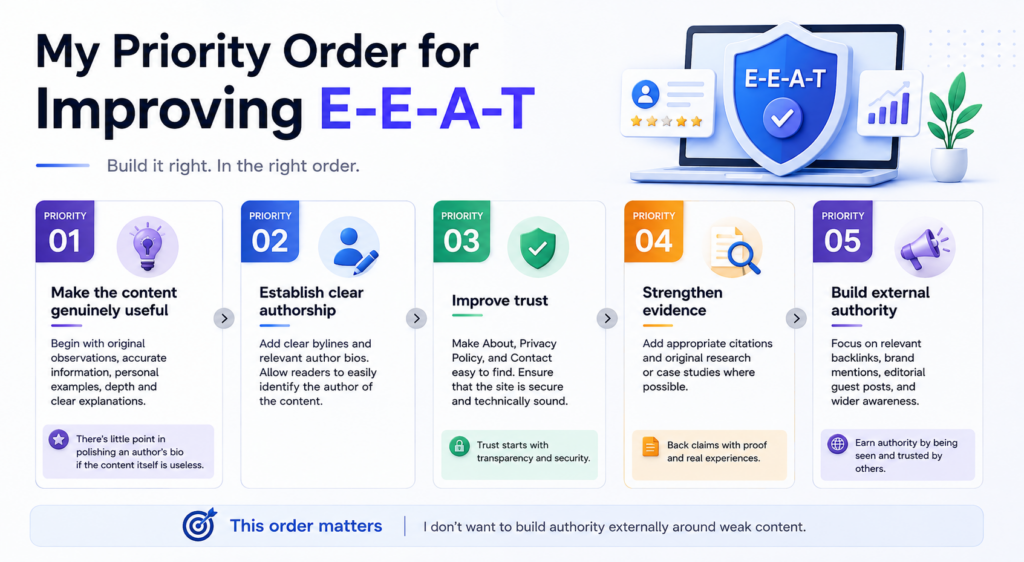
I would rank them in the following order:
Priority 1: Make the content genuinely useful
Begin with original observations, accurate information, personal examples, depth and clear explanations.
There’s little point in polishing an author’s bio if the content itself is useless.
Priority 2: Establish clear authorship
Add clear bylines and relevant author bios.
Allow readers to easily identify the author of the content.
Priority 3: Improve trust
Make About, Privacy Policy, and Contact easy to find.
Ensure that the site is secure and technically sound.
Priority 4: Strengthen evidence
Add appropriate citations and original research or case studies where possible.
Priority 5: Build external authority
Focus on relevant backlinks, brand mentions, editorial guest posts, and wider awareness.
This order matters because I don’t want to build authority externally around weak content.
E-E-A-T Content Authority Checklist
Here is the complete checklist I now use as a practical review:
- Does the article include genuine first-hand experience where relevant?
- Does it contain original observations?
- Can I add a relevant case study or experiment?
- Have I included useful personal examples?
- Is the author’s relevant experience clear?
- Does the article have a clear author byline?
- Does the content provide enough depth for the search intent?
- Are important factual claims supported by credible sources?
- Am I earning backlinks from relevant websites?
- Is the brand being mentioned by relevant external sources?
- Is brand and entity information consistent?
- Are guest posts genuinely useful and editorial?
- Is the website secured with HTTPS?
- Are About and Privacy information easy to find?
- Can visitors easily find legitimate contact information?
I don’t expect to see all the signals on every page, equally.
Experience signals are likely to be stronger for a personal SEO case study.
A technical seo guide might be more about expertise and references.
Established brands may have stronger authority signals.
It’s not about getting 100%.
The aim is to get good evidence of the content and its authors.
Final Thoughts
The biggest thing I can take away from this E-E-A-T checklist for content authority is that E-E-A-T is not something I can manufacture with a plugin, a few schema properties, or a checklist alone.
The loudest signals are from the stuff behind the page.
Someone with real experience has original observations. Someone who knows this stuff explains it right. An authoritative website is cited by other relevant sources. A good website is transparent about its people, information, and policies.
That’s the system I am trying to build on innovativeseo.in
And this is why I also view E-E-A-T as the capstone of my Content Authority strategy.
An author bio helps show who is creating the content. Content refreshes ensure that content stays accurate and useful. AI citation and GEO-focused content help me learn how information is discovered in newer search experiences. That’s where this E-E-A-T checklist comes in handy.
The goal is not to look authoritative.
The objective is to create content that can be trusted.
Frequently Asked Questions About E-E-A-T
Is E-E-A-T a Google ranking factor?
E-E-A-T itself is not a single ranking factor with a measurable score. Google uses many systems and signals to determine which content is helpful and trustworthy. E-E-A-T is best understood as a framework for evaluating the quality and credibility of content.
How can I improve E-E-A-T?
Start with the content itself. Add first-hand experience, original observations, accurate information, relevant sources, useful examples, and appropriate depth. Then strengthen authorship, website transparency, trust signals, and relevant external recognition.
Does E-E-A-T matter for AI search?
It is increasingly useful to think about E-E-A-T when preparing content for AI-powered search. AI systems need to identify useful and credible information, so clear authorship, original content, supporting evidence, and trustworthy website information can strengthen the overall credibility and usefulness of a source. However, there is no guaranteed E-E-A-T score or direct AI citation formula.
Are backlinks part of E-E-A-T?
Relevant backlinks can contribute to a website’s broader authority and reputation. However, link quantity alone does not demonstrate E-E-A-T. I would prioritize relevant, editorially earned links from credible websites over large numbers of low-quality links.
Is author experience more important than backlinks?
They serve different purposes. Author experience helps demonstrate who is qualified to create the content, while external links and mentions can contribute to broader authority. Strong content should work on both levels rather than relying entirely on either one.
How often should I review my E-E-A-T signals?
I would review important pages whenever I refresh the content, publish major updates, change authorship, or notice that information has become outdated. A broader quarterly content audit can also help identify missing author, trust, citation, and authority signals.