Introduction:
For a long time, my content refresh strategy SEO focused on publishing new content rather than taking the time to update old blog posts SEO. I added new keywords, wrote new articles, and grew my website each week, believing that new content was the only way to improve ranking. Each week I researched new keywords, wrote new blog posts, and grew my website. It seemed a good way to spend my time, for the number of articles published continued to grow.
However, one day I checked my performance in Google Search Console, and I saw something unexpected. Some older articles that had once seemed promising were slowly fading from view. They were not bad content, they were just old.
And that changed the way I viewed SEO.
Rather than asking, “What do I write next? I began asking, “Which existing content refresh strategy SEO should I update?”
That choice led me to develop a straightforward content refresh strategy SEO process. I selected five older posts, updated them carefully and waited to see what would happen. The results weren’t overnight miracles, but I did see that updating existing content sometimes is more valuable than always creating new articles.
If you’re growing a blog, this experience may save you weeks of unnecessary content creation.
Why Did I Choose to Refresh Old Content Instead of Publishing More?
One of the biggest misconceptions in SEO is that growth only comes from publishing new content. As I reviewed my site’s performance, I realized that a strong content refresh strategy SEO could deliver results without constantly creating new articles. What I saw was an opportunity to improve pages that Google had already indexed and understood, rather than letting older posts die a slow death.
The truth is, at some point, all websites have aging content.
Statistics are subject to change and may make some articles obsolete. Others become irrelevant as rivals offer better resources. Sometimes the intent of the search changes, but your article remains the same.
Instead of twenty new articles, I wanted to make better pages that Google already knew and already indexed.
Benefits of the current content refresh strategy SEO:
- Existing crawl history
- Some topical authority
- Internal links already pointing to it
- Existing impressions in search results
- A chance to improve rankings without starting from zero
That’s why I shifted part of my content refresh strategy SEO toward refreshing instead of only publishing.
How Did I Identify Posts Worth Refreshing?
I didn’t just choose 5 blog posts at random. I applied two simple filters.
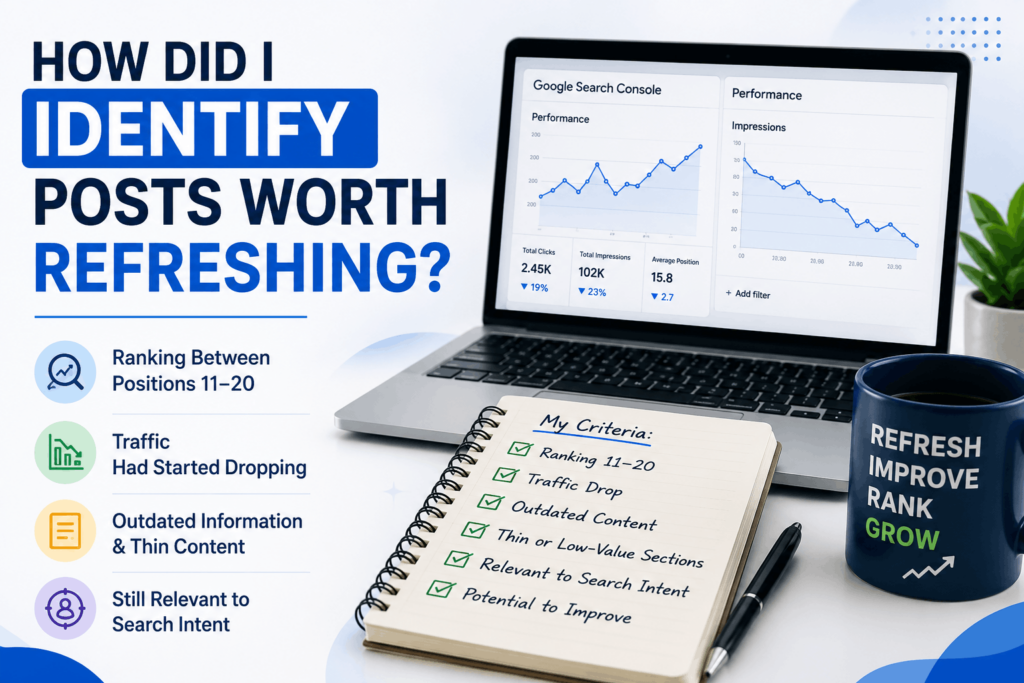
1. Ranking Between Positions 11-20
They were already near page one.
Rather than attempting to rank a brand new article, it’s often better to work on pages that are already somewhat close to higher visibility.
Pages just outside the top 10 have untapped potential.
2. Traffic Had Started Dropping
The second indicator was a decrease in impressions or clicks.
A refreshed candidate was an article that had historically performed well but was slowly losing visibility.
Sometimes the page was fine technically.
It just needed to be more useful, more up to date.
Other Signals I Looked For
I also checked whether a post had:
- Outdated screenshots
- Old statistics
- Missing FAQs
- Thin sections
- Weak headings
- Broken internal links
- Opportunities to answer newer search intent
These factors helped identify the posts on which to focus attention.
The Five Posts I Refreshed
I won’t name the specific articles, because the point here isn’t to show off specific URLs. Instead, I updated something like this.
- Post 1: An SEO Beginner Guide
The topic was still relevant, however, some best practices changed with newer Google updates.
I revised the examples, extended the explanations and simplified confusing sections.
- Post 2: A Tool Comparison Article
Several tools added new features.
I took out information that was no longer current and rewrote the comparison sections to reflect the current functionality.
- Post 3: A Technical SEO Guide
This article had good advice, but it was lacking practical examples.
I have added clearer explanations, step-by-step instructions, and an FAQ section.
- Post 4: A Content Marketing Article
The article had grown repetitive. I trimmed out unnecessary paragraphs, improved the headings, and added current industry references.
- Post 5: An Evergreen SEO Resource
Still getting impressions, but rankings have been slowly dropping.
I did not rewrite anything; I just made it more readable, updated the stats, and added internal linking.
While each article was on a different topic, the refresh process followed pretty much the same framework.
What Did I Change During Every Refresh?
One thing I learned quickly is that content refresh strategy SEO isn’t the same as rewriting the whole article.
Usually a few targeted improvements would suffice.
- Updated the title
Occasionally the title was no longer relevant to current search behavior.
I made titles clearer and more specific and aligned them with modern search intent.
- Added New Statistics and References
SEO is constantly changing.
Whenever I came across some outdated data or references, I replaced them with more up-to-date data.
It added a more contemporary and trustworthy feel to the content.
- Removed Thin Sections
Some paragraphs existed only because I had written them years ago.
If they weren’t adding value, I cut ’em.
Short useful content is often better than long repeated content.
- Improved Headings
Some headings were unclear.
I rewrote the sentences to answer user questions better, naturally supporting the relevance of keywords.
- Added FAQs
Many of the articles failed to ask the obvious follow-up questions.
Including FAQ sections made the content more complete and more relevant to informational search intent.
- Improved Internal Links
I have updated the posts with newer supportive articles linked.
This made it more topically relevant and assisted users in finding related content.
If, for example, you are building stronger authority signals, reading how to create an effective author bio and using a practical E-E-A-T checklist are good next steps.
- Checked Basic On-Page SEO
Before republishing, I reviewed:
- Meta title
- Meta description
- Image alt text
- Internal links
- External references
- Formatting
- Readability
These weren’t major changes individually, but together they noticeably improved content quality.
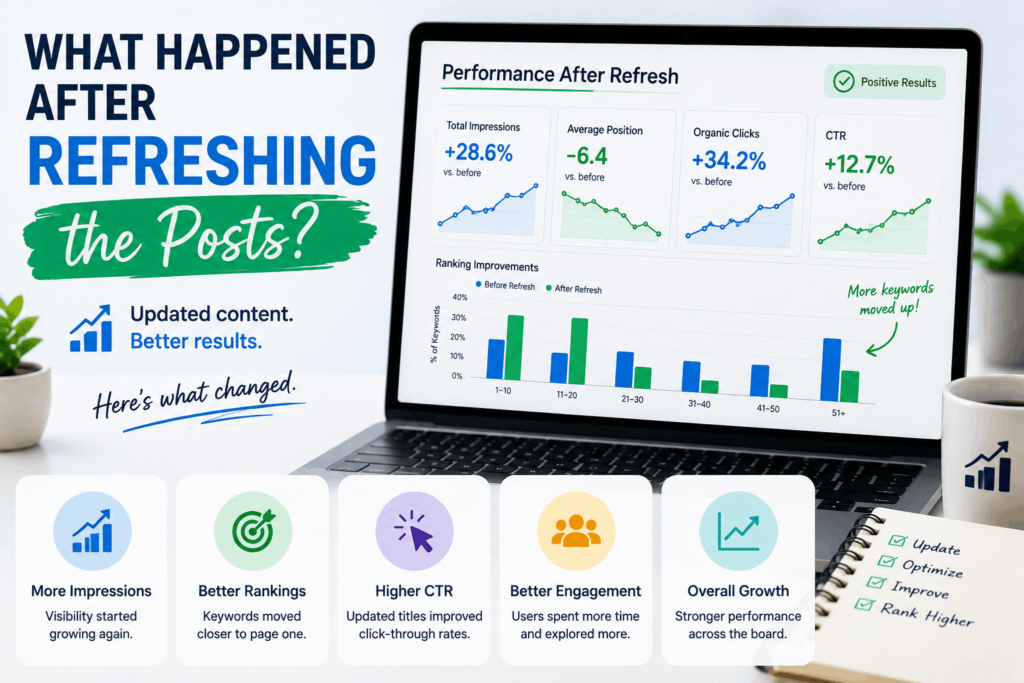
What Happened After Refreshing the Posts?
One thing I learned from following this content refresh strategy SEO process was I didn’t see dramatic ranking improvements in a few days.
That’s not how SEO works.
Instead, I was watching the pages for about four to six weeks after publishing the updates.
Here’s what I saw.
- Several pages began gaining impressions again.
- A few keywords moved closer to page one.
- Click-through rates improved slightly after title updates.
- Average positions improved for multiple target queries.
- Engagement appeared healthier because users had more complete information.
Some pages did not jump into the top three. Some moved only a few places.
In general, however, the improved articles did a better job than the pre-update articles. Which was an important lesson to me:
Consistent improvements tend to provide more reliable SEO growth than chasing dramatic wins.
These modest but positive content refresh strategy SEO results told me there’s room in my publishing workflow to update valuable content.
The Biggest Lessons I Learned
- Publishing More Isn’t Always the Answer
Sometimes your next SEO win is already sitting on your website.
Improving existing content can deliver better returns than publishing another article.
- Search Intent Evolves
Google’s understanding of topics changes over time.
Content that matched search intent two years ago may no longer fully satisfy today’s users.
Regular reviews help keep articles relevant.
- Small Improvements Add Up
Content refresh strategy SEO isn’t about making one massive change.
It’s about improving dozens of small details that collectively create a better experience.
- Evergreen Content Still Needs Maintenance
An evergreen content strategy doesn’t mean content stays perfect forever. Evergreen topics still require updates, examples, and current information to remain competitive.
- Expertise Needs to Stay Current
One benefit I didn’t fully appreciate at first was how content refresh strategy SEO strengthens E-E-A-T signals.
Regularly updating articles demonstrates that you’re actively maintaining your expertise rather than leaving outdated information online.
For topics that change frequently, this matters just as much as creating new content.
My Content Refresh Strategy SEO Checklist
As I refreshed several articles, I realized that a repeatable process was as important as the updates themselves. This content refresh strategy SEO checklist keeps me consistent, helps me not to miss important improvements, and makes every content update more effective.
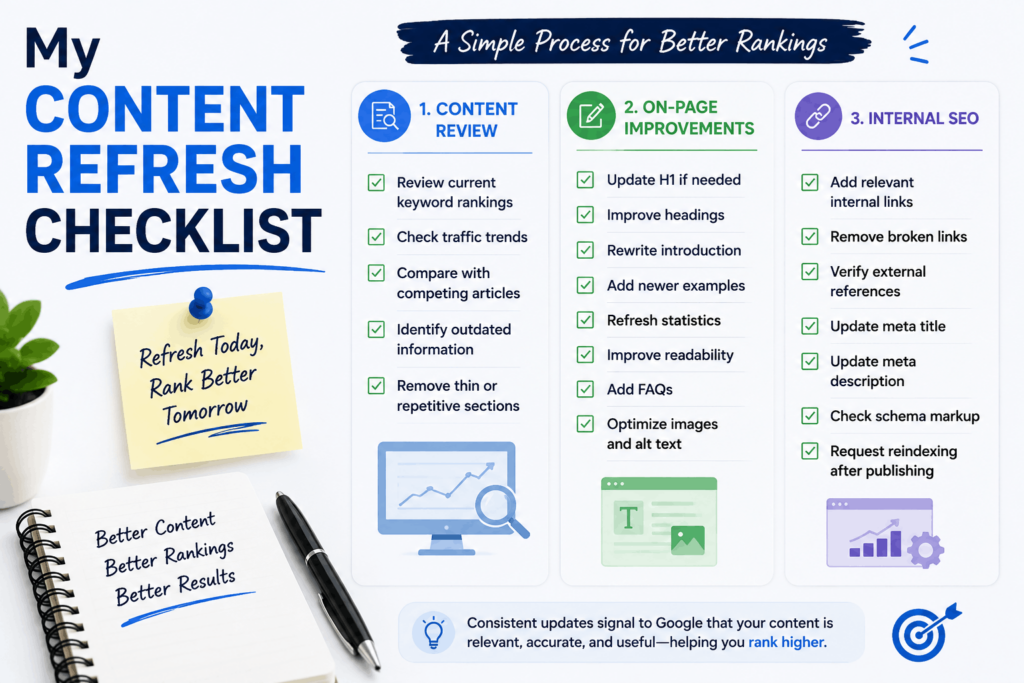
This checklist helps me regularly update old blog posts for SEO, whether I’m working on a technical guide or an evergreen resource. Do it over and over, and you will make fewer mistakes, and you will be better in the long run.
Content Review
- Review current keyword rankings
- Check traffic trends
- Compare with competing articles
- Identify outdated information
- Remove thin or repetitive sections
On-Page Improvements
- Update H1 if needed
- Improve headings
- Rewrite introduction
- Add newer examples
- Refresh statistics
- Improve readability
- Add FAQs
- Optimize images and alt text
Internal SEO
- Add relevant internal links
- Remove broken links
- Verify external references
- Update meta title
- Update meta description
- Check schema markup
- Request reindexing after publishing
Repeatability means every refresh is the same, not guesswork.
Conclusion:
In hindsight, adopting a content refresh strategy SEO mindset completely changed my approach to content marketing.
I still put out new stuff on a regular basis, but I look at existing content as an asset that needs constant maintenance over time.
Instead of automatically assuming every ranking drop requires a brand-new page, I first ask whether an existing article can better satisfy today’s search intent.
That one small change has helped me to maintain a better quality of content while getting more out of work I’ve already done.
In hindsight, adopting a content refresh strategy SEO mindset completely changed how I approach content marketing. The content refresh results weren’t instant, but they proved that refreshing existing content can be just as valuable as publishing something new.
More importantly, I began to see slow but steady improvements in blog post update rankings, increased user engagement, and overall content quality. Writing new articles is as important to my workflow today as an evergreen content strategy.
If you have been only focused on publishing new content, do not ignore what’s already on your website. The simplest way to increase visibility, boost topical authority, and achieve long-term, sustainable growth is to update old blog posts SEO.
Frequently Asked Questions
1. How often should I refresh old blog posts for SEO?
There is no set schedule, but it is a best practice to review key pages every 6 to 12 months. Posts on fast-changing topics may need more frequent updating.
2. Which blog posts should I refresh first?
Start with articles ranked 11-20, declining traffic, or out-of-date information. They tend to offer the quickest opportunities to improve.
3. Does refreshing content guarantee better rankings?
No. Refreshing content doesn’t guarantee you rankings. But refreshing stale information, improving the user experience, and matching content to what the user is currently searching for can help improve the odds of better long-term performance.