Search Intent Types SEO: Why Matching Intent Matters More Than Finding the Right Keyword
Finding a keyword with a decent search volume is merely a first step in SEO. “I’ve learned that even the best keyword over time will not help you if the content doesn’t match what the searcher is really looking for. That’s why understanding search intent types SEO is an essential part of my content planning process.
When I first began writing SEO content, I was obsessed with keyword metrics like search volume and keyword difficulty. Those metrics are useful, but they don’t tell the whole story. Google doesn’t rank pages just because they have the right keyword. It ranks pages that fulfill the user’s intent. If someone is looking to learn, Google would favor educational content. If they are comparing solutions, it often ranks comparison articles. And if they’re ready to buy, service or product pages tend to dominate the results.
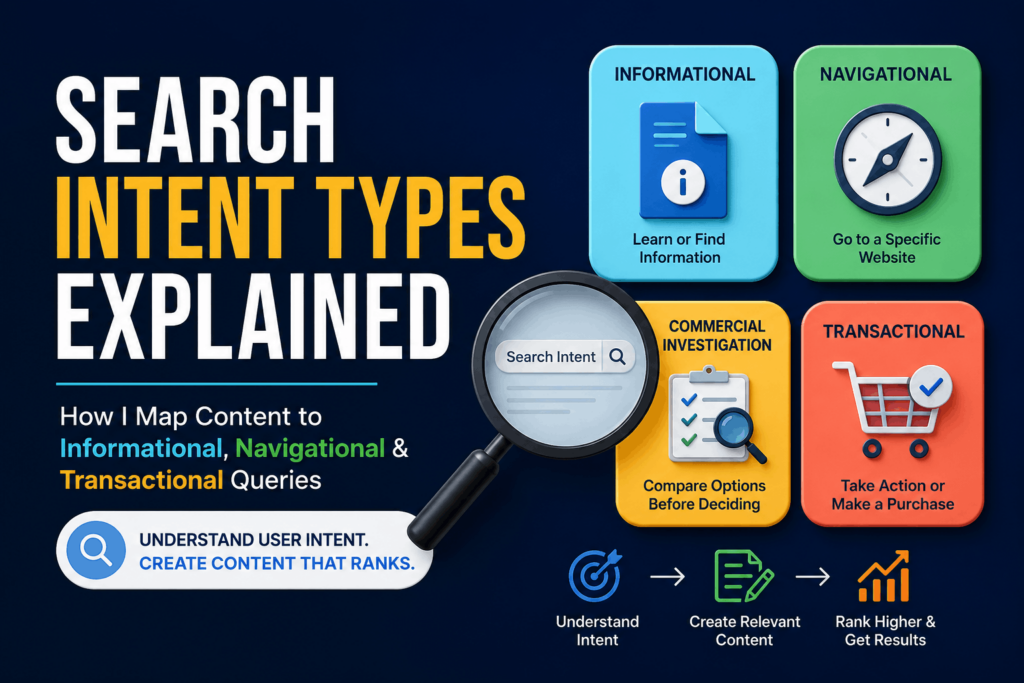
This is where search intent mapping comes into play. A keyword tells me what people are looking for, but user intent SEO helps me understand why they’re looking. That insight guides every decision I make, from the page format to the headings and content structure.
For example, the keyword “search intent types SEO” shows the user is looking for an explanation of the different types of intent and practical examples. But a keyword like “SEO services” has a totally different goal. In that case, users expect to find a business that can help them, not a detailed tutorial. Even though both keywords are in the SEO industry, the content that should be there to rank for each one is completely different.
That’s why I don’t just create content around keywords. Before I write, I always spend a few minutes looking at the Google search results to get a sense of what kind of page is already ranking. If the top results are guides, I know that the keyword has an informational intent. If I see a SERP full of comparison articles, I know that users are comparing options. This simple practice has allowed me to create content that satisfies both user expectations and Google’s ranking signals.
In this guide I’ll explain the four search intent types SEO, show you how I identify search intent using Google’s search results, and share how I map content to different intent types on innovativeseo.in. I’ll also talk about common intent mistakes and how matching content to user intent can improve not only rankings but also the overall user experience.
What Are Search Intent Types SEO?
Search intent is the reason why a user is making a search query. It tells you what people try to achieve when they enter a keyword in Google. One of the most important aspects of modern SEO is understanding that goal because Google rewards content that fulfills user intent, not just content with the right keywords. Whether the user is looking to learn, compare, find a website, or buy; understanding their intent allows you to develop content that better addresses their needs.
Search Intent Types SEO: Understanding the 4 Types of User Intent
Finding which of the four search intent types SEO the keyword belongs to is the next step after I understand why someone is searching. Every search query has intent and understanding that helps me to determine the best format of content to create before I start writing.
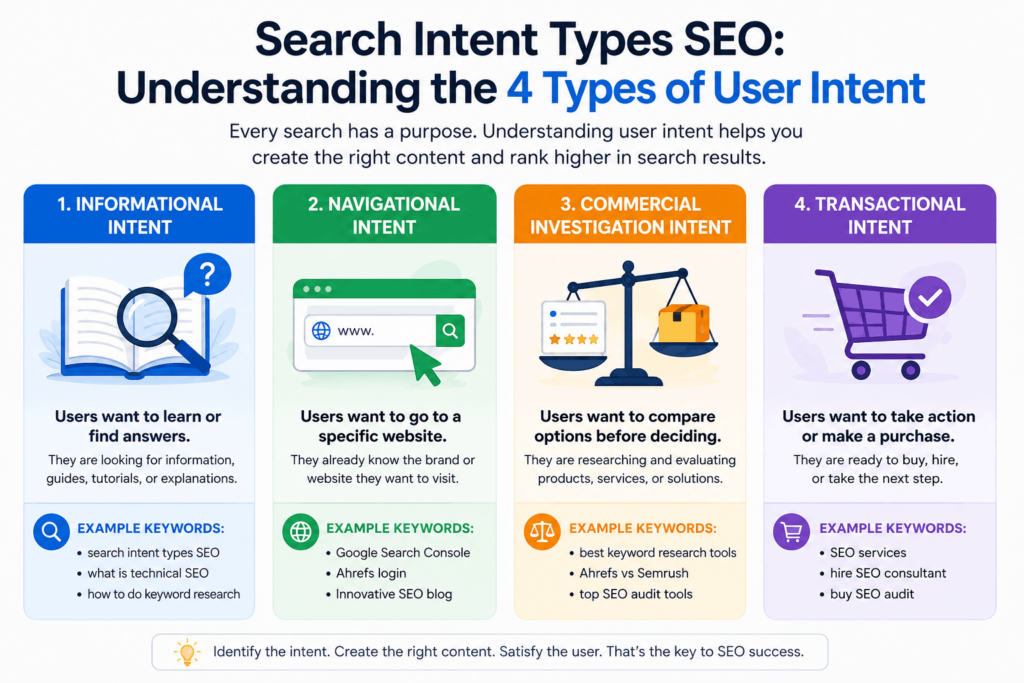
Rather than asking, “Can I rank for this keyword? “What is the user expecting to find?” I ask. That small change has made my search intent mapping process so much more efficient.
1. Informational Intent
Informational intent is when users want to learn something or get an answer to a question. They are searching for information, not for a product or a service.
Example keywords:
- Search intent types SEO
- What is technical SEO
- How to do keyword research
- SEO checklist
Best content for informational intent: How-to articles, guides, tutorials, educational blog posts. The majority of the content I publish on innovativeseo.in is in this category as the aim is to educate the readers and solve their SEO-related questions.
2. Navigational Intent
Navigational intent implies that the user already knows where they want to go. They use Google to basically reach a specific website, tool, or brand page.
Example keywords:
- Google Search Console
- Ahrefs login
- Google Analytics
- Innovative SEO blog
These searches almost always get the official website ranked on Google. Generally, it’s not worth building content around purely navigational keywords unless you own the brand.
3. Commercial Investigation Intent
Commercial investigation intent is often overlooked, but it is one of the most crucial stages in the buyer’s process. Users are not ready to purchase yet and compare different options before making a decision.
Example keywords:
- best keyword research tools
- Ahrefs vs Semrush
- top SEO audit tools
- best AI SEO software
Comparison articles, product reviews, and “Top 10” lists are the best for this intent because users are looking for help evaluating their options before taking action.
4. Transactional Intent
Comparison articles, product reviews, and “Top 10” lists are the best fit for this intent, as users are searching for help in evaluating their options before taking action.
Example keywords:
- SEO services
- hire SEO consultant
- Oracle APEX development services
- buy SEO audit
In terms of these keywords, service pages, product pages, pricing pages, and landing pages do a much better job than educational blog posts, as they are directly supporting the goal of the user.
Various search intent types SEO require various content strategies. In many cases, trying to rank a service page on an informational keyword or a blog post on a transactional keyword will lead to poor performance, as the content is out of line with what the user is looking for. I can create content that satisfies user intent and performs better in search results by understanding the difference between informational vs. transactional keywords, as well as navigational and commercial investigation queries.
Search Intent Types SEO: How I Identify Intent Before Creating Content
The first step is to understand the four search intent types SEO. The real value comes in understanding the right intent before you write a single word. Instead of just using keyword research tools, I allow Google to tell me what people are looking for by seeing the search results.
Read the SERP, Not Just the Keyword
Anytime I shortlist a keyword, I Google it and read the first page. I’m not looking at who is ranking; I’m looking at what kind of pages are ranking.
I ask myself questions like
- Are most results detailed guides or tutorials?
- Do I see comparison articles or “best tools” lists?
- Are service pages dominating the results?
- Are official brand websites appearing at the top?
The answers help me to uncover the user intent SEO behind the keywords. If Google continues to rank one type of content, it’s probably what users are expecting.
Match the Content Format to the Intent
Once I understand the intent, it is much easier to select the content format. I don’t force every keyword into a blog post. I build the page that best meets the searcher’s objective.
| Search Intent Type | Best Content Format | Example Keyword | Example Page Type |
| Informational | Guide or Tutorial | Search intent types SEO | Blog Post |
| Navigational | Homepage or Login Page | Google Search Console | Official Website |
| Commercial Investigation | Comparison or Review | best keyword research tools | Comparison Article |
| Transactional | Service or Landing Page | SEO services | Service Page |
This simple framework has become a cornerstone of my search intent mapping process.
How I Map Content to Search Intent on InnovativeSEO.in
I do the same for every article I publish on innovativeseo.in.
For example, my article “How to Do Keyword Research for SEO in 2026” is targeting informational intent because the readers want to learn a process. That’s why the article explains concepts step by step instead of promoting a service.
However, “Top 3 Keyword Research Tools for SEO” focuses on commercial investigation intent. Because people searching for that keyword are in the process of comparing tools before making a decision, an article in a comparison format is the best format.
My SEO Learning Roadmap 2026 guide is also informational in intent, as it helps beginners understand what to learn and in what order.
This process also helps me avoid intent mismatches. Before creating any page, I ask one simple question:
“If I were the searcher, what type of page would I expect to land on?”
That question keeps my content aligned with Google’s ranking signals and user expectations. Understanding the purpose makes it much easier to plan the outline, headings, internal links and calls to action. It helps you create more relevant content that’s more likely to perform well in search.
Search Intent Types SEO: Common Intent Mistakes I avoid
Even after learning about search intent types SEO, it’s easy to create content that misses the mark. Most ranking problems aren’t because of bad keyword research. It’s usually because there’s an intent mismatch.
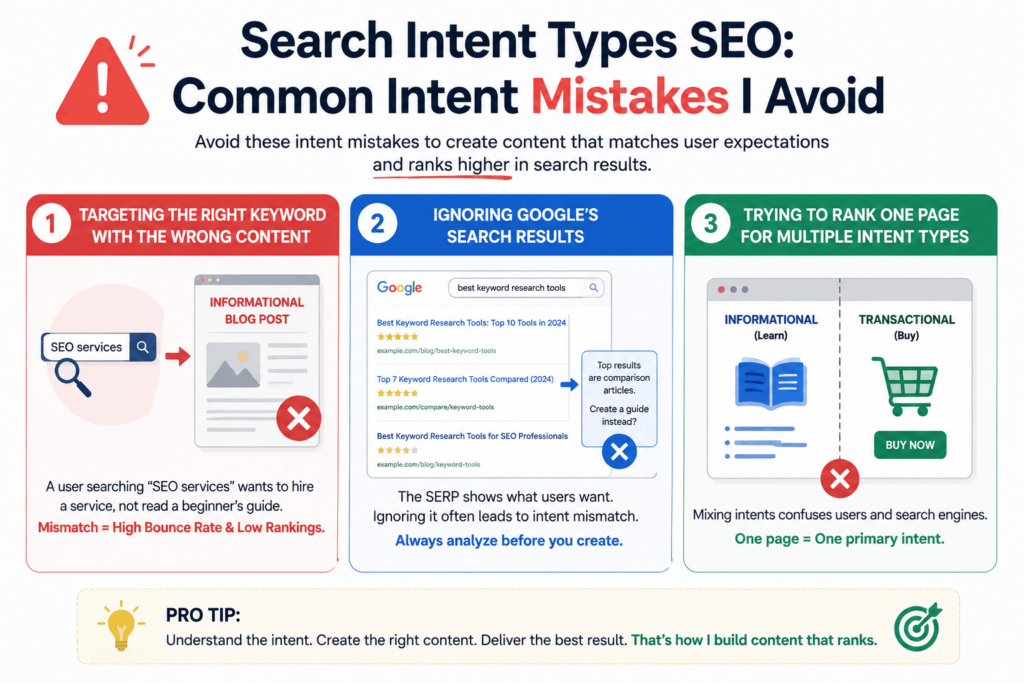
A common mistake is using the same type of content for informational vs transactional keywords. If someone searches for “What is search intent?” they’re looking for an educational guide. Someone searching for “SEO services” wants to find a company they can hire. If the content is not meeting that expectation, users will likely leave and Google will not be able to see it as the best result.
Another error is to ignore SERP analysis. Keyword tools have some great metrics, but Google’s search results reveal what users really want. Before I publish an article, I always check the first page to see if the dominant intent and content format are as expected.
Finally, I don’t try to serve multiple intents on one page. An informational guide is not the place to suddenly become a sales page, and a service page should not read like a tutorial for beginners. To have one clear intent for each page is better for users and search engines.
Search Intent Mapping Is Part of My Keyword Research Process
I don’t see search intent mapping as a separate SEO task, it’s core to keyword research.
My workflow goes like this:
Keyword Research >> Analyze Search Intent >> Choose Content Format >> Create the Outline >> Write & Optimize >> Add Internal Links
If you’ve read my keyword research guide, then you’ll know that getting a good keyword is only half the battle. I always validate intent first before I write because that determines if I’m going to write a guide, comparison article, service page or landing page.
This approach has helped me create content that has better relevance, easier structure and better alignment with what Google wants to rank.
Conclusion:
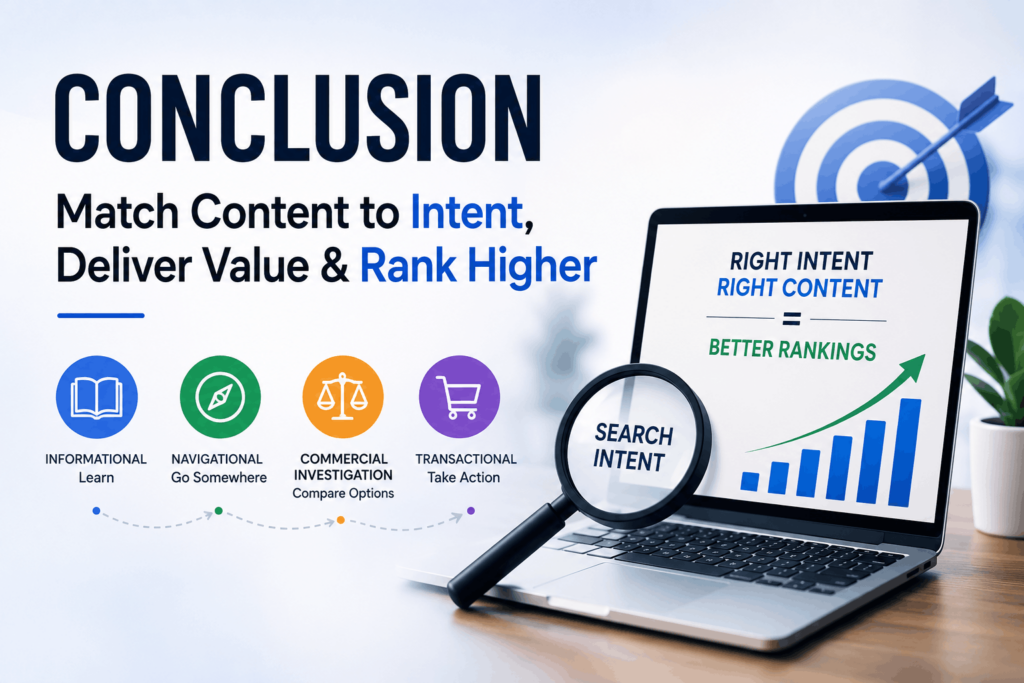
My approach to content creation has completely changed since I learned about search intent types SEO. I don’t just look at keywords, I look at the reason for the search. Regardless of the intent informational, navigational, commercial investigation, or transactional matching the content to that intent improves relevance, user experience, and long-term SEO performance.
Next time you’re doing keyword research, don’t just look at search volume and difficulty. Spend an extra couple of minutes to analyze the SERP, understand the intent, and pick the right content format. In my experience, that’s one of the fastest ways to make content that users and Google will love.
Frequently Asked Questions
1. What are the four search intent types in SEO?
The four search intent types SEO are informational, navigational, commercial investigation, and transactional. Each represents a different goal that users have when searching, and each requires a different type of content.
2. How do I identify search intent for a keyword?
The easiest way is to search the keyword on Google and analyze the top-ranking pages. The type of content dominating the SERP usually reflects the user intent SEO behind that query.
3. Why is search intent important for SEO?
Search intent is important because Google ranks pages that best satisfy what users are looking for. Matching your content to the correct intent improves relevance, engagement, and your chances of ranking higher.