Pillar Page Content Cluster Strategy: How I Built Topical Authority on This Blog
I made a mistake when I began publishing content on innovativeseo.in, a mistake I still see many website owners and marketers making today: Each blog post I treated as an SEO opportunity by itself. I’d research a keyword, write an article, publish it, and then move to the next topic, without ever thinking about how all the pieces fit together.
Eventually I realized that publishing more content wasn’t necessarily helping me build expertise signals. That’s when I began to implement a pillar page content cluster strategy. Instead of writing standalone articles, I started to structure my content around larger themes and intentionally link them together. This one change totally changed the way I approached content planning and helped me build a better foundation for topical authority SEO.
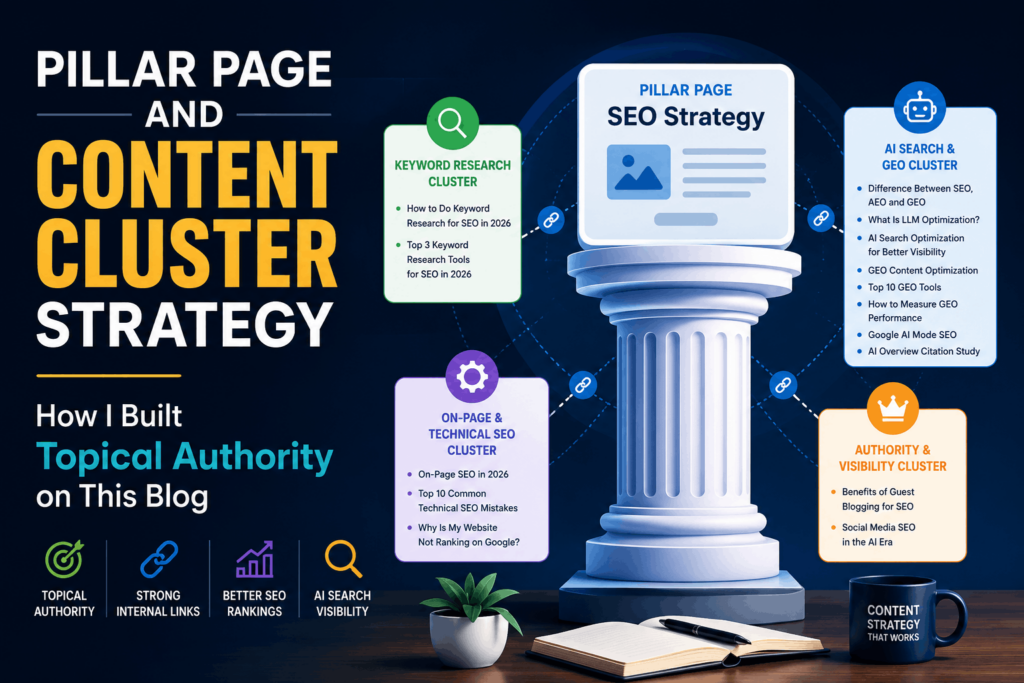
In this article I’ll walk you through how I used a pillar page content cluster strategy on innovativeseo.in, the content structure I created, what worked, what didn’t, and how you can build your own content cluster using the same approach.
What Topical Authority Actually Means (And What It Doesn’t)
The first time I heard the term topical authority SEO, I thought it was just about writing a bunch of articles on a topic.
Having worked on Innovative SEO I found that isn’t completely true.
In my experience topical authority is not about publishing hundreds of blog posts or trying to hit every keyword variation out there. It’s about demonstrating expertise and depth on a specific topic with linked content.
For instance, if I publish 1 article about keyword research, Google will know I wrote about keyword research.
However, if I publish:
- a complete keyword research guide,
- a comparison of keyword research tools,
- articles about on-page SEO,
- technical SEO,
- AI search optimization,
- GEO optimization,
- LLM optimization,
- and modern search behavior,
I can internally link them in a strategic way so that search engines can better understand what my website is about.
This was one of the biggest mindset shifts I made while building innovativeseo.in.
Instead of asking: “What is my next keyword to target?”
I started asking: “What topic is not finished on my website?
That one question served as the foundation for all of my pillar page content cluster strategy.
Understanding the Pillar + Cluster Model
I came to realize that depth on a topic was more important than just publishing random articles, but I needed a framework to help me properly organize content.
Then I started using the topic cluster model.
The idea is simple.
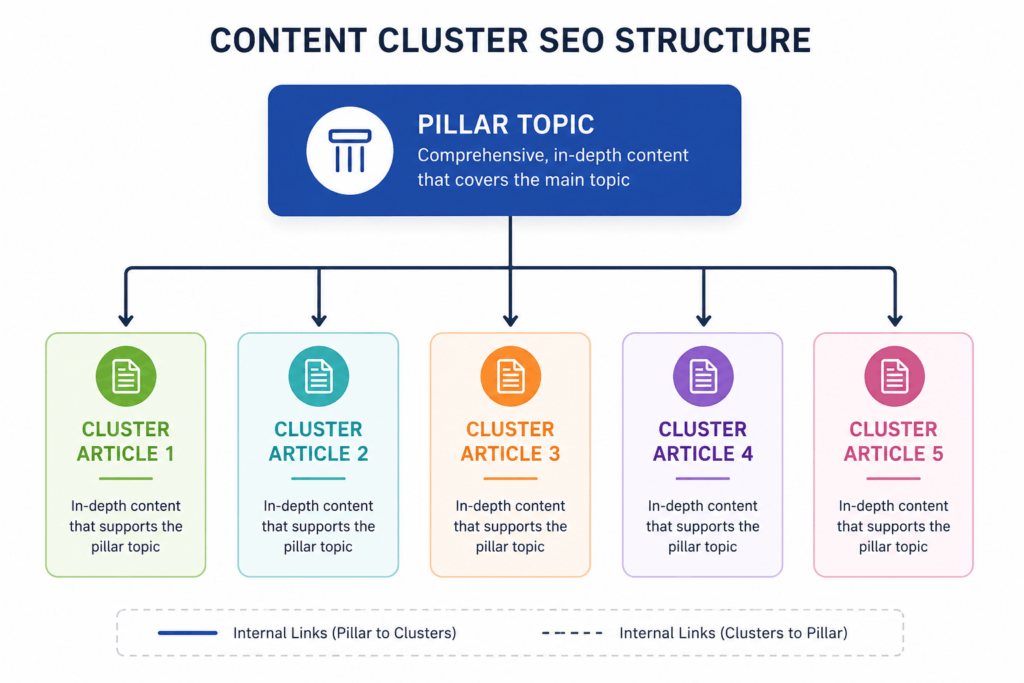
You create one big topic that is your pillar page, and then you write several supporting articles that cover a specific area of that topic in more detail.
The center point is the pillar page.
And the supporting articles are converted into cluster pages.
Each cluster page links to the pillar page, which links to all of the applicable cluster articles.
This creates a connected content ecosystem, not a bunch of separate blog posts.
Here’s an example of a typical content cluster SEO structure:
When I began implementing this model on innovativeseo.in, I decided to make SEO Strategy one of my core content pillars.
Instead of just posting random SEO articles, I wrote content around related subtopics, like:
- keyword research,
- keyword research tools,
- technical SEO,
- on-page SEO,
- AI search optimization,
- GEO,
- LLM optimization,
- search visibility,
- and modern ranking strategies.
Each new article is added to the overall topic and is not a standalone piece of content.
This change made content planning much easier, as each new article had a specific role in the overall structure.
Why Google (And AI Search) Rewards Topical Depth Over Breadth
One of the reasons I committed to a pillar page content cluster strategy is because search engines have evolved so much beyond simple keyword matching.
Instead of simply looking for a specific keyword on a page, Google now looks at how well a website covers a topic.
The same principle is in play in emerging AI search experiences.
When a person is looking up information about SEO, AI search systems don’t just bring up pages that have a keyword on them. They attempt to find sites that demonstrate a broader expertise on the subject.
I began noticing this change when I started publishing content on innovativeseo.in.
I started with traditional SEO topics like keyword research and technical optimization. But as AI search became more important, I started adding related content like:
- How to Do Keyword Research for SEO in 2026
- Top 3 Keyword Research Tools for SEO in 2026
- Difference Between SEO, AEO and GEO
- What Is LLM Optimization?
- AI Search Optimization for Better Visibility
- Top 10 GEO Tools for AI Search Optimization in 2026
- Google AI Mode SEO
- How to Measure GEO Performance Beyond Google’s AI Reports
These articles weren’t written because they were trending topics.
I published them because they answered important questions that naturally exist within the larger SEO ecosystem.
Content planning became simpler, opportunities for internal linking grew, and the entire structure of the website became much more organized due to more interconnected content being added.
I was building a connected knowledge base, not dozens of disconnected pages.
That, in my experience, is the real upside of using a pillar page content cluster strategy.
How I Structured the Content on innovativeseo.in (A Real Example)
After I adopted a pillar page content cluster strategy, I stopped planning content based on individual keywords and started planning based on full topics.
My goal was not to rank any one article. The goal was to help search engines and, increasingly, AI-powered search systems understand that innovativeseo.in is about SEO as a whole subject, not a bunch of unrelated topics.
I began by choosing one big topic that aligned with my skills and the long-term direction of search: SEO Strategy.
And from there I started finding supporting topics that came under this umbrella naturally.
In 2026, learning SEO isn’t just about knowing keyword research. Additionally, they must comprehend AI search, GEO, LLM optimization, technical SEO, on-page optimization, content strategy, and modern ranking signals.
I treated them as pieces connected to the same topic rather than as separate categories.
As AI search continued evolving, I expanded the cluster by publishing articles such as:
- Difference Between SEO, AEO and GEO: What Actually Works in 2026
- What Is LLM Optimization? A Beginner’s Guide for 2026
- AI Search Optimization for Better Visibility
- Top 10 GEO Tools for AI Search Optimization in 2026
- GEO Content Optimization: How to Optimize Content for AI Search
- How to Measure GEO Performance Beyond Google’s AI Reports
- Google AI Mode SEO: Search Visibility Is Quietly Changing
- I Compared AI Overview Citations Across 50 SEO Articles: Here’s What I Noticed
At the same time, I continued strengthening the foundational SEO cluster with articles such as:
- On-Page SEO in 2026: What Still Matters for Google Rankings
- Top 10 Common Technical SEO Mistakes
- What Are the Benefits of Guest Blogging for SEO?
- Why Is My Website Not Ranking on Google?
- Social Media SEO in the AI Era
Each new article was answering a different question from a user, while beefing up the SEO topic as a whole.
This changed my approach to content creation entirely. Rather than ask:
“Keyword with search volume?”
I began to ask:
What important question is there within this topic that I have not yet answered?
My pillar page content cluster strategy is still driven by that question.
My SEO Strategy Content Map
Below is a simplified version of the topic cluster model I built on innovativeseo.in
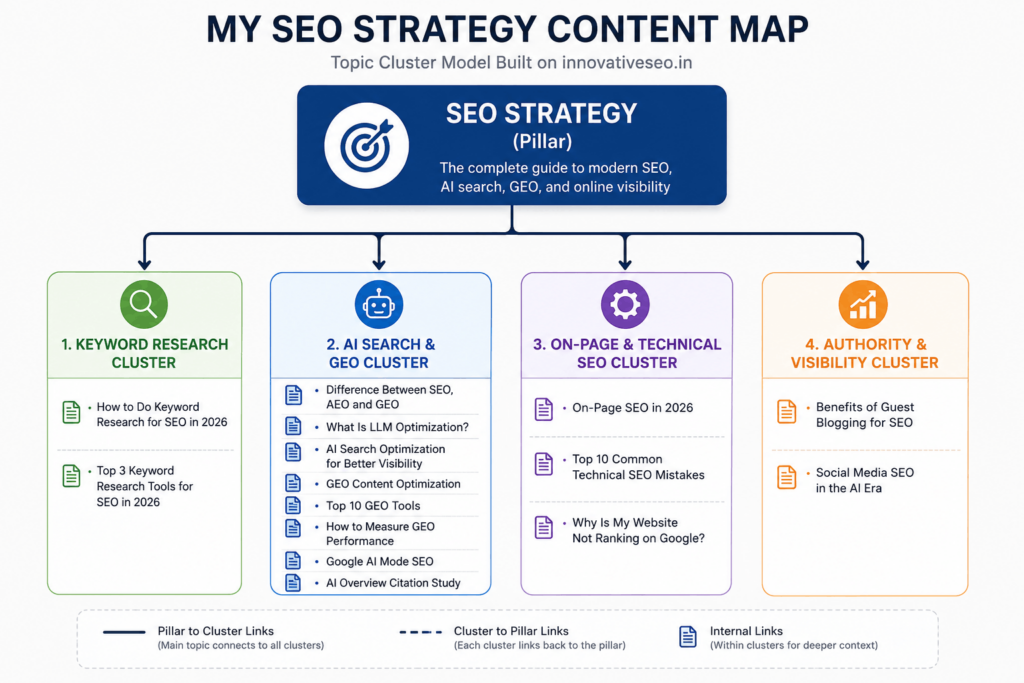
This structure keeps evolving as search behavior changes.
The benefit of a content cluster SEO approach is that I don’t have to redesign the entire site every time a new topic comes up. I can just as easily find where that topic fits into the existing structure and write another supporting cluster article.
How Internal Linking Became the Foundation of My Strategy
One of the biggest benefits I found after implementing a pillar page content cluster strategy was the effect of internal linking.
For example, when visitors come to my article on How to Do Keyword Research for SEO in 2026, I can naturally lead them to Top 3 Keyword Research Tools for SEO in 2026.
Similarly, visitors to Difference Between SEO, AEO and GEO often find value in reading What Is LLM Optimization?, AI Search Optimization for Better Visibility, and Top 10 GEO Tools for AI Search Optimization in 2026.
Likewise, a person reading On-Page SEO in 2026 can go on to Top 10 Common Technical SEO Mistakes and Why Is My Website Not Ranking on Google?.
This makes for a much better experience for readers as they do not have to manually search for related information. The website walks them through the subject itself.
In the meantime, search engines are getting a better sense of how all these pages relate to each other.
That’s why this post is meant to be the internal linking hub for the SEO Strategy cluster itself. Instead of a separate article, it ties together the big SEO, AI search, GEO and content strategy topics I’ve published on innovativeseo.in.
This article is also, in many ways, a live demonstration of the very pillar page content cluster strategy I’m describing.
What Worked (And Why I Continue Using This Approach)
As a result of executing a pillar page content cluster strategy for innovativeseo.in, I observed a few changes in my approach to planning, publishing, and connecting content.
The biggest improvement was in the clarity.
Before this approach every new article needed a new content strategy. I had to decide what to write about, whether it would be consistent with the previous articles and how it would fit into the overall structure of the website.
And once I started building content clusters, it became a lot easier. Every new article played a specific role in the larger SEO ecosystem.
Another huge plus was internal linking.
Articles were deliberately written around related topics so I didn’t have to look for relevant pages to link to.
For example:
- My article on How to Do Keyword Research for SEO in 2026 naturally connects to Top 3 Keyword Research Tools for SEO in 2026.
- Difference Between SEO, AEO and GEO naturally connects to What Is LLM Optimization?, AI Search Optimization for Better Visibility, and Top 10 GEO Tools for AI Search Optimization in 2026.
- On-Page SEO in 2026 naturally supports Top 10 Common Technical SEO Mistakes and Why Is My Website Not Ranking on Google?.
This enhanced the user experience and the overall topical authority SEO structure of the website.
Content planning was also so much easier for me. I didn’t have to worry about looking for random keyword opportunities on a weekly basis; I just looked at my current cluster and asked myself what important questions are still being left unanswered.
But maybe the greatest advantage was that the website began to feel more like a knowledge base than a bunch of blog posts. Each article was part of a larger conversation, not just vying for attention on its own.
What Didn’t Work
The overall strategy worked well, but I did make a few mistakes with my first pillar page content cluster strategy.
One of the major mistakes was publishing articles before mapping the cluster structure.
Some of my prior articles were on related topics, but they were not intentionally linked internally. Therefore, they served more as independent content pieces rather than cluster articles.
I also did some content just based on search volume and not asking if it was really adding to the overall topic.
Another lesson I learned is that publishing more articles doesn’t mean topical authority SEO.
If you have multiple pages that answer similar questions or target overlapping search intent, it can actually weaken the cluster rather than strengthen it.
Finally, I underestimated the importance of continued updates. Content clusters need to evolve as search behavior, AI search systems and SEO best practices continue to evolve.
A pillar page content cluster strategy is a long-term commitment. It needs to be constantly improved.
Step-by-Step: How to Build a Content Cluster From Scratch
This is the exact procedure I advise you to follow if you want to create your own pillar page content cluster strategy.
Step 1: Choose One Broad Topic
Choose one subject that is very relevant to your business or expertise to begin with.
Don’t try to be an authority on many unrelated subjects at the same time.
Step 2: Identify Supporting Questions
Find the questions your audience is asking, rather than just keywords.
For example, an SEO cluster might consist of:
- keyword research,
- technical SEO,
- on-page SEO,
- AI search optimization,
- GEO,
- LLM optimization,
- authority building,
- and performance measurement.
Step 3: Create a Content Map
Construct a basic content plan before publishing, indicating how each article will connect to the pillar page and to each other.
This prevents overlapping topics and helps in long-term planning.
Step 4: Publish High-Quality Cluster Content
Every article must fully answer a particular question.
Don’t write thin articles just to make the cluster bigger.
Step 5: Build Internal Links Intentionally
Use contextual internal links to connect all related articles.
Good internal linking is the backbone of a solid content cluster SEO strategy.
Step 6: Update and Expand the Cluster
As search trends evolve, continue to add new supporting content to enhance the overall topic.
This is particularly true for pillar content SEO 2026, where AI search and user behavior are still rapidly changing.
Common Mistakes to Avoid
Here’s what I’d avoid if I were building a new pillar page content cluster strategy from scratch today:
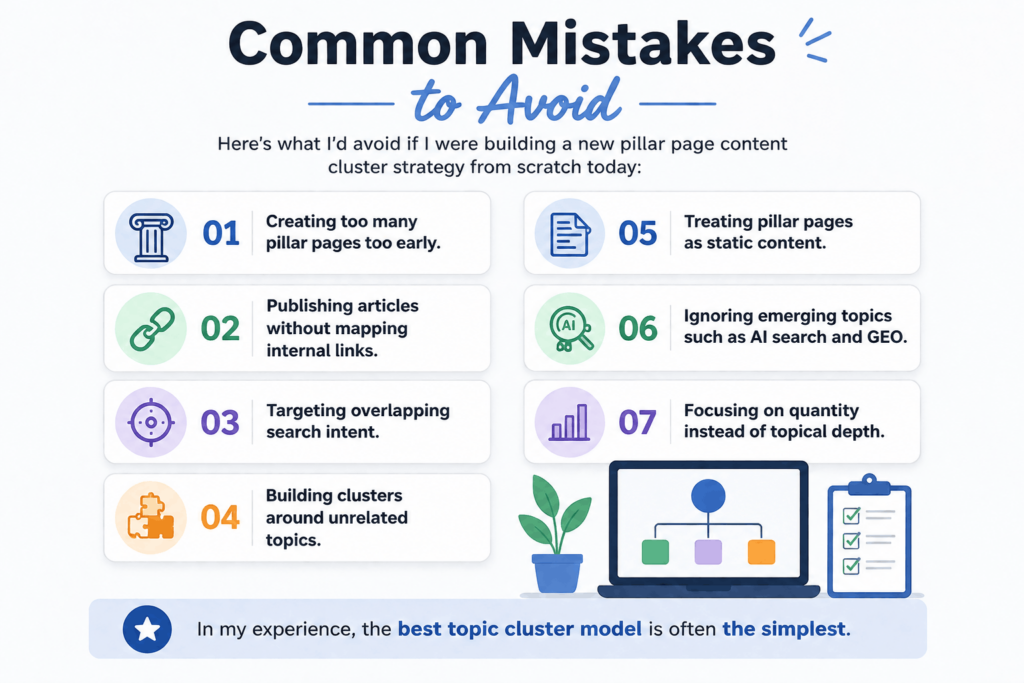
- Creating too many pillar pages too early.
- Publishing articles without mapping internal links.
- Targeting overlapping search intent.
- Building clusters around unrelated topics.
- Treating pillar pages as static content.
- Ignoring emerging topics such as AI search and GEO.
- Focusing on quantity instead of topical depth.
In my experience, the best topic cluster model is often the simplest.
Conclusion
Thinking back, I can’t believe how much implementing a pillar page content cluster strategy changed the way I do SEO content planning.
Rather than publishing individual articles and hoping they rank, I now work on building interconnected content ecosystems to help readers find an entire topic.
This has allowed me to link traditional SEO topics such as keyword research, technical SEO and on-page optimization to new areas like AI search, GEO and LLM optimization on innovativeseo.in.
More importantly, it has given every article in a larger strategy a clear purpose.
In fact, the article itself exemplifies the strategy it describes in many ways.
If you’ve read the related articles linked to throughout this post, you’ve already experienced the exact pillar page content cluster strategy that I use on innovativeseo.in. This article is not just describing the framework; it’s part of the same content cluster through purposeful internal linking, topical coverage and structured content relationships.
That’s how I’ve ultimately continued to build topical authority SEO on this blog.
Frequently Asked Questions
What is a pillar page content cluster strategy?
A pillar page content cluster strategy is a way of organizing content. It is made up of one main pillar topic, supported by a number of related cluster articles that link to each other internally. Search engines and users can easily understand what has been covered and what has not with this structure.
How many cluster articles should a pillar page have?
No number in particular. In my experience it’s enough to start with five to ten good supporting articles and the cluster can go on growing over time as new search opportunities appear.
Does a pillar page content cluster strategy help with AI search visibility?
There’s no strategy that can guarantee rankings. But by building comprehensive topical coverage with a pillar page content cluster strategy, you can help search engines and AI-powered search systems better understand your expertise. This can improve visibility across traditional and AI search experiences.