Keyword research is the foundation of every successful SEO strategy, but it is also one of the most misunderstood aspects of search engine optimization. One of the biggest mistakes that beginners make is focusing only on search volume while completely ignoring search intent. If you’re wondering how to do keyword research 2026, the reason why people search is so much more important than just finding keywords with high search numbers.

I’ll walk you through the exact process I teach beginners to do keyword research, step-by-step, so you can find relevant, low-competition opportunities that can actually drive traffic and rankings.
The Keyword Research Mistake Most Beginners Make
The first thing most people do when they start learning SEO look for the highest-volume keyword in their industry.
For example, if you run a fitness website you might want to rank immediately for:
- Weight loss
- Fitness
- Workout plans
If you run an SEO website, you may target:
- SEO
- Digital marketing
- Keyword research
The problem?
These keywords are often very competitive and more importantly don’t necessarily show what the user really wants.
Let’s compare two keywords:
| Keyword | Monthly Searches | User Intent |
| SEO | High | Very broad |
| how to do keyword research 2026 for SEO | Lower | Specific learning intent |
A beginner in SEO might select a keyword based on its search volume, while an experienced professional prioritizes keywords with clearer user intent and a greater potential for ranking.
This evolution in approach distinguishes contemporary SEO practices from outdated methods.
As of 2026, effective keyword research emphasizes understanding user behavior before focusing on metrics.
What Keyword Research Means in 2026?
Keyword research has changed dramatically over the past few years.

10 years ago, SEO professionals were focused on:
- Exact-match keywords
- Keyword density
- Search volume
- Ranking one keyword per page
Today, search engines understand:
- Context
- User behavior
- Relationships between topics
- Search intent
- Content quality
So modern keyword research is not about finding one keyword and repeating it on a page.
It’s about getting the whole topic behind a search.
Intent Is More Important Than Volume
Let us look at a simple example.
Say you find these two keywords.
| Keyword | Monthly Searches |
| SEO tools | 25,000 |
| best SEO tools for small businesses | 700 |
Most beginners would choose the first keyword.
However, the second keyword is more often effective because:
- Competition is lower
- User intent is clearer
- Visitors are closer to making a decision
This is why intent is more valuable than search volume nowadays.
When I teach beginners I always say:
Don’t ask, “How many people search for this keyword?” first.
Instead ask:
“Why are people searching for this keyword?”
That one question can completely change your keyword strategy.
Long-Tail Keywords Are More Valuable Than Ever
Long-tail keywords are longer and more specific search phrases.
Examples include:
- keyword research process
- SEO keyword research steps
- search intent keyword research
- find low competition keywords
- how to do keyword research 2026 for SEO
These keywords typically:
- Have lower competition
- Attract highly targeted visitors
- Match user intent better
- Convert at higher rates
Long-tail keywords are often the fastest way to get organic traffic for new sites.
AI Search Is Changing Keyword Research
Another big reason why keyword research has changed is the rise of AI-powered search.
People don’t just search with short phrases anymore.
Instead of searching:
- keyword research
Users now search:
- how do I find low-competition keywords?
- what is the best keyword research process for beginners?
- how do SEO professionals find keywords in 2026?
AI-powered search engines and AI-generated search results are getting better at understanding natural language.
Therefore, successful keyword research focuses on these rather than isolated keywords.
- Questions
- User problems
- Topic clusters
- Search intent
This shift is one of the major SEO trends to understand in 2026.
Step 1: Define Your Topic Niche and Seed Keywords
The first step in the keyword research process is defining your niche and finding your seed keywords.
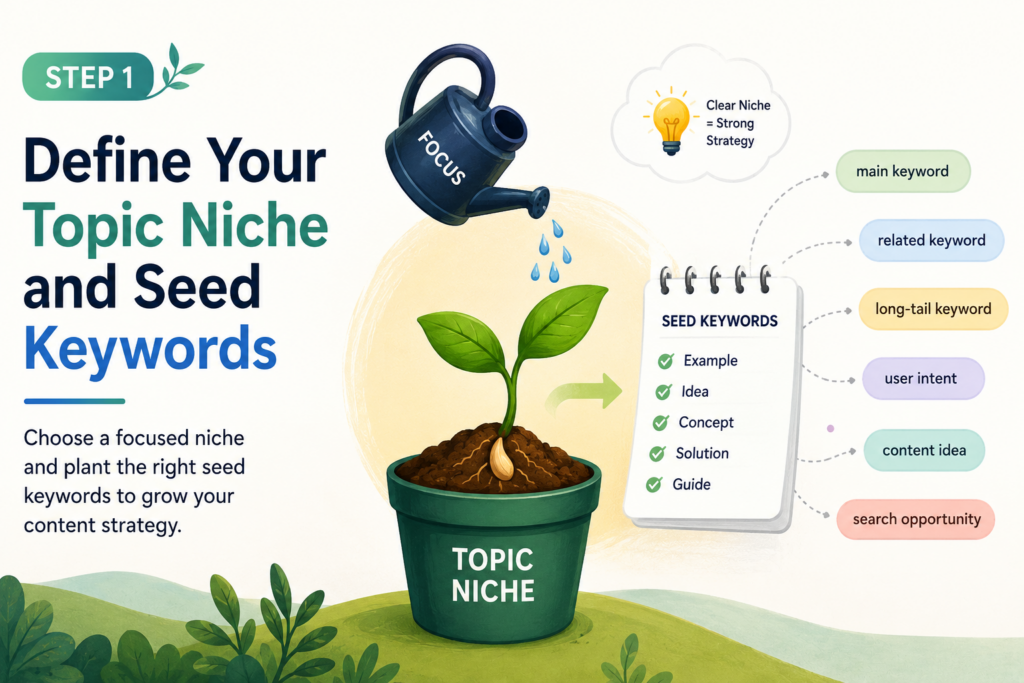
Many beginners jump into a keyword tool without doing this step first. “Wrong”.
You need to know your audience before you open any software.
Ask yourself:
- What does my audience care about?
- What products or services do I provide?
- What problems do customers need solved?
- What do customers always ask?
Your answers become your baseline.
What Are Seed Keywords?
Seed Keywords are topics that are broad in relation to your niche.
Examples for an SEO website include:
- SEO
- Keyword research
- Technical SEO
- On-page SEO
- Link building
For a fitness website:
- Weight loss
- Strength training
- Home workouts
- Healthy eating
For an eCommerce store:
- Running shoes
- Hiking gear
- Sports apparel
The seed keywords are the beginning of your research process.
My Personal Example
When I researched keywords for this article, I didn’t start with Ahrefs or Semrush.
I started with a blank document.
Then I wrote a list of topics I wanted to teach:
- keyword research
- keyword research process
- search intent
- low competition keywords
- SEO keyword research steps
These are the topics I identified and then I started expanding them.
This easy exercise keeps your keyword research focused on actual audience needs not random data.
Create a Seed Keyword List
I recommend creating a simple spreadsheet.
Column 1:
- Topic
Column 2:
- Seed Keyword
Column 3:
- Notes
Example:
| Topic | Seed Keyword |
| Keyword Research | keyword research |
| SEO Training | SEO basics |
| Content Strategy | content planning |
| Search Intent | user intent |
You don’t need hundreds of seed keywords.
Even 10-20 strong starting topics will do.
Once your list is built, you’re ready to start building it into actual keyword opportunities.
Step 2: Use a Tool to Expand Your Keyword List
Now that you have seed keywords it’s time to find the related opportunities.
This is where keyword research tools come in.
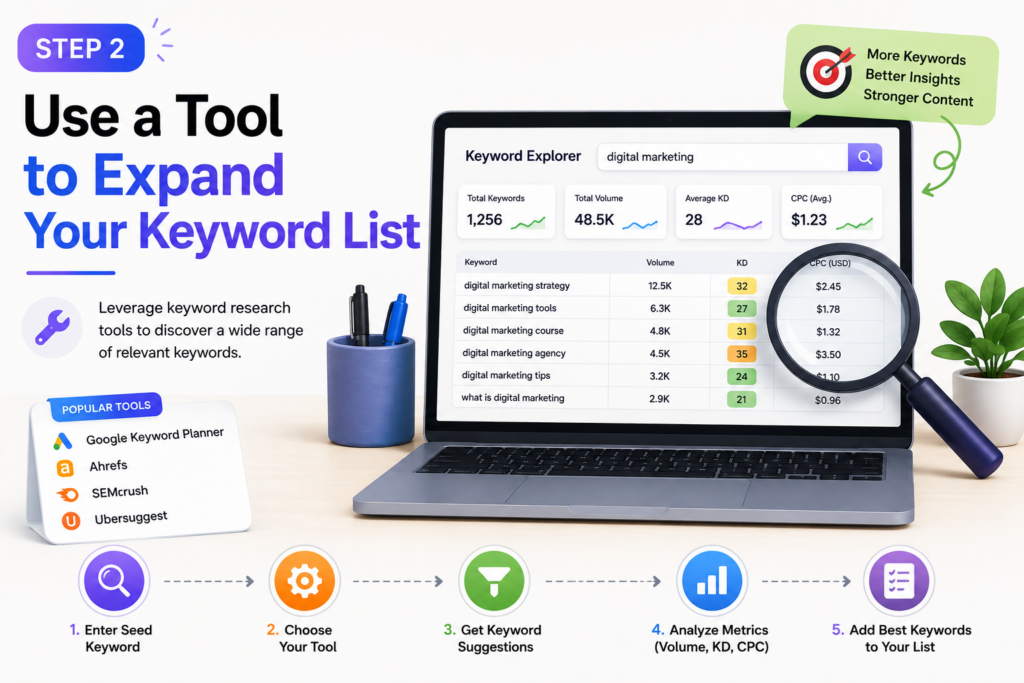
Notice tools follow understanding your audience.
That’s on purpose.
The best SEO professionals value thinking ahead of tools.
Keyword tools are designed to help you:
- Discover new keyword ideas
- Find long-tail keywords
- Identify keyword variations
- Analyze competition
- Understand demand
If you are unsure which platform to use, then I recommend reading our detailed comparison of keyword research tools for SEO in 2026 (Ahrefs vs Semrush vs Ubersuggest)
Option 1: Ahrefs
Ahrefs is one of the most popular SEO tools out there.
I often recommend it to intermediate and advanced marketers due to its huge keyword database.
With Ahrefs, you can:
- Generate keyword ideas
- Analyze keyword difficulty
- Estimate traffic potential
- Research competitors
- Discover content gaps
For example:
If you enter:
keyword research
Ahrefs may suggest:
- keyword research process
- keyword research for beginners
- keyword research checklist
- how to find low competition keywords
Soon this widens your list of opportunities.
Option 2: Semrush
Semrush is quite powerful keyword research platform.
Its strengths include:
- Keyword discovery
- Competitor analysis
- Topic research
- Intent categorization
One thing I really like is the ability to help identify the purpose of keywords.
This is useful when you come to organize keywords later in the process.
Option 3: Free Keyword Research Tools
If you are a beginner don’t worry if you don’t have a paid subscription.
Many successful websites started with free tools
Some excellent free options are:
- Google Keyword Planner
- Google Autocomplete
- People Also Ask
- Related Searches
- Google Search Console
These tools can show dozens of valuable keyword opportunities for beginners.
Expand Before You Filter
One common mistake is filtering keywords too soon.
This stage you aren’t trying to figure out what keywords to go after.
Your mission is to just collect ideas.
Think big.
Document all relevant and then there is the filtering process.
Step 3: Filter by Difficulty and Intent
Once you’ve expanded your keyword list, you’ll likely have dozens or hundreds of keyword ideas.
Now we need to decide which opportunities are worth pursuing.
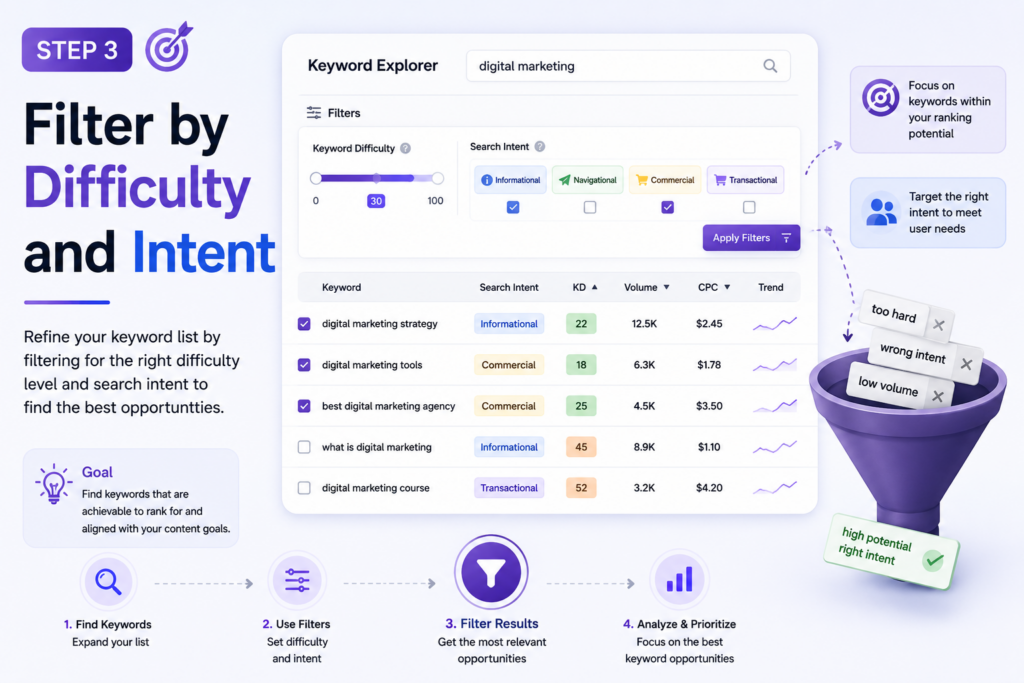
This is where two factors become very important:
- Keyword Difficulty
- Search Intent
Understanding Keyword Difficulty
Keyword Difficulty is an estimate of how hard it is to rank for a keyword.
Most SEO tools will give you a difficulty score.
The numbers may vary, but the point remains the same:
- Low difficulty = easier competition
- Medium difficulty = moderate competition
- High difficulty = strong competition
If your website is new, start with low difficulty opportunities.
An attempt to rank for highly competitive keywords often results in disappointment.
Understanding Search Intent
Search intent is the reason why someone conducts a search.
Every keyword has a reason.
Before you produce content, ask: What does the user want to accomplish?
Understanding intent helps you create content that meets users’ expectations.
In the next step, we’ll learn how to categorize keywords based on intent and use that information to build a smarter SEO strategy.
Practical Example: Filtering Keywords by Difficulty and Intent
Here’s a simple example.
Imagine you came up with the following keyword ideas:
| Keyword | Difficulty | Intent | Action |
| SEO | High | Broad | Skip for now |
| keyword research process | Medium | Informational | Target |
| best keyword research tools | Medium | Commercial | Target |
| Ahrefs login | Low | Navigational | Skip |
| how to find low-competition keywords | Low | Informational | Target |
| buy SEO software | High | Transactional | Consider later |
When I teach beginners I recommend that they look for keywords meeting three requirements:
- Relevant to your audience
- Match the content you can create
- Have realistic competition levels
A keyword may have low difficulty but if it doesn’t match your audience it’s not worth going after.
Similarly, a keyword might be very relevant, but if your website is brand new and the competition is ultra fierce, it might be better off saved for later.
This is about finding the sweet spot where relevance, intent and competition meet.
Step 4: Group Keywords by Intent Type
You’ve filtered your keyword list, now what? Group keywords by intent.
This is one of the most valuable steps in the SEO keyword research process, because it helps you create the right content for the right audience.
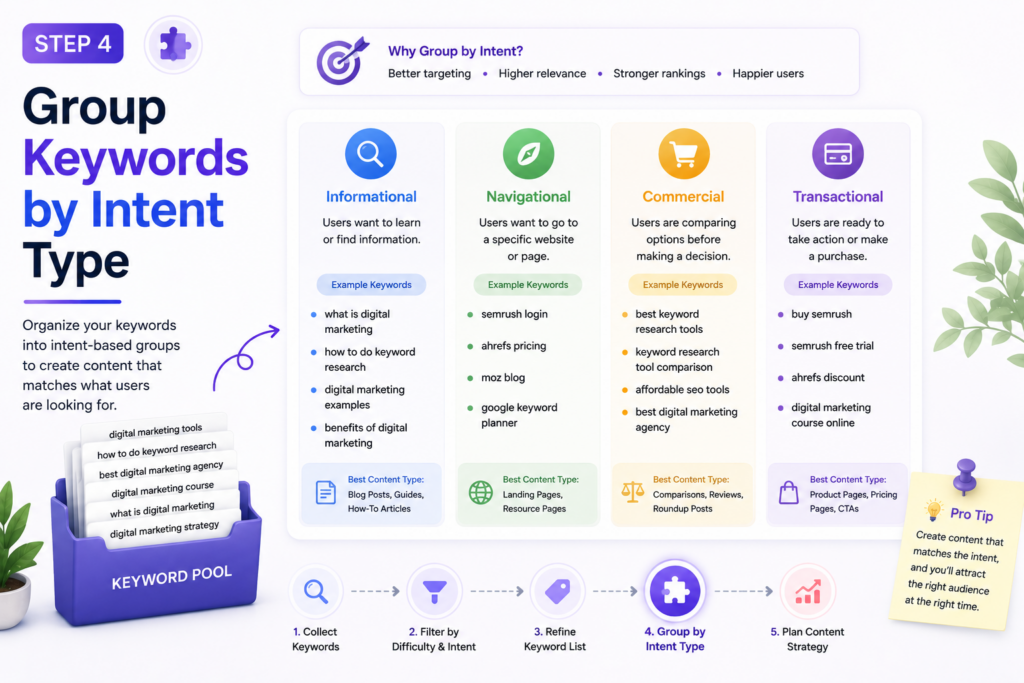
Many beginners create a separate page for each keyword they find.
This often results in duplicate content and keyword cannibalization.
Then, cluster similar keywords based on user intent.
Informational Intent
Informational intent users seek answers, explanations or guidance.
Examples:
- What is keyword research?
- How to do keyword research 2026?
- SEO keyword research steps
- Search intent keyword research
Best content formats:
- Blog posts
- Tutorials
- Guides
- Educational resources
This article is an example of informational content.
Commercial Intent
Users with commercial intent are researching options before making a decision.
Examples:
- best keyword research tools
- Ahrefs vs Semrush
- Ubersuggest review
- keyword research software comparison
Best content formats:
- Comparison articles
- Reviews
- Product roundups
- Buying guides
Commercial keywords often have strong conversion potential because users are evaluating solutions.
Transactional Intent
Users with transactional intent are ready to take action.
Examples:
- buy SEO software
- SEO services pricing
- keyword research agency
Best content formats:
- Service pages
- Product pages
- Landing pages
These keywords usually generate leads and sales.
Why Intent Grouping Matters
Suppose you get these keywords:
- how to do keyword research
- keyword research process
- SEO keyword research steps
A beginner can write three separate articles.
An experienced SEO would typically consolidate them into one comprehensive guide as the pages have the same informational intent.
Proper grouping of keywords helps:
- Improve topical authority
- Reduce keyword cannibalization
- Create stronger content
- Improve user experience
This simple practice can dramatically improve your SEO performance.
Step 5: Prioritize Based on Your Site’s Current Authority
One of the biggest reasons keyword strategies fail is because website owners target keywords that don’t match their current authority level.
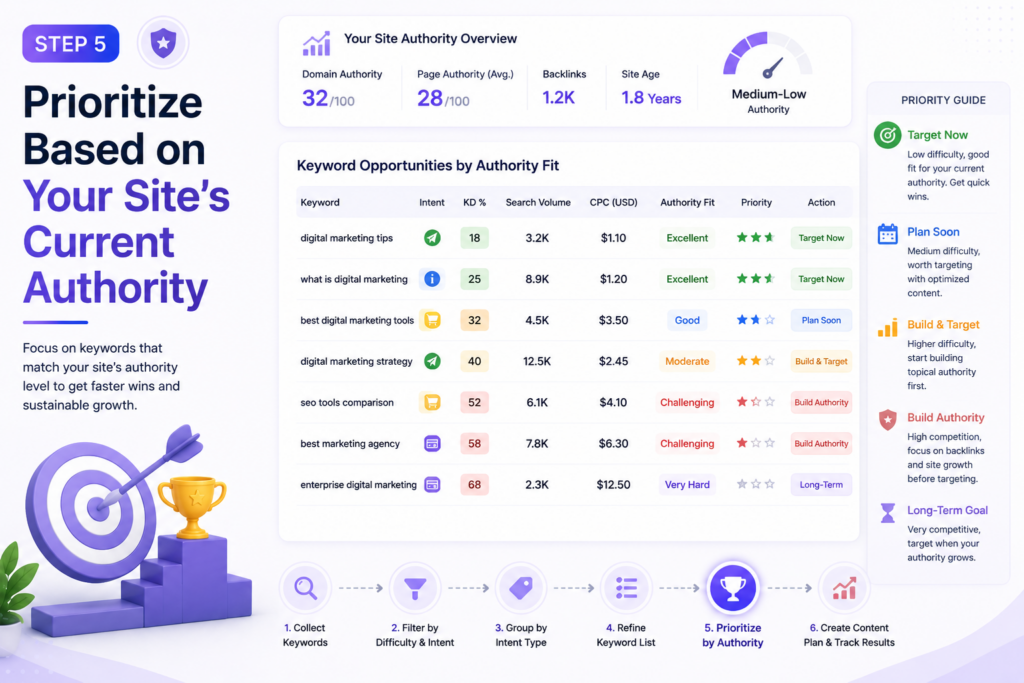
A new website should not copy the strategy of a major established brand.
Always consider your website position when selecting keywords.
For New Websites
If your website is relatively new, focus on:
- Long-tail keywords
- Question-based searches
- Low-difficulty opportunities
- Niche-specific topics
Examples:
- how to do keyword research 2026 for SEO
- keyword research checklist for beginners
- how to find low competition keywords
These keywords are usually easier to rank for and build topical authority.
For Growing Websites
If your website already has some traffic and content, you can start targeting:
- Medium-difficulty keywords
- Topic clusters
- Competitive informational content
Examples:
- Keyword research process
- SEO keyword research guide
- Search intent keyword research
At this point, you want to broaden topical coverage.
For Established Websites
Established websites can compete for:
- High-volume keywords
- Competitive commercial searches
- Broad industry topics
Examples:
- SEO
- keyword research
- SEO tools
These keywords need more authority, backlinks and content depth.
Focus on Realistic Opportunities
When I teach beginners I always emphasize one principle: “It’s better to be #1 for ten realistic keywords than #50 for one highly competitive keyword.”
Building authority takes time.
Select opportunities that align with your current level.
As your website grows, so too can your keyword targets.
With modern on-page SEO in 2026, this principle still holds, where topical relevance and user satisfaction often trump targeting large keywords.
Common Keyword Research Mistakes to Avoid
The keyword research process is understood, yet beginners commit avoidable mistakes.
Let’s see the most common ones.
1. Chasing Search Volume Only
High search volume doesn’t automatically mean a keyword is valuable.
Always check intent before you act.
2. Ignoring Long-Tail Keywords
Many sites ignore long-tail opportunities because the search volumes seem smaller.
In reality, long-tail keywords often provide better ranking opportunities and attract highly targeted visitors.
3. Skipping Intent Analysis
Two keywords may look similar but serve different purposes.
Before creating content, always ask “What does the user want?”
4. Targeting Keywords Beyond Your Authority
Trying to rank for very competitive keywords too early can slow your progress.
Start with achievable wins.
5. Ignoring Technical SEO
Great keyword research can’t fix serious technical issues.
Your rankings will suffer if search engines have difficulty crawling, indexing or understanding your content, no matter how strong your keyword strategy is.
Make sure you don’t make these common technical SEO mistakes that often hold back search visibility before investing heavily in content creation.
Quick-Start Keyword Research Checklist
Use this checklist when researching keywords for a new article or website.
10-Minute Keyword Research Checklist
Define your niche
- Identify 10–20 seed keywords
- Expand keywords using Ahrefs, Semrush, or free tools
- Look for long-tail keyword opportunities
- Analyze keyword difficulty
- Review search intent
- Remove irrelevant keywords
- Group keywords by intent
- Prioritize opportunities based on website authority
- Create content that satisfies user intent
- Review on-page SEO fundamentals
- Check technical SEO health
- Track rankings and refine your strategy
Save this checklist and use it every time you begin a content project.
Final Thoughts:
In 2026, the way to do keyword research isn’t about the keyword with the highest search volume.
Good keyword research begins with understanding your audience, understanding their intent and creating content that really helps them.
If you are a beginner, focus on:
- Understanding intent
- Targeting long-tail keywords
- Choosing realistic opportunities
- Building authority gradually
Tools are useful, but they are no substitute for strategic thinking.
The most successful SEO professionals start with people, then validate their opportunities based on keyword data.
Follow this step-by-step process and you will build a much stronger SEO foundation than most beginners out there.
Frequently Asked Questions
1. What is keyword research in SEO?
Keyword research is the process of identifying the words and phrases people use in search engines so you can create content that matches their needs and search intent.
2. How do I find low-competition keywords?
Look for long-tail keywords, niche-specific topics, and question-based searches. Most SEO tools provide keyword difficulty scores that can help identify easier opportunities.
3. Which keyword research tool is best for beginners?
Google Keyword Planner, Google Autocomplete, and Ubersuggest are excellent starting points. As your SEO skills grow, tools like Ahrefs and Semrush provide more advanced keyword insights.
4. How many keywords should I target on one page?
Focus on one primary keyword and several closely related secondary keywords that share the same intent. Avoid targeting unrelated keywords on the same page.